



The BJP has deployed six organisation secretaries and planned a booth-level enrolment drive to restore missing voter names ahead of the 2027 Uttar Pradesh Assembly elections.
Yogi Adityanath has claimed that 1.27 crore Hindu voters were missing after the SIR, while the final electoral roll recorded a net reduction of around 2.05 crore voters.
The upcoming SSR will allow eligible voters to seek inclusion or correction through Forms 6, 7 and 8, with the final electoral rolls scheduled for January 4, 2027.
With the 2027 Uttar Pradesh Assembly elections approaching, the revision of electoral rolls has emerged as a major organisational priority for the Bharatiya Janata Party (BJP). The party has deployed six organisation secretaries to coordinate booth-level campaigning and developing strategy. Campaigns have also been initiated aimed at identifying voters whose names may be missing from electoral rolls and facilitating their inclusion.
The campaign has gained political significance following Chief Minister Yogi Adityanath’s claim that 1.27 crore Hindu voters were missing from the electoral rolls. The assertion has brought the Election Commission of India's (ECI) Special Intensive Revision (SIR) exercise into the centre of Uttar Pradesh's electoral politics.

What The SIR Found And Why The Numbers Matter
The SIR in Uttar Pradesh began on October 27, 2025, and concluded on April 10, 2026, covering all 75 districts and 403 Assembly constituencies. The exercise involved house-to-house enumeration to verify existing entries, identify ineligible voters and update the electoral rolls.
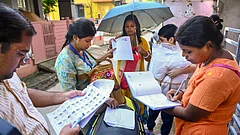



The draft roll published on January 6 had contained approximately 12.55 crore names, with 2.89 crore voters initially missing. Subsequent claims, objections and verification resulted in the addition of 84.28 lakh voters, while another 8.15 lakh entries were deleted before publication of the final list.
The initial 2.89 crore figure included approximately 46.23 lakh deceased voters, 2.17 crore voters classified as shifted or absent and 25.47 lakh duplicate entries. Other cases involved voters whose enumeration forms were not returned or who could not be traced by Booth Level Officers (BLOs).
The category of shifted or absent voters requires closer scrutiny. It can include migrant workers, students and families who have relocated, as well as people whose addresses could not be verified. Some may remain eligible to vote but need to update their registration. Similarly, an untraceable voter is not automatically an ineligible voter. The classification indicates that the BLO could not establish the individual's presence or obtain the required enumeration form. Such cases require further verification.
Yogi's 1.27 Crore Claim And The BJP's Electoral Calculations
The controversy intensified when Adityanath claimed that 1.27 crore Hindu voters were missing from the electoral rolls following the SIR. Speaking at an Aaj Tak Panchayat programme, he also alleged that the proportion of Muslim voters had increased by 1.65 per cent after the revision.
The chief minister cited discrepancies between Assembly electoral rolls and other government databases. These included approximately 66 lakh voters allegedly present in panchayat electoral rolls but absent from the Election Commission's lists, 55 lakh Hindu beneficiaries of government welfare schemes whose names were allegedly missing and 4.5 lakh voters in the 18–19 age group.
The Samajwadi Party (SP) has questioned the transparency of the revision and sought accountability from the Election Commission. The Opposition has argued that electoral-roll corrections must not become a means of selectively influencing voter representation.
For the BJP, the controversy has translated into a major organisational campaign.
According to media reports, at a meeting in Lucknow on November 13, attended by Adityanath, Maurya and state BJP president Pankaj Chaudhary, party leaders decided to prioritise voter-list corrections and enrolment. The campaign is expected to begin on November 20, following publication of the next draft electoral rolls.
District units have reportedly been asked to facilitate the inclusion of 10,000–25,000 eligible voters in every Assembly constituency, with a target of at least 50 voters per polling booth. The party is aiming to restore between 40 lakh and 80 lakh names.
The BJP has also deployed six organisation secretaries from other states to oversee its campaign across Uttar Pradesh's organisational regions. Karamveer from Chhattisgarh, Chandrashekhar from Madhya Pradesh, Ajay Kumar from Rajasthan, N Madhukar from Andhra Pradesh and Telangana, Pawan Sai from Jharkhand and Satish Dhond from Maharashtra have been assigned responsibilities.

How Voters Can Get Their Names Included Through SSR
The next stage is the Special Summary Revision (SSR), which allows eligible voters to register, correct their details or seek restoration of their names. Unlike the intensive verification undertaken during the SIR, the SSR provides an opportunity to update electoral rolls through claims and objections.
The draft electoral rolls are scheduled for publication on November 17, 2026. The claims and objections period is expected to continue until December 16, with the final rolls scheduled for publication on January 4, 2027.
Eligible voters whose names are missing can apply for inclusion using Form 6. First-time voters who have attained 18 years of age can also use this form to register. Existing voters who have shifted residence or need to correct their personal details can submit Form 8. Form 7 can be used to raise objections to existing entries or request the deletion of registrations belonging to deceased or otherwise ineligible voters.
Applications can be submitted through the Election Commission's Voters' Services Portal, the Voter Helpline application or offline through Booth Level Officers and Electoral Registration Officers. Voters can check their registration status through the Electoral Search portal.
Possessing a voter ID card does not automatically guarantee that a person's name appears on the current electoral roll. Citizens must verify their registration in the relevant constituency and approach the electoral authorities if their names have been wrongly excluded.
For the BJP, the SSR offers an opportunity to translate its concerns over missing voters into a targeted enrolment drive ahead of the 2027 elections. However, the larger question remains whether Adityanath's 1.27 crore estimate represents genuine electoral exclusion or discrepancies arising from migration, duplicate registrations and differences between government databases.
Ultimately, the credibility of the revision will depend on transparent verification and ensuring that every eligible citizen, irrespective of religion or political preference, retains the right to vote.








