A profound question is how we should view women. Should it be only from the perspective of respect? I believe that, alongside respect, viewing women as a force of creation also benefits the state's development. After all, the real assessment of any society's progress is based on how actively half its population participates in the development process. When women move beyond the threshold of their homes and establish their identity through their labour and capabilities in farms and fields, factories, offices, markets, startups, self-help groups and the world of entrepreneurship, the change does not come only in the lives of those women but also changes the direction of the entire economy. The increase in women's labour force participation over the past nine and a half years under the Yogi Government in Uttar Pradesh is a major testament to this.
The figures related to Nari Shakti in Uttar Pradesh are not merely an increase in employment figures. Behind them is the expansion of social consciousness, in which women are becoming partners in their families' economic responsibilities, emerging as an active force in development, and stepping forward to make decisions for themselves and their families. Chief Minister Yogi Adityanath has set a vision for the state of development with Nari Shakti as its foundation. From self-help groups to banking and digital services, from farms to small industries, and from traditional occupations to modern entrepreneurship, their presence has become widespread. This transformation shows that when opportunities, security, skills and institutional support come together, women’s talent gives momentum not only to families but also to the state’s economy.


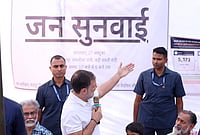
In Indian thought, women are certainly revered, but this becomes meaningful only when it finds expression in policy, is reflected in the budget, becomes visible in deployment at police stations, and is seen in the confidence of a daughter walking through a village lane. In a vast state like Uttar Pradesh, where traditions are deeply entrenched, this question is profoundly political as well as economic. The Working Women’s Felicitation Ceremony held recently in the Pindra assembly constituency of Varanasi was a glimpse of this very thought. More than 10 thousand women, Anganwadi workers, cooks, Safai Mitras and ASHA workers were all present on one platform. These women's labour had long nurtured the foundations of society, yet they remained deprived of recognition until a decade ago. Today, this recognition is being voiced in Uttar Pradesh and is reflected in the figures.
The biggest and most fundamental figure is the increase in women’s labour force participation in the state from 12 percent to more than 36 percent. This threefold leap cannot be the result of any single scheme. It is the outcome of a long process in which education, security and opportunities have advanced together. When a state believes that a daughter’s dream should not remain incomplete merely because she was born into a poor family, it becomes the state’s responsibility to support her at every step, from education to capital. Under the Mukhyamantri Kanya Sumangala Yojana, assistance of Rs 25 thousand from the birth of a daughter until graduation, reserving half of the seats in Atal Residential Schools for daughters, extending Kasturba Gandhi Schools up to Class 12, and soon connecting 50 thousand meritorious daughters with the Rani Lakshmibai Scooty Yojana are not separate pieces but links in the same chain of thought. The foundation of this thinking is: do not leave a daughter alone at any point; make her part of the mainstream.
Security sits at the centre of this debate because until a woman feels safe, opportunities for education and employment remain incomplete. The increase in women police personnel in the state from 10 thousand to 44 thousand, with the possibility of further growth in the coming period, sends a message of empowerment. Mission Shakti Centers, women beat police officers, the Integrated Women Beat System, and three women PAC battalions are being established in the names of the warrior women Veerangana Avanti Bai Lodhi, Uda Devi Pasi, and Jhalkari Bai. Building the security structure of the present in the names of the warrior women of history is meaningful in itself, both symbolically and practically.
After security and education, the third and perhaps the most decisive link is economic self-reliance. Initiatives such as Lakhpati Didi, Drone Didi, and BC Sakhi have taken women beyond traditional boundaries and connected them with areas such as technology, banking, and entrepreneurship, where men were hitherto considered dominant. Under Project Ganga, 4,000 women entrepreneurs will be included in the plan to prepare digital entrepreneurs in 8,000 Nyaya Panchayats. This decision places women in the village economy beyond the role of consumers and into the role of producers and service providers. The association of more than 04 lakh women with milk producer organisations such as Balini, Samarthya, Kashi, Baba Gorakhnath and Srijani, their participation in more than 96 lakh MSME units, and the fact that nearly half of more than 24 thousand startups are being operated by women – these figures show that women are no longer merely becoming employment seekers but are increasingly becoming employment providers as well. This change permanently transforms a society's thinking because an economically empowered daughter or daughter-in-law also becomes an equal partner in household decisions.
An emotional link in this entire picture is also the completion of marriages of more than 05 lakh daughters under the Mukhyamantri Samuhik Vivah Yojana. Women getting ownership rights over their own homes through more than 01 crore Gharounis, more than one crore twenty-five lakh elderly, destitute women and persons with disabilities receiving the support of pensions, and making bus travel free for mothers above 60 years of age – all these together present the picture of a society that knows how to give women the respect that is their due. From the sports field to space technology, from a sub-inspector who won gold at the Commonwealth Games to a village Didi flying a drone, this expansion shows that it is no longer possible to confine women’s capabilities within traditional moulds.
Even so, we cannot say the journey is complete. That would be self-congratulatory, but one thing is certainly clear: the direction is now clear. The daughter of the state who once could not even reach the threshold of a school for fear for her safety is today making her place in the police force, in startups, and on the sports field. This is the story of a trust that was woven gradually, policy by policy.
About the Author: Deepmala is the Director of The GI Store at the Chaitanya Prabha Foundation. Her work focuses on promoting authentic Geographical Indication (GI) tagged products, empowering traditional artisans, and driving sustainable community development.
Disclaimer: The views and opinions expressed in this article are those of the author(s) and do not necessarily reflect the official policy or position of the publisher. While every effort has been made to ensure the accuracy of the information, the publisher is not responsible for any errors or omissions, or for the results obtained from the use of this information.