



From the perspective of the Yogi government’s vision for religious tourism, the Kanwar Yatra also presents a roadmap for Uttar Pradesh’s economic goals. Millions of shoulders draped in saffron, bamboo kanwars carried on those shoulders, and a sea of people moving forward amid chants of 'Bol Bam', these are indicators of the state’s economic progress. Varanasi, Prayagraj, Mathura, and the numerous smaller religious destinations that are today strengthening Uttar Pradesh’s economy through religious tourism – the Kanwar Yatra is another link in this chain. Chief Minister Yogi Adityanath has made resources available to give this pilgrimage a global scale, driven by his vision of taking Uttar Pradesh towards the goal of becoming a one-trillion-dollar economy. The economic activity being generated around the Kanwar Yatra is also a part of this larger vision.
Now, let us look at the figures presented by experts. According to a 2024 research report by the Giri Institute of Development Studies in Lucknow, the Kanwar Yatra generates business worth approximately Rs 1,000 crore, or more than Rs 10 billion, in Uttar Pradesh. This was not always the case. Since 2017, alongside the rapid increase in the number of Kanwariyas in the state, markets for hotels, roadside eateries, transportation, tents, religious items and local businesses have also grown steadily. This year, estimates from the business community are even higher. According to market sources, the Kanwar Yatra during this month of Shravan is expected to generate economic activity worth around Rs 1,500 crore. A trader who runs a shop on Railway Road in Yamunanagar says that continuous rainfall suddenly drives up demand for raincoats and slippers during this season. At the same time, the heat and humidity increase sales of bottled water, ice and glucose. Medicine sellers, fruit traders and small shopkeepers report similar experiences. The flow of faith is reaching the cash registers of traders across every section of society.

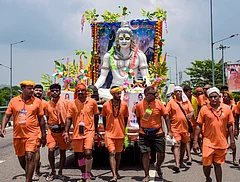

The Kanwar Yatra also brings a distinct vibrancy to the markets for religious articles and clothing. According to shopkeepers, saffron T-shirts carrying messages dedicated to Mahadev, gamchas and waterproof mobile covers are witnessing stronger demand this year than ever before. Mahadev slogan T-shirts priced between Rs 80 and Rs 500 are particularly popular among young Kanwariyas. There has also been a steady increase in demand for decorative steel urns used during the ritual of offering water to Lord Shiva. The roadside eatery and food industry are among the biggest beneficiaries of the pilgrimage. A worker who normally depends on small daily-wage jobs can earn up to Rs 600 a day by working at roadside eateries during the Kanwar Yatra. At the same time, he also gets easy access to two wholesome meals a day. The transport sector becomes equally active. As many as 60 roadways buses operate regularly on the Haridwar route from the Muzaffarnagar depot alone, and plans are being worked out to increase this number during the pilgrimage season so that millions of devotees do not face inconvenience. This entire system demonstrates how a religious event can create a chain of employment at every level from the transport corporation to workers at the very bottom of the economic pyramid.
A balanced system is necessary to ensure the safety of devotees while maintaining continuity in business activity. The Yogi government’s carefully designed micro-plan provides direction to this vast temporary economy. It is a framework that moves forward by taking both faith and economics together. Chief Minister Yogi Adityanath has issued clear instructions to officials to keep meat and liquor shops closed along the Kanwar routes, ensure that food licences and registration certificates are clearly displayed at eateries, and keep DJ sound levels within prescribed limits. These measures are intended to ensure smooth management of the pilgrimage. Alongside restrictions, the government is also focusing on expanding facilities. The Kanwar Yatra has now been transformed into a well-organised, safe and economically productive event through a carefully planned model. This model is an extension of the Uttar Pradesh government’s broader vision for religious tourism, under which religious centres such as Ayodhya, Naimisharanya, Chitrakoot and Vindhyachal have been connected with regular weekend travel packages through initiatives such as the Sugam Darshan scheme under the 'Visit My State' campaign.
Along with the Kanwar Yatra, Uttar Pradesh is also closely connected with the larger goal of transforming the state into a one-trillion-dollar economy. Events such as the Kanwar Yatra can set an economic cycle worth thousands of crores in motion without any major capital investment, relying instead on public faith and a well-organised administrative system. Small shopkeepers, street vendors, roadside eatery owners, transport operators and workers in the unorganised sector all benefit from this activity. This model of religious tourism is not merely a means of benefiting large investors; it can also become a vehicle for taking prosperity to the last mile of society. The Kanwar Yatra has emerged as an example of this. When a well-organised government micro-plan provides faith with the support of safety and convenience, this economic flow becomes even more powerful and reaches every section of society. This is the greatest strength of this unique convergence of faith and economics.
About the Author: Ajay Gupta is the President of Sanyukt Vyapar Sangh, Meerut, and a representative of the local business community. He writes on issues related to trade, commerce, religious tourism, and the economic impact of major public and cultural events.
Disclaimer: The views and opinions expressed in this article are those of the author(s) and do not necessarily reflect the official policy or position of the publisher. While every effort has been made to ensure the accuracy of the information, the publisher is not responsible for any errors or omissions, or for the results obtained from the use of this information.













