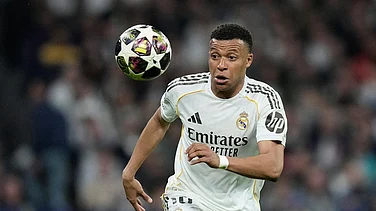
Portugal will stage tributes for Cristiano Ronaldo during Saturday’s UEFA Nations League match against Denmark
The full squad is expected to wear Ronaldo’s No. 7 shirts before kick-off at the Estadio Municipal de Braga
The match is set to pause in the seventh minute so supporters can applaud Ronaldo, with UEFA reportedly granting permission
Portugal are lining up a series of tributes for Cristiano Ronaldo in Saturday's UEFA Nations League match against Denmark, bringing immediate focus to the end of an international career that ran for more than two decades. The Portuguese Football Federation has approved a collective gesture involving the full squad.
Supporters at the Estadio Municipal de Braga are also set to take part in the farewell during the match. The plans come days after Ronaldo's retirement from international football, announced on November 5, and underline his place in Portugal's modern football history.
Portugal are moving into a post-Ronaldo phase while trying to honour a player who shaped the national team across 23 years, from his debut in 2003 to his final appearance in September 2026.
Matchday Tribute Plans
The No. 7 will be everywhere. Every Portugal player is expected to wear Ronaldo's shirt number before kick-off as the team walks out at the Estadio Municipal de Braga.


The decision was finalised at a Thursday meeting involving Portuguese Football Federation president Pedro Proença, coach Jorge Jesus and the senior leadership group. Captains Bernardo Silva, Rúben Dias and Bruno Fernandes took part in those discussions.
The meeting brought together federation leaders and coaching staff after Ronaldo announced his retirement on November 5. The match is also due to stop in the seventh minute so supporters can applaud Ronaldo. UEFA has reportedly given special permission for the pause. Ronaldo's attendance remains unconfirmed.
Jesus Explains Decision
Jesus addressed the plans in his pre-match press conference. He made clear the tribute came from the federation, not from the coaching staff alone.
“Such decisions are always the responsibility of the Portuguese Football Federation, more specifically its football and sporting departments and its president,” Jesus said.
“It is brilliant because nobody can forget the 23 years Cris spent with the national team, what he achieved for Portugal, and the impact he has had on the world of football,” Jesus added.
Federation Symbolism
The federation has planned another gesture. It has decided to keep vacant the room Ronaldo used at Cidade do Futebol, Portugal's national team training complex.
The move is meant to preserve a symbolic place for the former captain during the first international break since his retirement. It reflects how central Ronaldo had been to Portugal through much of the modern era.
Portugal are now preparing for life without him. Bruno Fernandes and Bernardo Silva are among the experienced players expected to take on greater leadership roles as the squad adjusts to the change.
Record-Breaking Career
Ronaldo leaves with numbers that stand alone. He retired from international football with 146 goals in 234 appearances, making him the leading goalscorer and most-capped player in the history of men's international football.
His Portugal debut came against Kazakhstan on August 20, 2003. His international career ended on September 24, 2026. During that span, Portugal won Euro 2016 in France and added Nations League titles in 2019 and 2025.
Ronaldo scored 11 goals in 27 World Cup appearances. He also holds the men's record of 14 goals in European Championship final tournaments. He became the only player to score at six different men's World Cups—Germany 2006, South Africa 2010, Brazil 2014, Russia 2018, Qatar 2022 and the 2026 tournament.
His combined tally of 25 goals across the European Championship and the World Cup is another men's international record. He scored against 49 different national teams, with Luxembourg conceding 11 and Hungary nine.
His record also includes 10 hat-tricks, including two four-goal hauls, and 22 converted penalties. Of his 146 international goals, 124 came in competitive matches rather than friendlies.