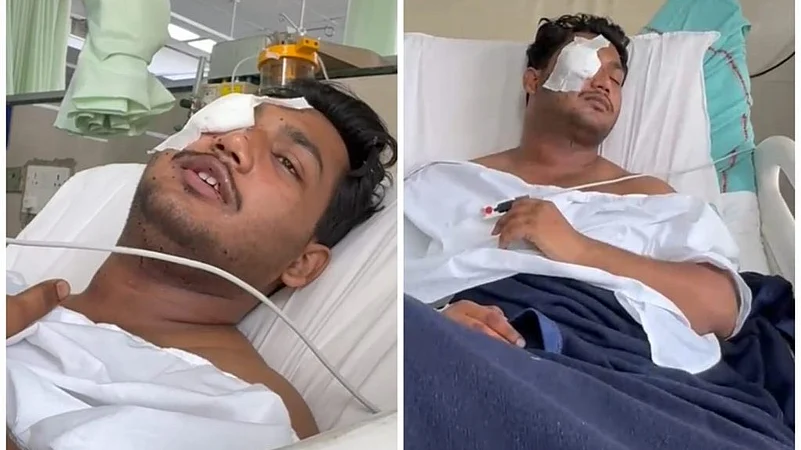
As the debate in Parliament over the use of excessive force and pellet guns against student protesters continues, experts have warned that injuries caused by pellet guns can result in irreversible damage, particularly when there is substantial soft-tissue loss, bone defects, or disruption of the continuity of nerves and blood vessels.
Injuries affecting structures with a limited capacity to regenerate such as major nerves, blood vessels, bones and joints, spinal cord, and vital organs may result in a long-term disability, chronic pain or a permanent loss of function despite optimal treatment, they said.
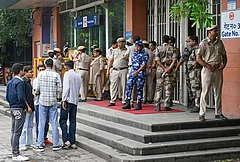
On July 20, students protesting against NEET paper leaks were at the receiving end of alleged police brutality while marching from Jantar Mantar towards Parliament in the national capital. The police resorted to firing tear gas shells and hitting protesters with batons.
As images and videos of protesters who sustained pellet injuries emerged online, it was alleged that the Rapid Action Force (RAF) had fired several metal pellets at students, causing cluster injuries and disability.
A pellet gun fires cartridges loaded with up to 600 metal or rubber pellets, which disperse in a widespread manner at speeds of 1,000 feet per second.
Shalini Solanki, faculty member at the school of studies in forensic science, Samrat Vikramaditya Vishwavidyalaya in Ujjain, Madhya Pradesh, said that unlike a conventional firearm bullet, which is a single projectile, a shotgun cartridge or a pellet cartridge releases multiple small pellets.



"Consequently, the severity of injury depends not only on the number of pellets that strike the body, but also on factors such as the firing distance, pellet size, impact velocity, angle of impact, and, most importantly, the anatomical structures involved," she told PTI.
One teenager, Sahil Lochab, may lose vision in his right eye as a result, even as other students have suffered injuries on their faces, necks, chests, arms and legs.
Lochab's family said doctors informed them that the pellets which caused the injuries were made of metal. The RAF said in a statement on July 28 that it used anti-riot gear and fired multiple rounds of non-lethal munitions, including two rounds of plastic pellets.
The SOP requires a pellet gun to be fired from a distance of at least 500 feet and below the waist.
"Pellets fired from a distance tend to cause multiple superficial wounds with limited tissue damage. However, at close range, pellets bunch together and strike as a single mass, causing massive and complex tissue destruction, soft tissue loss, and extensive bleeding," said Dr Nikhil Valsangkar, senior consultant and unit head, department of orthopaedics and robotic joint replacement, Sarvodaya Hospital in Greater Noida west.
"Superficial pellet wounds and injuries to highly elastic skeletal muscle can often heal well or suffer mostly reversible stretching injuries. However, the damage is frequently irreversible if there is substantial soft-tissue loss, bone defects, or a loss of nerve and blood vessel continuity," he added.
Stretching is a mechanism by which a pellet damages tissue where a temporary cavity is created, which expands and displaces surrounding tissue.
"Resulting permanent disabilities can include blindness, hearing loss, chronic pain, joint stiffness and psychological trauma, or PTSD (post traumatic stress disorder)", Dr Sakshi Singhal, consultant, surgical oncology, Yatharth Hospital in New Delhi, said.
PTSD is when one tends to relive the experience through flashbacks, feeling severe anxiety, always tensed or hypervigilant.
Dr Vandana Prakash, clinical psychologist and senior consultant, Max Superspeciality Hospital Vaishali, said that the impact is more severe on those "who have had a previous history of trauma or have lesser emotion regulation, or young age or are women." Flashbacks and nightmares take a long time to fade away, sometimes, never, she said.
Consequences of a pellet injury, however, depend more on where they strike on the body than how many strike. Wounds limited to the skin, subcutaneous layer or superficial muscles may heal well with medical care.
Solanki, who specialises in forensic ballistics, said the face is particularly vulnerable as several delicate features are packed into a relatively small area.
"Besides cosmetic deformity, injuries to the facial nerve may result in weakness or paralysis of facial muscles, while injuries involving the eyes can lead to partial or complete vision loss depending on the structures affected," she said.
Shots fired into one's shoulder region can be most concerning due to the concentration of critical neurovascular structures, Singhal said.
"Possible outcomes can include severe haemorrhage, loss of function in limb, or chronic neuropathic pain. Though fractures are not likely, at close range and in high velocity injuries, they are possible," she said.
Chances of visual recovery are good in cases of corneal abrasion, retinal tear if repaired early, mild bleeding into anterior chamber of the eye or mild vitreous haemorrhage, and poor in cases of globe rupture, macular destruction or optic nerve damage, Singhal added.
The liver, kidneys, and spleen are highly vulnerable because when struck, they absorb the kinetic energy of the pellets poorly and suffer extensive disruption, tearing over the whole extent of the impact cavity, Valsangkar said.
"While the lungs are somewhat protected by their low density and high elasticity, a close-range shotgun blast to the chest can still be devastating, causing multiple heavy tears to the lungs, the heart (myocardium, valves), and major blood vessels, leading to massive internal bleeding," he said.
Not every pellet, however, is required to be removed immediately, and in many cases, attempting to remove deeply embedded ones may cause more damage to the tissue than leaving them in place -- treatment should therefore be individualised, Solanki said.
Over the long-term, the wounds, especially those involving retained pellets, would require a continuous monitoring and the victim must be highly vigilant about infection prevention.
Victims must ensure they receive prophylactic antibiotics and a tetanus immunisation, and monitor for a delayed bone healing or bone infections, Valsangkar said.
Among victims with multiple retained pellets or pellets located in high-risk anatomical sites, doctors may recommend a periodic evaluation, including blood lead level testing if there is concern about prolonged exposure from retained lead fragments -- significant lead poisoning is however uncommon, Solanki said.
She added that recovery from eye injuries often continue long after initial surgery, with delayed complications such as retinal detachment or glaucoma potentially occurring years after original injury.