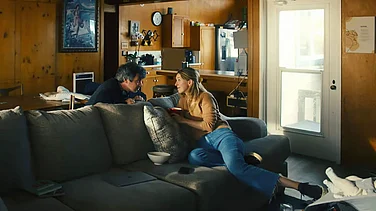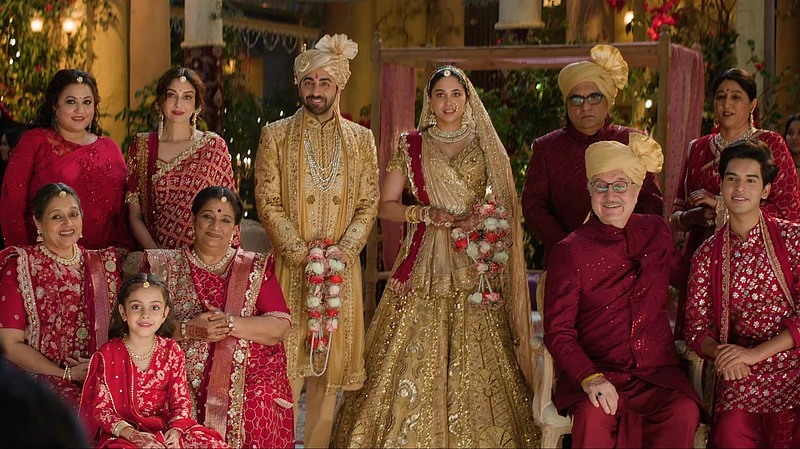
Yeh Prem Mol Liya explores marriage, family expectations and a woman’s choice of home.
Sharvari delivers a strong performance as Purva, while Ayushmann Khurrana plays Prem.
Himesh Reshammiya’s music complements Sooraj Barjatya’s return to the family drama genre.
Sooraj Barjatya returns to the family drama with Yeh Prem Mol Liya, a film built around a seemingly simple question: why should a woman have to leave her home and move into her husband's family after marriage? The premise offers an opportunity to examine the expectations placed on women, the compromises demanded by marriage and the possibility of building a household on different terms. However, the film struggles to move beyond its own idea of what a family should look like. Its attempt to present a progressive arrangement is weighed down by patriarchal attitudes, familiar stereotypes and an excess of family drama. It is a frustrating watch that mistakes the presence of everyone under one roof for genuine progress.
The film follows Prem Mishra (Ayushmann Khurrana), who moves from Bihar to Mumbai with his family in the hope of making a career in music. At a railway station, he spots Purva Solanki (Sharvari) and is immediately drawn to her. Their paths cross again at a garba celebration, where Prem expresses his interest in her. Purva, however, has no intention of getting married. She lives with her family in a bungalow in Walkeshwar and does not want to leave them behind to move into a husband’s household. Prem proposes a different arrangement: after their marriage, he and his family will move into her home. The two families eventually come together, but the film’s idea of a shared household raises more questions than it answers.




The central problem with Yeh Prem Mol Liya is the gap between what it wants to say and what it actually shows. Purva is introduced as a woman with responsibilities and a strong attachment to her family. Her decision not to marry is rooted in the expectation that marriage will require her to give up the life she has built. This is a valid conflict and one that could have given the film a compelling point of view. Yet Purva's independence is repeatedly defined through her ability to look after other people.
Even when the film appears to give Purva her agency, the narrative keeps finding ways to make Prem the person who steps in and takes charge. He becomes a saviour to a family that does not necessarily need rescuing, while Purva's own concerns take a back seat. The film calls attention to a woman’s right to choose where she lives, but rarely considers her right to live on her own terms without being responsible for everyone else.


The gender divide within the households is equally telling. Women are largely occupied with domestic responsibilities while the men gather to talk and make decisions. Prem's father, played by Swanand Kirkire, embodies this patriarchal outlook. His behaviour is often difficult to tolerate, and the film does little to challenge the assumptions behind it.

The film's treatment of Prem's career is particularly frustrating. His professional ambitions are repeatedly pushed aside by family complications, and when an important recording opportunity is affected, the consequences do not receive the weight they deserve.

Sharvari is the film’s most engaging presence as Purva. She brings warmth to the character and gives her moments of concern and frustration a degree of sincerity. However, the writing limits what she can do with a role that repeatedly asks her to accommodate others. Ayushmann is likable as Prem, but the character’s romantic pursuit and self-appointed role as the family’s problem-solver make him difficult to root for. His performance cannot bridge the gap between the film’s progressive premise and its conservative ideas.
Kirkire makes Prem’s father an exasperating character, even if his later outburst gives the character a moment of complexity. Seema Pahwa and Supriya Pathak bring warmth to Purva’s family, while Saumya Tandon and Shruti Seth add to the ensemble. Surbhi Tiwari and Geeta Agrawal Sharma also feature in the family drama.

Anupam Kher’s presence is welcome, although the film’s handling of his character’s death leans on a familiar dramatic device rather than earning the emotional response it seeks. The supporting cast has enough talent to make the household feel lived-in, but the screenplay gives several characters little room beyond their place in the family. Himesh Reshammiya's music is one of the film's more agreeable elements.
For a film released in 2026, Yeh Prem Mol Liya has surprisingly little to say to a younger audience about relationships, independence or the changing idea of home. Its heart may be in the right place, but good intentions cannot make up for a story that repeatedly falls back on old expectations. The film wants to celebrate a woman’s choice while continuing to measure her worth through how much she does for her family. Barjatya’s return to family drama offers little beyond a dated idea of domestic harmony.
Himesh Reshammiya's music is one of the film's more agreeable elements. The songs generally understand the mood Barjatya is aiming for, even if the soundtrack does not leave a lasting impression. The repeated use of a song across different situations also becomes noticeable.
For a film released in 2026, Yeh Prem Mol Liya has surprisingly little to say to a younger audience about relationships, independence or the changing idea of home. Its heart may be in the right place, but good intentions cannot make up for a story that repeatedly falls back on old expectations. The film wants to celebrate a woman’s choice while continuing to measure her worth through how much she does for her family.


It also assumes that living together is the answer, without seriously considering that independence, distance or living alone can be equally valid choices. Barjatya’s return to family drama offers little beyond a dated idea of domestic harmony.