Only three states provide eggs on every school day under PM POSHAN
School meal menus differ widely despite common national nutrition norms
Eggs remain at the centre of India's school nutrition debate
By The Numbers| Cracking the Mid-Day Meal: India's Great Egg Divide
An analysis of how states vary in providing eggs under the PM POSHAN scheme despite common nutrition standards

Summary
For an eight-year-old child in Tamil Nadu, one egg is served on all school days, which alone provides 6.12 grams of protein and 80 calories of energy every day. In Assam, one egg per week per child is given on Wednesdays, as per the respective government records.
The same child in Uttar Pradesh shares with 99 other students a kilogram of soybean thrice a week and 15 litres of milk once a week, which collectively gives him only about 2.25 grams of additional protein and 32.3 kcal of energy daily.
These children are entitled to the same nutritional standards under the National Food Security Act (NFSA). However, states across India, since the start of the mid-day meal scheme in 1995, have been largely divided into egg-providers and those sticking to traditional vegetarian meals.
The debate over eggs in mid-day meals resurfaced after the West Bengal government decided to take away eggs from the food served at government schools. State Minister Dipak Burman argued that vegetarian diets can adequately meet children’s nutritional requirements.
Three Decades of Debate
The history of mid-day meals, even when it was not called that, goes back to the 1920s in Tamil Nadu. Eggs, however, were only added to the meal in the 1980s — much before the scheme was launched across India.
The Mid-Day Meal Scheme was officially launched on August 15, 1995, as the National Programme of Nutritional Support to Primary Education. Now, it is called the PM POSHAN Scheme – implemented across India in partnership with the States and UTs.
Over three-decades and the debate over eggs has not been cracked. Many states have either never introduced eggs in mid-day meals, or have stopped giving eggs now.
Unlike Tamil Nadu and Andhra Pradesh, Uttar Pradesh, Gujarat, Rajasthan, Punjab and Haryana have not adopted eggs as part of the mid-day meal. Even though Madhya Pradesh and Delhi discussed it, the eggs were never introduced in schools.
The overall responsibility for providing cooked and nutritious meals to eligible children under the centrally sponsored scheme lies with the state governments and the Union Territory Administrations, according to the official guidelines. The States and UTs have to fix their menus according to their local needs to meet the recommended nutritional requirements.
Advertisement
The NFSA 2013 mandates minimum nutritional standards for every meal served to school children. Under the rule, it is mandatory to provide 450 calories and 12 grams of protein each school day to the students in primary classes and 700 calories and 20 grams of protein to the students from upper primary classes.
The rule applies to children studying in classes I-VIII, or those in the 6 to 14 years age group in the government and government-aided schools. The schools will have to provide one hot cooked midday meal free of charge, every day except on school holidays. The Act was introduced to meet nutritional standards and is being implemented through the PM POSHAN Scheme.
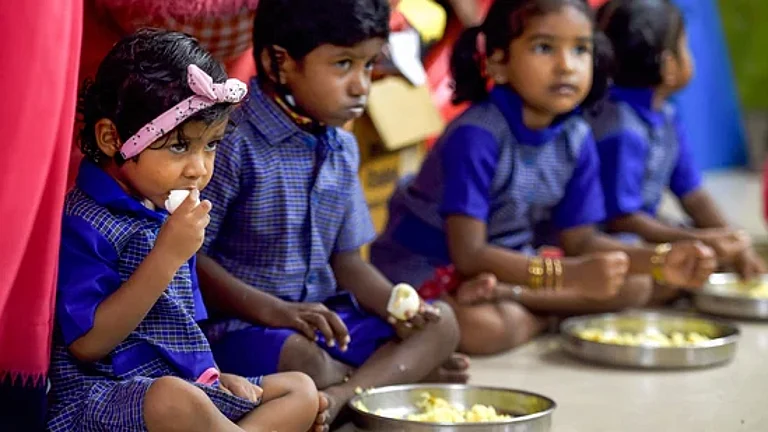
Who Gets the Egg?
In 2025, a report from the United Nations World Food Programme (WFP) listed 17 states and UTs that were providing eggs as an additional food, including West Bengal. It noted that just three states/UTs – Andaman and Nicobar Islands, Andhra Pradesh, and Tamil Nadu – were supplying one egg to students on all school days.
Advertisement
Among the states that provide eggs, but not milk, as an additional food item are Telangana, Assam, Bihar, Jammu & Kashmir, Jharkhand, Meghalaya, Mizoram, Odisha, and Sikkim. The report also notes that Tripura and Lakshadweep were providing eggs through local initiatives.
The 'Landscape Analysis of Pradhan Mantri Poshan Shakti Nirman (PM POSHAN), Menu – A Report' assessed PM POSHAN menus across States and Union Territories, comparing them with recommended nutritional norms. It documented state-specific practices such as the provision of eggs, milk, fruits and other supplementary foods.
The Egg Map of PM POSHAN
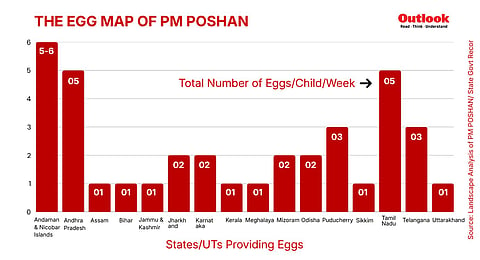
The Egg Map of PM POSHAN
According to the WFP's Landscape Analysis of PM POSHAN, 11 states were providing milk as an additional food item under the scheme at the time of the analysis. Four States/UTs – Karnataka, Kerala, Puducherry and Uttarakhand – were providing both eggs and milk at least once a week.
Chhattisgarh, Dadra & Nagar Haveli and Daman & Diu, Goa, Gujarat, Haryana, Rajasthan and Uttar Pradesh were providing milk but not eggs.
Advertisement
Going Beyond 450 & 700 Calories
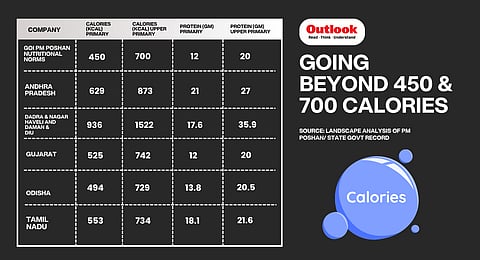
Among the limited states listed for nutritional norms, Andhra Pradesh stands out as it is providing nine grams of additional protein above the Centre's minimum in primary and seven grams in upper primary. The state provides eggs five times a week. In addition to mid-day meals, Andhra Pradesh also provides breakfast three days per week. The nutritional values refer to the entire prescribed meal, of which eggs are only one component.
Similarly, primary students in Tamil Nadu have a protein intake of 18.1 grams – six grams more than the requirement. In the case of upper primary students, it is about two grams higher than prescribed. For primary students, Tamil Nadu is also providing breakfast on five days.
Gujarat, which does not serve eggs but provides breakfast in addition to the mid-day meal, meets the Centre's minimum nutrition requirements.
The report, however, highlighted that eggs have a Digestible Indispensable Amino Acid Score (DIAAS) of 113%, whereas cereals and pulses combined have a DIAAS value of 60-70%. DIAAS is one of the methods to assess protein quality.
Advertisement
“Generally, animal proteins (i.e., dairy, eggs, and meat) are considered ‘excellent’ quality proteins. In contrast, plant proteins and cereal grains generally have DIAAS values that are less than 75, except for soy protein,” the report stated.
The report suggested that the food norms should be revised to include a variety of food sources, such as fruits and green leafy vegetables, and minimise the dominance of cereals in the current menu to enhance the nutritional value.

Vegetarian Alternative Not Providing the Same Quantity and Quality of Protein
The report noted that in an effort to improve the protein quality of the meals, many states offer eggs to the children during school meals; however, considering that many children studying in these schools were vegetarian, schools offer alternative options to eggs.
The vegetarian alternatives do not necessarily provide the same quantity or quality of protein, the report noted. “For example, bananas are provided to children who do not consume eggs in the states of Jharkhand, Karnataka, Kerala, and Uttarakhand. However, bananas do not serve as a suitable substitute for eggs as a protein source,” the WFP report said.
According to a PTI report, Ganga Ram Hospital dietician Aakanksha Arya said that eggs cannot truly be replaced by any other single food. She explained that eggs are an excellent source of high-quality protein and also provide vitamin B12, vitamin D, essential amino acids, and healthy fats.
“If schools currently serve eggs once or twice a week, replacing them would require providing an equivalent amount of protein from other foods, which many children may not be able to consume in sufficient quantities,” she said.
Eggs: Source of Most Affordable, High-Quality Proteins
The union government in 2013 termed the egg “a wholesome, nutritious food with high nutrient density” because, in proportion to its calorie count, it provides 12% of the daily value of protein and a wide variety of other nutrients.
The government said that nutritionists all over the world believe that malnutrition can be solved through one of the most affordable, high-quality proteins: eggs. The per capita availability of eggs in India has increased from five eggs per annum in 1950-51 to 106 in 2024-25.
The total number of eggs produced has increased from 183 crore in 1950-51 to 15,000 crore in 2024-25, the second-largest in the world.
Egg Production Nearly Doubles in a Decade
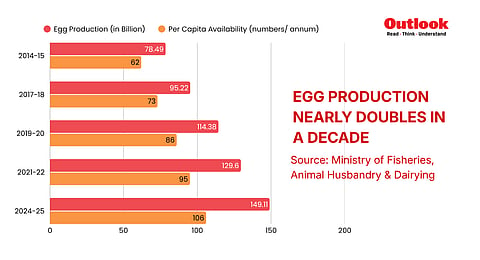
While the per capita availability of eggs has improved over the years, India is still far from the National Institute of Nutrition's recommendation of 180 eggs per capita per year.
How Healthy are the Children?
According to Poshan Tracker, in the 0-5 age group across India, 6.35 crore children were studied in May 2026, and 30% were severely to moderately stunted, while 12% were severely to moderately underweight.
In October 2024, 7.31 crore children in the same age group were measured. About 40% were found to be stunted, and 17% of children were underweight. The government records also suggest that India has 8.53 crore eligible beneficiaries under the Supplementary Nutrition Programme.
Further, under the 15th Finance Commission (2020-26), various schemes were promoted to address malnutrition. The list included Anganwadi services, Poshan Abhiyaan and the Scheme for Adolescent Girls.
In 2019, the Ministry of Health and Family Welfare (MoHFW), UNICEF and Population Council released the Comprehensive National Nutrition Survey (CNNS) 2016-18 report. It was the first-ever nationally representative nutrition survey of children and adolescents in India.
As per government estimates, 33% of the Indian population is under 18 years and of this, 20% is constituted by school-age children, “which represents the future workforce of the country”.
The CNNS 2016-2018 shows that, on average, 1 in 3 children suffer from chronic undernutrition and almost 1 in 5 children suffer from acute malnutrition or wasting. It also highlights significant micronutrient deficiencies in school-age children, suggesting that malnutrition is a major problem that affects children beyond the 1,000-day window.
The report also highlighted that around 55% of respondents in the 0-4 years, 5-9 and 10-19 years age groups reported themselves as vegetarian, while around 35 to 40% reported they are non-vegetarian. Only about 6 to 8% registered as vegetarians with an egg diet in the three age groups.
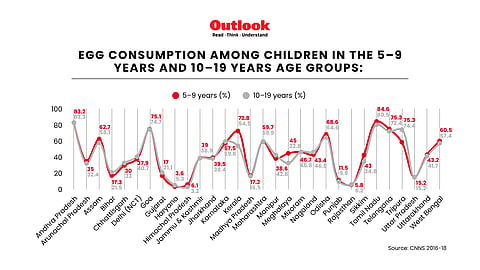
The survey also shows that states with long-standing egg programmes, such as Tamil Nadu, Andhra Pradesh and Telangana, report the highest levels of egg consumption among children, while Haryana, Rajasthan and Uttar Pradesh are among the lowest.
Egg consumption among children in the 5–9 years and 10–19 years age groups:
The Progress
The National Family Health Surveys have shown that India has registered an improvement in the malnutrition indicators – stunting (impaired growth and development in children), underweight and wasting (dangerously thin for their height).
In 2005-06, about half (48%) of children under the age of five were stunted, while 43% were underweight, and 20% were wasted. By 2023-24, in the under-five category, about 30% of children were stunted, 32% were underweight, and 19% were wasted.
The WFP report says that malnutrition during school age can lead to “high absenteeism, early dropout, poor academic performance, delayed cognitive development, short stature, health issues, and poor prospects”.
India today produces more eggs than ever before and remains the world's second-largest egg producer. Yet nearly one in three children continues to suffer from chronic undernutrition. Even though every child is entitled to the same nutritional standards under the law, what appears on a school lunch plate still depends largely on the state in which that child studies.
Published At:
Tags