Bullet-proof armoured vehicles used in Kashmir are patrolling Bengal neighbourhoods categorised as politically sensitive. Central paramilitary forces have started outnumbering state police personnel on poll duties—more than 2,000 companies have already landed in the state. Dozens of officers from other states are arriving as observers. The Election Commission of India (ECI) has been in a chest-thumping mood, insisting that this will be an unprecedentedly free and fair election—a true festival of democracy that Bengal has not experienced.
West Bengal Assembly Elections 2026: The Curious Case Of Akhtar Ali
The BJP’s all-out war against the TMC’s rule in Bengal has turned it into the most intense assembly election of 2026, albeit with greater democratic concerns.

Akhtar Ali, though, does not know whether to call what has happened to him a tragedy or a farce. The high school teacher has been assigned the responsibility of being the presiding officer at a polling station in his home district of Murshidabad in central Bengal. He, though, does not have voting rights, as of April 16, a week before the district goes to the polls.
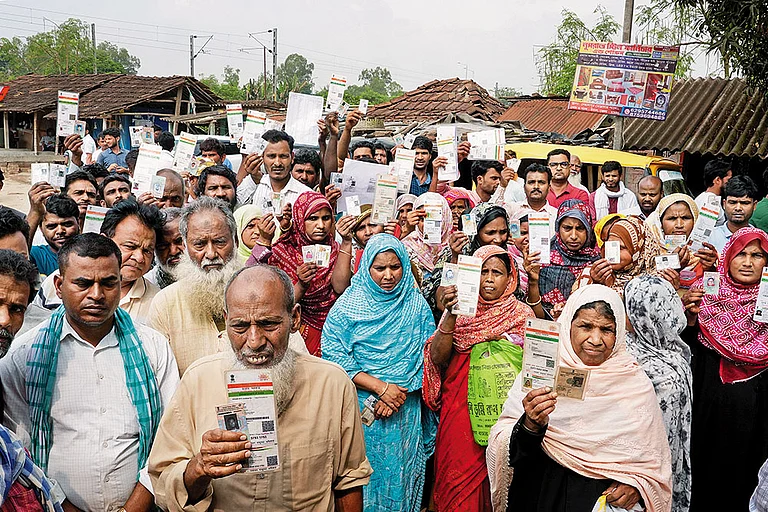
During the ECI’s Special Intensive Revision (SIR) of voter rolls, 64 lakh names were removed as belonging to dead and migrant voters. Another 27 lakh who had filled enumeration forms were excluded for having ‘logical discrepancies’ in their records. Ali is among those 27 lakh. Their appeals against such exclusions are pending before tribunals set up by the Supreme Court.
With a very limited window for clearance from the tribunal, which started functioning on April 17, the fate of these 27 lakh voters are in limbo. Of them, about 17 lakh are Muslims and about 10 lakh are Hindus, according to demographic profiling of the list done by the major political parties. The voter roll will freeze for the 152 first phase constituencies on April 21 and for the 142 second phase constituencies on April 27. Those whose names are not cleared by the tribunal by then will not be able to vote in this election. The majority of the Muslims deleted from the roll are from the constituencies going to the polls in the first phase.
Ali has been a voter of Samserganj constituency. He says he asked the authorities how he could preside over the polling process when he himself has been dubbed as a doubtful voter. “I was told to stop thinking and just carry out the duties I’ve been assigned to,” he says. He insists he submitted all the papers and so did his younger brother, Abdus Sattar, an assistant professor at a college. “Does anyone even consider the emotional toll of conducting an election while having my own rights suspended?” he asks.

In Nandigram constituency, a huge percentage of Muslim women voters have been deleted, most of whom possess all the necessary documents | Photo: Sandipan Chatterjee

The extensive voter deletion has become the biggest talking point ahead of the elections in which the Trinamool Congress (TMC) chief Mamata Banerjee is seeking her fourth straight term as the chief minister. Banerjee alleges targeted voter deletion at the behest of her principal challenger, Prime Minister Narendra Modi’s Bharatiya Janata Party (BJP). Modi hit back, alleging that the TMC is opposing the SIR because they don’t want the ‘infiltrators’ identified.
Advertisement
Explaining why the SIR process in Bengal became so intense while remaining rather quiet(er) in some other states, Mukulika Banerjee, a professor of social anthropology at the London School of Economics (LSE), says that this reflects the BJP’s desperation to win Bengal. In her words, “It’s the only Indian state with a three-term female chief minister who matches the prime minister in her popular appeal and also commands a party that has a strong presence on the ground.”
She observes that the Union government and the ECI have crafted an elaborate mechanism to try and shape a Bengal electorate that’s most likely to vote for the BJP. This is pretty unprecedented for Indian democracy, she says. “In democracy, voters choose their government. But here the government in New Delhi is choosing the voters. This is against the basic spirit of democracy,” says Banerjee, author of the 2021 book, Cultivating Democracy: Politics and Citizenship in Agrarian India.
Advertisement
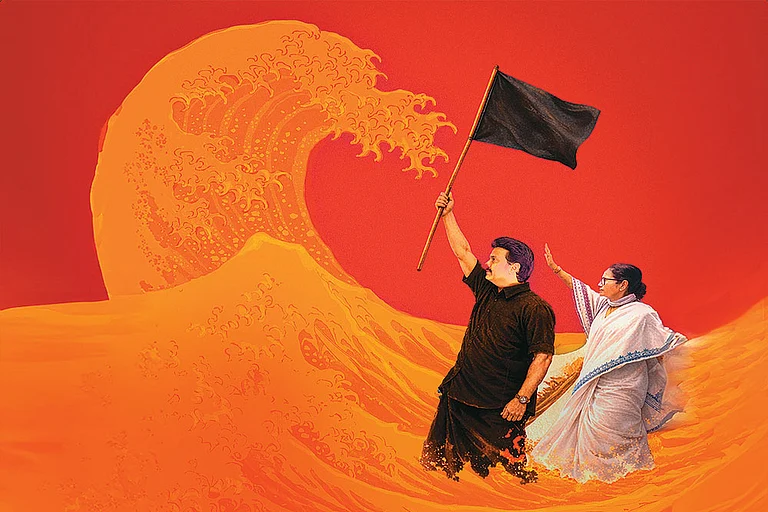
Muslims, who make up 27 per cent of the state’s population—according to the 2011 census—overwhelmingly supported the TMC in the 2021 assembly election. Kolkata-based research non-profit Sabar Institute’s publications point out that women, especially from the lower strata of the society, are among the other major victims of the roll revision exercise. They are considered among the TMC’s major support base due to their welfare schemes.
Kolkata-based economist and political commentator Suparno Moitra, however, does not suspect any ill intention on part of the ECI. He believes cleaning the roll of irrelevant voters and suspected illegal migrants was a necessary task. “The ECI’s execution has been faulty at many levels, but I do not see any reason to suspect Muslims were specifically targeted. I see no design. We can see many Hindus are complaining of wrongful deletions,” he says.
‘If we consider the increase in anti-incumbency and Hindu-polarisation, we see a neck and neck battle.’
Advertisement
He feels the BJP is expected to gain from the loss of the TMC’s voters, including proxy votes cast for dead and absentees, but the party may also suffer if the voters irate by the roll revision exercise hold the BJP responsible for the ECI’s mismanagement.

The BJP won 77 seats in the 294-seat assembly in 2021 and led in 90 assembly segments in the 2024 Lok Sabha elections. Elevating this figure to the level required to secure a majority in the assembly—that is, winning 148 seats—remains a formidable challenge for the saffron camp. Past electoral records show the TMC led over others in 169 assembly segments in both the 2021 assembly election and the 2024 parliamentary polls. The BJP has 59 such seats. There are another 47 ‘swing seats’ where results have differed in different elections.
The heavy deletion of voters from the Muslim-majority districts, though, has given the BJP a real opportunity. Several of the swing seats, and several of TMC’s strongholds, have lost 10-20 per cent of its electorate.
Advertisement
In the 2019 Lok Sabha election, the BJP came close to the TMC’s numbers. The TMC got 2.47 crore (43.69 per cent) votes, while the BJP got 2.3 crore (40.6 per cent). The gap stood at only 17 lakh votes. While the TMC led in 164 assembly segments, the BJP led in 121. However, in the 2021 assembly Lok Sabha election, the TMC polled 2.89 crore votes, while the BJP bagged 2.29 crore, leaving a gap of about 60 lakh votes (10.5 per cent) between the two parties. The gap narrowed in the 2024 Lok Sabha election, when the TMC secured 2.76 crore votes and the BJP 2.34 crore. The gap stood at 42 lakh (seven per cent) votes.

Since 2019, the BJP’s share has almost stood at around 2.3 crore or 38-40 per cent. The TMC’s votes have swung between 2.47 crore and 2.89 crore. Now that 90.6 lakh names have been stricken off the list, including 27 lakh in limbo over logical discrepancies, the saffron camp is pumped up that they are closing in on the gaps. “The TMC’s false voters and illegal Bangladeshis and Rohingyas have been removed from the voter list. Her rule is over,” Suvendu Adhikari, the leader of the opposition in the state assembly, enthusiastically said at an election rally.
According to a Bengal BJP leader’s estimate, the 17 lakh Muslim voters in limbo are anti-BJP voters. The 10 lakh Hindu voters include supporters from both parties, though predominantly the BJP. They believe the 64 lakh voters deleted as dead or migrant included “at least 10 to 15 lakh false votes” that the TMC voters allegedly used to cast. “So, we estimate the TMC has lost 30 to 35 lakh votes. If we consider the increase in anti-incumbency and Hindu-polarisation, we see a neck and neck battle,” says the leader.
Many within the BJP are hopeful that in Kolkata and its surrounding urban areas—driven by growing anti-incumbency sentiment against the TMC over issues such as corruption and lack of industries and employment opportunities—unexpected results may emerge in certain assembly seats where the party has never previously held a lead. However, in these districts, the Left retained a 15,000-40,000 vote support base in about two dozen constituencies. If they retain those votes, the BJP will not have much of a chance of denting this TMC citadel.
The TMC says the BJP, too, will lose some of its voters, not only from the Matua community, but also a large number of Hindi-speaking people whose names got deleted during the first phase. “Our vote share gap may reduce, but they can’t reach us,” a TMC minister says. The party sounds confident it will gain in the northern parts of the state. Besides, the TMC believes the harassment that the SIR exercise caused people will backfire on the BJP. “The anti-BJP polarisation in our favour will be stronger than the anti-incumbency polarisation in the BJP’s favour,” says a TMC veteran.
Meanwhile, different central investigative agencies have swung into action. The National Investigation Agency (NIA), the Directorate of Enforcement (ED) and the Income Tax Department officials are chasing several TMC leaders on old and new charges. The ED even arrested a top functionary of the Indian Political Action Committee (I-PAC), the TMC’s political consultant. The Left sees these actions as the BJP’s desperate bid to polarise voters using agencies.

According to Sanjay Kumar, a professor at the New Delhi-based Centre for the Study of Developing Societies (CSDS), Bengal is heading for an interesting election, as the contest looks tougher than the 2021 polls due to the heavy deletions from the voter roll. “However, despite the deletions, as of a week ahead of the first phase of polling, the TMC still seems to have an edge, unless any major development takes place in the next few days till the day of voting,” says Kumar.
Whatever the outcome, this election will be etched in history as one that sacrificed a sizable chunk of the electorate in the name of ensuring a festival of democracy. When nearly 27 lakh voters were reduced as ‘collateral damage’ of a purported purification process; and when the festival was about the process, not voters. But the likes of Akhtar Ali will remain in the ECI’s election fairytale as inconvenient, irremovable blots.
Snigdhendu Bhattacharya is a journalist, author and researcher.
This article appeared in Outlook’s May 1 issue, 'Dravida Banga Ltd' which looked at the states going into elections and the issues facing them including delimitation and special intensive revision.
Published At:
Tags