The ECI issued a public warning to TMC in a social media statement.
The SIR has shrunk the Bengal voter list by 90.6 lakh or roughly 12 per cent.
Thus, in the total deletion of 90.62 lakh, Muslims make up 31.1 lakh or 34 per cent.
Bengal Elections 2026: Can BJP's Machinery Upset TMC's Maths?
As more than 27 lakh people have their democratic rights suspended, Amit Shah’s ‘Mission Bengal’ aims to bulldoze all equations, but they may still have to fight the maths

Summary
The Bengal assembly election 2026 will be free from fear, violence, intimidation, inducement, false voting, booth jamming and obstructing voters from coming out to vote, the Election Commission of India (ECI) said in a social media statement on April 8, a fortnight before the first phase of the two-phase election in the state.
This was no general statement of assurance to voters. It was a threat to the state’s ruling party, Chief Minister Mamata Banerjee’s Trinamool Congress (TMC). In the words of the poll panel, it was their “straight-talk” to the TMC.
The TMC hit-back promptly. In their “straight-talk” to the ECI, the party demanded that the elections must be free from Delhi’s control, political bias, selective targeting and double standards.
Such political language from an election commission is unparalleled in Indian democracy, says Sabyasachi Basu Ray Chaudhuri, a political scientist at Kolkata’s Rabindra Bharati University. “This comment will allow opposition parties to question if the elections would truly be fair when the ECI makes comments targeting any particular party,” he notes, adding that loss of credibility of institutions like the ECI and government investigative agencies bodes ill for democracy.
Jawhar Sircar, India’s former Culture Secretary and a former member of the Rajya Sabha, considers it “abnormal” for Chief Election Commissioner Gyanesh Kumar “to think that all 24 CECs before him, including legends like Sukumar Sen and T.N. Seshan,” were wrong in their ways of conducting intensive electoral roll revisions. Kumar “invented a legally questionable SIR and behaves like Genghis Khan,” Sircar says, adding that he has never seen such bias like the one displayed by the Kumar-led commission.
The ECI’s comments, as expected, turned into a weapon in the TMC’s hands. Kumar had already emerged as a key polarising figure. “This election is against the Amit Shah-Gyanesh Kumar nexus,” TMC MP Kalyan Banerjee told party supporters at a rally in Kolkata’s suburbs.
CPI(M) Bengal unit Secretary Mohammad Salim senses the ECI is trying to create a TMC versus BJP binary to keep people away from the Left. “They are playing a political game. The people will foil their plan,” he says.
Advertisement
For years, maths, and winds or waves, have determined electoral results. But the 2026 Bengal assembly election is one such where neither do the maths support the Bharatiya Janata Party’s (BJP) claim of being in a position of forming the next government, nor have political pundits noted any pro-BJP wind or wave.

After drawing national attention with its extraordinary performance in the 2019 Lok Sabha election—when the party took a lead in the state’s 121 of 294 assembly constituencies, the BJP won 77 seats in the 2021 assembly election and led in only 90 assembly segments in the 2024 parliamentary polls. The majority mark being 148 seats, they never looked to be in a position to topple the TMC government.
Pro-change waves were clearly felt ahead of the 2011 assembly election that ushered in the TMC era after the end of the Left’s 34-year-rule. The TMC’s momentum had steadily risen from its 2009 Lok Sabha election performance—in which the Left was reduced to below the majority, and followed it up with a series of by-election wins. In contrast, the BJP has not been able to produce any mass movement in the past two years.
Advertisement
Yet, the BJP camp is enthused. As the SIR shrunk the Bengal voter list by 90.6 lakh or roughly 12 per cent, they hope they will manage to make up the 7-10 per cent gap in vote share with the TMC as observed from 2021. “We have the machinery,” says a Bengal BJP leader, unwilling to be named. The machinery, as he explained, is supposed to function as the following: the ECI will tackle the TMC’s administrative influence and organisational power using its own poll-time authority and the Central forces will take charge of security, charging up the anti-TMC voters. The political leadership from the BJP and the Rashtriya Swayamsevak Sangh (RSS) family of organisations will do the rest—increasing Hindutva polarisation to ensure more Hindus turn out to vote.
Kumar’s alleged proximity to Home Minister Amit Shah has been a matter of heated political controversies. He served under Shah in two different ministries, first in Home Affairs and then in the Ministry of Cooperation. He played instrumental roles behind the bifurcation of Jammu and Kashmir as well as the functioning of the Trust that built the Ram temple in Ayodhya.
Advertisement
The new law under which the BJP government appointed him, first as an election commissioner and then the chief election commissioner—rubbishing objections from the Opposition—was challenged in the Supreme Court in 2024. The apex court is yet to start the hearing. Recently, even the Chief Justice of India, Surya Kant, recused himself from hearing it. While the constitutionality of his appointment remains unheard in the court, Kumar seems to have earned the mistrust of the opposition parties, not only the TMC.
In Sircar’s words, Kumar “is unusually undignified and juvenile to be attacking the TMC directly.” He notes that Kumar had earlier also targetted Rahul Gandhi, the Leader of the Opposition in the Lok Sabha. Such remarks reveal his “unquestioned bias against the Opposition.”
Recently, the Parliament was quick to reject the impeachment motion brought against Kumar by the opposition parties. During his election campaign in Bengal, Narendra Modi expressed his full trust in the commission being run by people he and his political deputy, Shah, appointed.
Advertisement
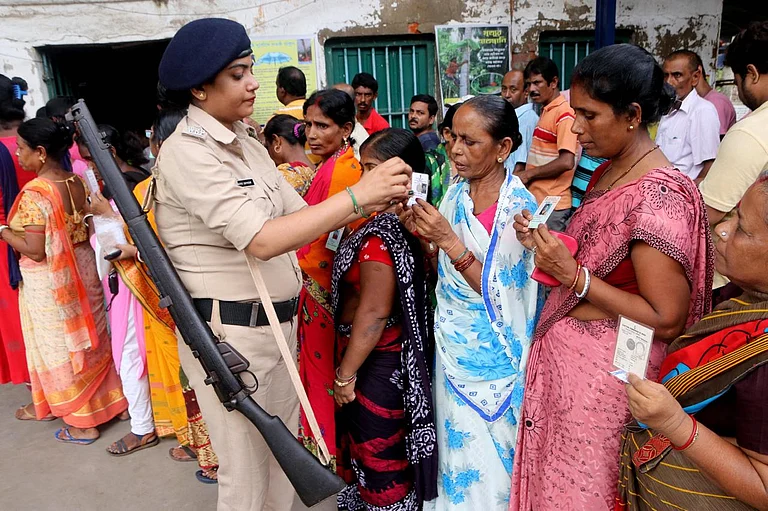
Of the total 90,62,215 names deleted from the roll, 58,20,896 were removed under the absent, shifted, dead, and duplicate categories at the time of publishing the draft roll. Another 5,46,053 were deleted through Form-7 objections at the time of publishing the final roll. Thereafter, another 26,95,266 names were excluded on the grounds of ‘logical discrepancies’—a category the Kumar-led commission created.
According to data Outlook accessed from political sources, of the 63,66,949 names deleted through the first two stages, about 49 lakh were Hindus. Thus, the Hindu share of deleted voters stood at 77 per cent, higher than the Hindu population share of 70 per cent in the state. This is largely attributed to the fact that following the BJP’s consistent threats of conducting a nationwide citizenship screening to purge Muslims—‘Bangladeshi infiltrators’, in their words—Muslims started getting errors like name or spelling mismatches in the papers corrected well before the Special Intensive Revision was announced in June last year.
However, in the artificial intelligence-driven exercise to find logical discrepancies in entries, Muslims made up the overwhelming share. Of the 26,95,266 names deleted from this list through court-appointed tribunals, about 17.65 lakh or 65 per cent were Muslims.
Thus, in the total deletion of 90.62 lakh, Muslims make up 31.1 lakh or 34 per cent—significantly higher than their 27 per cent share in the state population, as per the 2011 census. Since Muslims voted overwhelmingly in favour of the TMC in the 2021 assembly election, a high number of deletions of Muslims voters is expected to impact the TMC’s fortune in several constituencies, the BJP hopes.
Murshidabad, the district with India’s highest Muslim population, saw its electoral roll shrunk by 7.49 lakh voters. Roughly two-thirds of the district’s population is Muslim. With 22 seats in the district, the average deletion per constituency is 34,000 voters. In the 2021 assembly election, when the district recorded intense pro-TMC polarisation among Muslims, the TMC’s winning margins in most of the seats stood well above 30,000 votes.
However, in the 2024 Lok Sabha election, when the Muslim votes sharply split between the TMC and the Congress, not only had the winning margins got thinner, but even the BJP ended up leading in a few. This time, if a 2021-like pro-TMC polarisation does not take place, the deletions may bring the BJP to the winning position in several seats.
The pattern of deletion is no less important than the absolute numbers. “Maths is not simply figures. They have their own chemistry,” points out political scientist Sibaji Pratim Basu, a former Vice-Chancellor of the state’s Vidyasagar University. He highlights how several seats in the district of North 24 Parganas and Nadia have lost a massive number of Hindu voters from the Matua sect who were predominantly BJP supporters.
“The BJP, too, will suffer the blow from such deletions in multiple constituencies,” Basu says, adding, “That’s why even these deletions do not seem to bring the BJP close to power.”
The BJP can, indeed, suffer. North 24-Parganas is one of India’s most-populous districts. It has 33 assembly seats. The district lost 12.6 lakh voters—or roughly 38,000 per constituency. This rate is higher in the areas bordering Bangladesh, where thousands of Matuas have been thrown out of the list. In 2021, the TMC won 28 seats here. Only in five, their winning margin was below 20,000 votes. In contrast, all of the BJP’s five seats were won by less than 13,000 votes.
According to political organisers compiling assembly-wise data on deletions, Bagda constituency, which the BJP won by a margin of 10,000 votes in 2021, lost about 50,000 voters, and over 90 per cent of them are Hindus. Of this 50,000, about 10,000 were removed for logical discrepancy and 94 per cent of them are Hindus.
Gaighata, which the BJP won by a similar margin in 2021, has lost 43,000 voters, and 95 per cent of them are Hindus. The percentage remains the same for the 20,000 odd names deleted for logical discrepancies.
The BJP believes their machinery will help mobilise Hindus on an unprecedented scale. Shah has said he will be camping in Bengal for the last 15 days to oversee both phases of elections on April 23 and 29. The ECI will be in charge of affairs. Central paramilitary forces will be manning the booths and sensitive neighourhoods. Another BJP leader believes that even if the party falls short of a majority, Governor R.N. Ravi would allow the party time to gain strength through defections. Such propositions are being popularised through unofficial social media networks to boost the morale of BJP supporters, he says.
Basu Ray Chaudhuri agrees that the TMC may end up losing a few seats due to the high number of deletions among Muslim voters. Besides, the loss of Muslim share of the electorate and the increasing administrative takeover by the ECI has infused oxygen into the saffron camp. “However, how the larger electorate responds to the perception that the ECI and the Central agencies are working for the BJP is a bigger question,” he says.
Snigdhendu Bhattacharya is a journalist, author and researcher
Published At:
Tags