Massive crowds and emotional loyalty—from migrant workers to first-time voters—underline Vijay’s appeal, but whether this translates into votes remains uncertain.
TVK’s real impact may lie in fragmenting the anti-DMK or opposition vote, potentially reshaping outcomes even without winning many seats.
Strong messaging on corruption and dignity, TVK lacks cadre strength and booth-level machinery—key to sustaining long-term political relevance in Tamil Nadu.
From Fandom To Franchise: Vijay Tests Political Pull In Tamil Nadu Polls
Actor-turned-politician Vijay’s TVK is trying to mobilise the anti-Dravidian vote and cut into traditional banks

Summary
When Vijayakumar decided to return to Tamil Nadu from Qatar, where he had been working for the past three years, it was not due to uncertainties in West Asia. “When Thalapathy is fighting the battle, I have to be here,” he says. In Thirupparankundram, on the outskirts of Madurai, Vijayakumar, once a Dravida Munnetra Kazhagam (DMK) worker, had come to meet and campaign for a Tamilaga Vettri Kazhagam (TVK) candidate. “It is for Thalapathy,” he says, referring affectionately to actor-turned-politician Vijay.
If Vijayakumar left behind his previous political affiliations and abruptly took leave from his job, putting his career at risk, Saran claims to have swum nearly a kilometre from Atchenkulam just to reach the outskirts of Kanyakumari, where Vijay was holding a roadshow. “Any amount of risk is immaterial if we are to see God,” he says. Vijay is the latest in a long line of Tamil Nadu film stars to launch a political party, and in doing so, he has already upended the dynamics of state politics during this election campaign. While political opponents and some observers remain sceptical about whether the superstar’s fan base can translate into votes, his presence and the potential impact he may have on the electoral landscape, are widely acknowledged.
“I don’t think that the TVK is going to emerge as the second-largest party,” says Palanivel Thiaga Rajan, a minister in M.K. Stalin’s cabinet. However, he adds, “If they succeed in securing around 15 per cent of the vote and if the NDA is limited to around 50 seats, that could herald significant changes in the future.”
In his recent rallies, Vijay has been vociferous in his attacks on the ruling DMK government. “Both the DMK and the AIADMK want to keep power within themselves. That is why they are apprehensive about us. They fear that nepotism and corruption will continue if we are kept out of power. Give me one chance, it will change Tamil Nadu,” he said at a rally in Kanyakumari.
In the last phase, campaigning is centring on delimitation and federalism; on the ground, the TVK factor is being discussed enthusiastically. “How much the TVK is going to puncture the established parties’ fortunes is the bigger, most interesting and perhaps most enduring question that this election throws out,” says John Solomon, a political analyst based in Chennai.
Advertisement

In Tamil Nadu, despite Dravidian dominance, 15-20 per cent of votes go to parties outside the two main blocs, never consolidated into a stable base. This is where the ‘Vijay factor’ matters, how much he mobilises this anti-Dravidian vote and cuts into traditional banks, as voters like Muthulakshmi, a street vendor, believe he will deliver change. She had long been a supporter of the AIADMK. “After Amma, J. Jayalalithaa, we were left abandoned. Now I hope Vijay will deliver for us,” she says.
Her words reflect the enduring emotional connection that film stars command among sections of voters in Tamil Nadu. However, some draw a clear distinction between film stars who succeeded in politics and those who did not. “Be it MGR or J. Jayalalithaa, they entered politics after gaining substantial exposure in the field. MGR, before launching his own party, the AIADMK, was one of the DMK’s tallest leaders. His screen charisma certainly added to his political success. The same holds true for Jayalalithaa, who served as the party’s propaganda secretary before eventually leading it,” says Dr. Ramu Manivannan, former head of the Department of Political Science and Public Administration, Madras University.
Advertisement
According to him, the key question remains whether the large youth crowds thronging Vijay’s rallies will actually translate into votes. Leaders and cadres from both the DMK and the AIADMK, whom Outlook spoke to, were dismissive of the political significance of these gatherings.
Muthukrishnan, a DMK cadre we met at a rally in Madurai points to a recent incident in Kanyakumari, where a supporter tried to throw flowers at Vijay during a roadshow. “He mistook it for a bomb and, leaving aside the cycle he was riding, rushed to the safety of the caravan behind him. This shows how different real life is from the reel,” he adds.
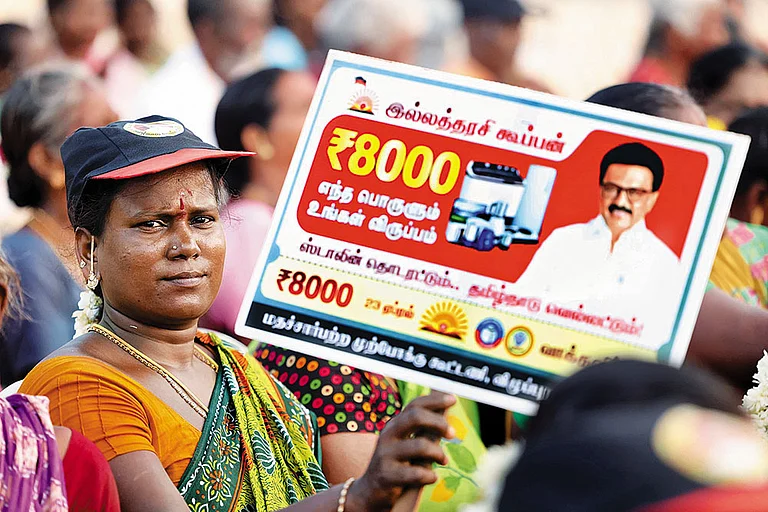
When a stampede at a TVK rally in Karur claimed 41 lives, Vijay’s swift return to Chennai also drew criticism, with some viewing it as a sign of political immaturity and a lack of on-ground crisis leadership.
Advertisement
Some observers draw parallels between the TVK and the Desiya Murpokku Dravida Kazhagam (DMDK), founded by actor Vijayakanth. He launched the party in 2005 and contested all seats in the 2006 Assembly election. While the party failed to win a single seat, it secured a notable 8.3 per cent vote share in its very first outing.
“Later, Vijayakanth aligned with the AIADMK. Though his party had a clearer ideological positioning, it could not sustain its growth,” says Jayakumar, a senior journalist, drawing comparisons with the TVK. The DMDK is now in alliance with the DMK and was given ten seats to contest. According to him, the TVK currently lacks both a strong organisational structure and a clearly defined ideological framework.
Though Bharatiya Janata Party (BJP) talks reportedly continued till the last moment, TVK leaders frame their fight against corruption, nepotism and for dignity, according to Nirmal Kumar. “We are fighting this battle alone against all pressure because our fight is for the dignity of the state and transparency is important for us,” he adds.
Advertisement
The TVK’s immediate performance may matter less than what follows, whether it converts floating voters into cadres and evolves beyond personality.
Observers, including Jayakumar, say the TVK’s prospects are weakened by lack of organisational depth. In Tamil Nadu, success hinges on booth-level mobilisation, cadre strength and welfare linkages, where the DMK and the AIADMK retain an edge; without this, messaging risks staying rhetorical rather than converting into votes. At the same time, the TVK’s pitch as a clean alternative against corruption, nepotism and for dignity seeks an anti-establishment space, signalling autonomy and resisting perceptions of alignment with national forces like the BJP.
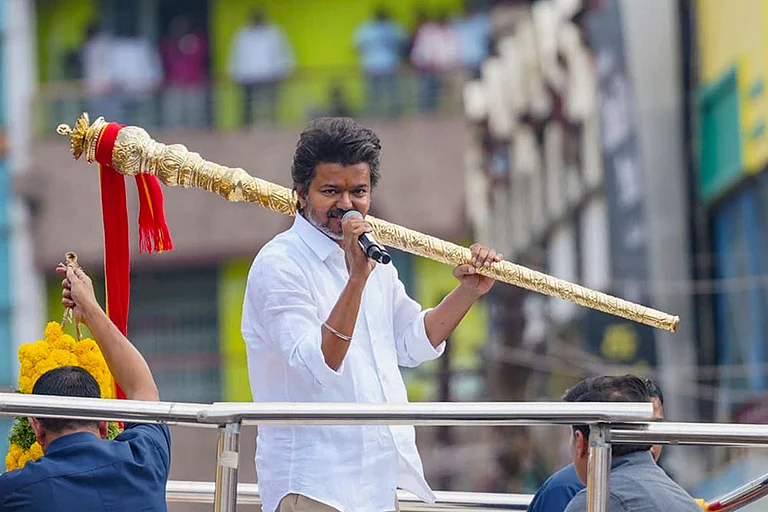
“More than seats, the percentage of votes they garner is important. Vijay is contesting in two seats and in some other constituencies, there is a chance of a good fight by the TVK. This could considerably increase their share of unaligned votes,” says John Solomon.
However, even if the TVK secures a respectable vote share, doubts remain about sustaining momentum without organisation, evident in Trichy North, where hardly any TVK workers were found campaigning. “We work when leaders from Chennai come,” was the refrain of a teenager who identified himself as a Vijay fan. The DMK won this constituency by a margin of over 50,000 votes in 2021. Sitting MLA Inigo S. Irudayaraj dismissed the prospects of Vijay making any significant impact here. “Vijay is not among the people,” he told Outlook while campaigning.
In Perumbur, Chennai, the second constituency where Vijay is contesting, the DMK had again secured victory by a margin of over 50,000 votes. However, TVK leaders see this as a sign of confidence rather than a disadvantage, according to Nirmal Kumar.
The TVK’s immediate performance may matter less than what follows, whether it institutionalises support, converts floating voters into cadres and evolves beyond personality. Since the 1972 AIADMK formation split, bipolar politics persisted; the DMK now seeks to overturn this cycle and return to power.
“This election is being fought without any strong semblance of anti-incumbency. The presence of a new entrant and the realignment of alliances are making it peculiar,” notes Ramu Manivannan. This marks a departure from Tamil Nadu’s conventional electoral logic, where anti-incumbency is decisive; its relative absence introduces uncertainty and space for new actors. At the centre is TVK, the cynosure of attention not merely when it comes to seats, but for its potential to reshape electoral arithmetic, particularly in how it fragments the anti-DMK vote.
In a tightly contested, bipolar system, even a modest diversion of votes can alter outcomes across multiple constituencies. If the TVK draws disproportionately from disillusioned DMK voters, it could indirectly benefit the opposition. Conversely, if it cuts into the opposition’s base, it may ease the DMK’s path. Thus, beyond its own performance, TVK’s role as a vote-splitter could prove crucial in determining whether this election reinforces or disrupts Tamil Nadu’s long-standing political pattern.
N.K. Bhoopesh, is an assistant editor, reporting on south india with a focus on politics, developmental challenges, and stories rooted in social justice
This article appeared in Outlook’s May 1 issue, 'Dravida Banga Ltd' which looked at the states going into elections and the issues facing them including delimitation and special intensive revision.
Published At:
Tags