The current DMK dispensation has introduced a host of welfare measures, including the breakfast programme, cash transfers and loan waivers
The opposition AIADMK has used its manifesto to outline the welfare measures it plans to implement if voted to power
As elections drew closer, newly launched TVK recalibrated its earlier stance on freebies and anchored its manifesto around welfarism
Tamil Nadu Elections: DMK, AIADMK, TVK and the Politics Around Welfare Schemes
While some economists and policymakers question the rationale of initiatives launched by political parties, labelling them as “freebies”, Dravidian parties view them as instruments of social justice

Radhika, 41, travels nearly 20 km every day from her home in Perundurai, near Erode, to a nearby town for work. She has been employed as a daily-wage labourer at a dairy farm for several years, while her husband works as a construction worker. Together, they support a family of five, their two children and Radhika’s elderly father, who suffers from age-related ailments.
“My husband and I are able to manage our household, including education and medical expenses, despite our modest income, largely because of government support,” she says. “Earlier, I used to spend around Rs 1,000 a month for travel. Now, that expense has come down significantly. My daughter, who is pursuing a degree in Erode, no longer has to pay for her commute either.”
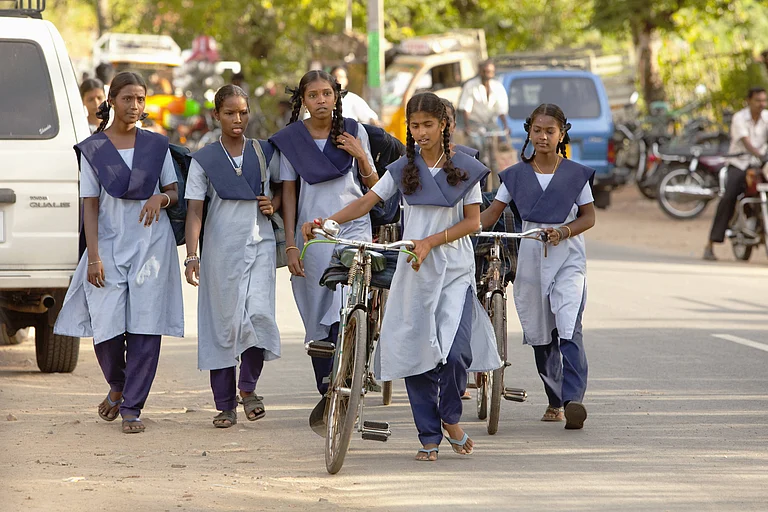
Radhika and her daughter are among the lakhs of beneficiaries of a scheme Tamil Nadu Chief Minister MK Stalin introduced soon after he took over the reins of governance in 2021. The government claims that on average, women are able to save Rs 600 to Rs 800 monthly by making use of this free travel scheme. The free bus travel scheme is one of the many welfare schemes implemented by the Stalin-led government in its five-year term.
Tamil Nadu, known for its Dravidian model of social justice delivery, has long implemented such measures well before Stalin or even Jayalalithaa and her mentor, AIADMK founder and former Chief Minister MG Ramachandran. While some economists and policymakers question the rationale of these initiatives, labelling them as “freebies,” Dravidian parties view them as instruments of social justice.
The current DMK dispensation has introduced a host of welfare measures, including the breakfast programme, cash transfers and loan waivers, and has been actively highlighting these initiatives during the run-up to the state assembly elections. The opposition AIADMK, meanwhile, has used its manifesto to outline the welfare measures it plans to implement if voted to power.

The AIADMK has promised to extend free bus travel to men and to introduce the Kula Vilakku Scheme, which will provide Rs 2,000 per month to women heads of families holding ration cards. In addition, it has announced a one-time special assistance of Rs 10,000 per family to offset the rising cost of living. Providing two-wheelers to five lakh women at a subsidy of Rs 25,000 is another key promise.
Advertisement
The newly launched Tamilaga Vettri Kazhagam (TVK), led by actor Vijay, had initially criticised welfare measures as “freebie” politics and sought to foreground a ‘development-centric’ agenda. However, as elections drew closer, the party appeared to recalibrate its stance, anchoring its manifesto around welfarism as well, including a promise of Rs 2,500 per month for women.
This volte-face, in a way, underscores how deeply welfare politics is entrenched in Tamil Nadu’s political landscape.
In the early years of Dravidian rule, CN Annadurai, upon coming to power, promised subsidised rice, a commitment that was later expanded by M. Karunanidhi during his tenure as Chief Minister. This underscores how the DMK leadership sought to address poverty through such welfare measures.
From subsidised rice, the focus has now expanded to consumer appliances. The AIADMK manifesto for the upcoming election promises free refrigerators for all ration card holders, among a slew of other measures.
Advertisement
The DMK, on its part, has announced a Rs 8,000 coupon for the purchase of home appliances, and an increase in the Kalaignar Magalir Urimai Thogai (Women’s Rights Scheme) to Rs 2,000 per month. Ahead of the poll announcement, the Tamil Nadu government transferred Rs 5,000 to 1.31 crore women beneficiaries under the scheme in February 2026. This included Rs 3,000 as an advance for three months and a Rs 2,000 “special summer assistance.”
The Chief Minister has described the DMK’s manifesto this year as the “superstar,” while Edappadi K. Palaniswami has termed his party’s manifesto the “real hero.”
On the outskirts of Madurai, in a nondescript village called Thenpalanchi, Outlook met Adi Laxmi, an agricultural labourer. She views every promise made by political parties with enthusiasm.
“We got a television after Kalaignar (Karunanidhi) came to power in 2006. From then onwards, I began watching the news,” she says. Though literate, Adi Laxmi is neither inclined to read newspapers nor willing to spend on them. She adds that access to television news helped her become more aware of current affairs and, in turn, her rights.
Advertisement
Adi Laxmi’s story reflects another dimension of what is often dubbed as “freebies,” or disparagingly labelled populist measures: their role in fostering empowerment. Economist Venkatesh Athreya, who has conducted fieldwork in rural Tamil Nadu, corroborates his experience.
“People often say they can understand subsidising food and education, but question why television sets are given to the poor. The fact is it is a mode of empowerment. Many women have told me they were introduced to the world of news only after they received free television sets,” he says. Athreya also finds it hypocritical to dismiss welfare measures as freebies. “The term ‘populism’ is often used by mainstream media to denigrate efforts to help the poor. At the same time, when corporates raise concerns, governments cut corporate taxes and roll out schemes to stimulate industry, arguing that corporates create wealth. In reality, it is human labour that creates wealth,” he adds.
Advertisement
In 1982, then Chief Minister MG Ramachandran, aiming to expand school participation, introduced the noon meal scheme, making it one of the largest such initiatives in the world. Tamil Nadu became the first state in the country to implement a universal free midday meal scheme in schools, which, according to various studies, helped reduce dropout rates among children.

From rice and school meals, welfare measures evolved further in 2006, when M. Karunanidhi offered free television sets to economically weaker sections, an initiative that was widely criticised at the time as the height of populism. In 2011, Jayalalithaa expanded this approach by distributing grinders, mixers and fans under the ‘Amma’ brand. While a few commentators often view such measures as an “unproductive” burden on the exchequer, political scientist Vignesh Rajahmani offers a different perspective. “Studies suggest that increased television viewing has reduced women’s tolerance of domestic violence,” he notes.
The pillars of the Dravidian movement, according to many political scientists, lie in enabling the socio-economic mobility of marginalised communities. Political scientists Kalaiyarasan and M. Vijayabaskar, in The Dravidian Model, argue that the anti-caste movement helped forge a broad-based Dravidian identity. “The Dravidian mobilisation managed to build a people’s coalition articulating popular demands against an elite oligarchy,” they write. This shared identity brought together diverse social groups and contributed to the resilience of the Dravidian political bloc in Tamil Nadu.
The trajectory of welfarism across different political phases in the state lends credence to this argument. Welfare measures such as the noon meal scheme did not originate merely as electoral tools; in fact, they predate Independence. In 1921, the Justice Party, during its administration of the erstwhile Madras Presidency, introduced initiatives to provide meals to schoolchildren. Successive governments, whether under the Congress during K. Kamaraj’s tenure, or later the DMK and AIADMK, expanded and strengthened these programmes over time.
“The welfare measures are being presented as a right, not as benevolence,” says Rajahmani. He cites the example of how Stalin named the cash transfer scheme as Magalir Urimai Thogai, literally, a “rightful entitlement,” rather than framing it as a benevolent dole.
This framing helps explain why, at least in Tamil Nadu, such welfare measures are not widely seen as “freebies,” but as legitimate entitlements that people can demand from the state. Moving beyond the binary of right-wing and left-wing populism, Rajahmani describes this approach as “empowerment populism,” which, he argues, characterises Tamil Nadu’s model.
“The cash transfer increases disposable income in the hands of women, enabling them to spend more on children’s education and small investments. Women’s workforce participation in Tamil Nadu is over 40 per cent, one of the highest in the country, and such measures would sustain and contribute to such a trajectory,” he says.
Though often criticised by neoliberal economists as “freebies,” such measures are interpreted by several political scientists as instruments that deepen, and at times radicalise, democracy. VMS Subagunarajan, political analyst and author, frames welfare as a layered process of empowerment rather than a one-dimensional transfer of benefits.
“Empowerment is not singular; it is multi-layered. When a Dalit girl is enabled to pursue higher education, even abroad, that is empowerment. When the state provides appliances to reduce the drudgery of domestic labour, that too constitutes empowerment,” he argues. In this reading, the welfare architecture of Dravidian parties is not merely redistributive but also socially transformative, rooted in an ideological opposition to hierarchical social orders.
This perspective situates Tamil Nadu’s developmental trajectory within a broader political project. From being one of the poorer states in the 1960s, with rural poverty exceeding 60 per cent, it has emerged as a leader in several human development indicators. The argument here is that welfare provisioning, far from being fiscally reckless, has contributed to building human capital and expanding social participation.
At the same time, this view is not without its internal criticism. Economist Athreya points out the structural limits of welfare politics. While he challenges the neoliberal tendency to dismiss such measures as fiscally irresponsible, especially when state support to corporates is normalised, he underscores that welfare cannot substitute for deeper structural reforms.
“It is often the same state that expands welfare for the marginalised that also accommodates big capital and advances policies that may undermine labour rights,” he notes. This tension reveals a central contradiction: welfare measures may alleviate immediate inequalities and expand democratic participation, but they do not necessarily alter the underlying political economy.
Despite all the rhetoric, welfare policies and announcements are being used by political parties to extend their political constituency. But the sociopolitical mobilisation that Tamil Nadu has gone through has made them appear as rights demanded by marginalised sections.
In that sense, welfare politics in Tamil Nadu operates as both a redistributive mechanism and a stabilising force, one that cushions the social impact of market-oriented reforms while sustaining a broader democratic consensus. In essence, welfarism as an entitlement in Tamil Nadu represents a negotiated balance, between redistribution and growth, rights and patronage, and immediate relief and long-term transformation.
A shorter, edited version of this appears in print,
This article appeared in Outlook’s April 21 issue, 'I ran to bomb Iran, but instead I ran' which looked at the US-Israel war on Iran and what it means for families living through it and what is at stake in the states going to elections in the first phase
Published At:
Tags