Vijay is seeking to turn fan loyalty and years of social work into political capital through his young party
TVK positions itself within the Dravidian tradition, naming the DMK as its main political rival and the BJP as its ideological enemy
Analysts remain sceptical about whether crowds and fan networks can translate into votes and seats.
Vijay's TVK Hopes To Whistle New Tune In Tamil Nadu, Powered Mostly By Fans
Banking on an organised fan base and discontent with established parties, actor Vijay’s TVK is attempting a political crossover in Tamil Nadu

Summary
“There is only one person who will stand with you for everything – Vijay. I hope to be the protector of Tamil Nadu. Today, this Vijay, your Vijay, has not come to ask you only for votes. I have come asking for justice. I came into politics to seek justice for you.”
Clad in his trademark white linen shirt and light beige trousers, C Joseph Vijay walks on the makeshift stage in Salem on Friday now just as a film actor, but also as the president of Tamilaga Vettri Kazhagam. In the background, the chant “Unga Vijay, unga Vijay” rolls through the air. Salem is already on its feet. Before he even begins, the crowd is screaming. Waiting for him.
He opens his political address with these words. The atmosphere is electric, though the speech marks a modest shift from his maiden political speech on 27 October 2024. That first address came eight months after the 51-year-old megastar launched his party in February 2024 at Vikravandi, a small town about 150 km south of Chennai in Viluppuram district.
From baby steps in Kollywood, with his director-father S. A. Chandrasekhar casting him after his lead debut in Naalaya Theerpu in 1992 at 18, to Poove Unakkaga, Kaadhalukku Mariyadhai, Naerukku Naer, Thulladha Manamum Thullum and Kushi between 1996 and 2000, Vijay built a loyal audience. With Thirumalai, Ghilli and Pokkiri, he became a mass hero, a status he retains after Leo and The Greatest Of All Time (GOAT).
"I heard that Vijay has for years entertained launching a political party powered solely by his star appeal. I think those around him flattered him that this was the right time, with space opening up due to AIADMK's perceived decline," says N. Ram, former editor-in-chief of The Hindu and director of the Hindu Publishing Group.
Among those watching at the Salem meeting on Friday, 13 February 2026, was 23-year-old Aadhavan Murugesan, who had also been at Vijay’s party launch at Vikravandi sixteen months earlier. This time, he stood on the road, away from the ground near the stage, as the gathering was restricted to Salem district members.
Advertisement
An HR professional in Krishnagiri and from a politically aware family as his father was once vice-president of the Panchayat Union and continues to be traditional DMK supporter. But Aadhavan mirrors a wider generational restlessness. Like young voters seeking new alternatives, he supported Naam Tamilar Katchi, headed by former actor and director Seeman, and then Pattali Makkal Katchi, founded by Dr S. Ramadoss. Tamilaga Vettri Kazhagam (TVK), however, is the first party he has formally joined as a cadre.
“What drew him in,” he says, “was years of social work.” Much before Vijay entered politics, Aadhavan was involved in volunteer activities through Vijay Makkal Iyakkam from 2019: blood donation drives, educational support, disaster relief and local welfare initiatives as part of the activities organised by Vijay’s fan club. “Back then,” Aadhavan says, “it was only about service. Politics wasn’t even there.”
Advertisement
When Vijay launched TVK in February 2024, he joined officially, seeing it as an extension of that work. What changed things for him was Vijay’s consistent presence during public crises: support for NEET protests, advocacy for victims of the Sterlite firing, opposition to demonetisation, involvement in the Jallikattu issue, protests in Nagapattinam, and outspoken support for the Sri Lankan Tamil community.
For Aadhavan, these were not just statements; they translated into action: eye donation campaigns, blood banks, sewing machines for women, free food schemes offering rotis, milk and eggs, and cyclone relief delivering rice and groceries to affected communities. This, he argues, is why he rejects claims that TVK lacks administrative ability. “Governance,” he says, “begins with intent and consistency, not time spent in government.”
He is particularly disturbed by critics, especially in the media and established parties, who dismiss TVK as “tharkuri” and "anil" meaning squirrel. “If young people lack political knowledge,” he asks, “whose failure is that?” To him, the ridicule reflects an older political class unsettled by a younger generation questioning entrenched power.
Advertisement
Politically, he believes TVK is clear: the DMK is its main opponent, the BJP its ideological enemy. He insists TVK will never align with the BJP, which he sees as harmful to social justice, and echoes Vijay’s claim that the DMK maintains an undeclared understanding with it. Commitment, he says, runs through his household: his brother is also a TVK cadre, and he is confident he can bring his family to vote for the party in the April 2026 Assembly elections.
For K.G. Arunraj, an IRS officer who has joined TVK, Vijay’s entry into politics marks the culmination of over two decades of public engagement. “I have observed Vijay’s public life for over 25 years. He has sustained his social work, engagement with public issues, and gradual, deliberate move into politics,” says Arunraj, now the party’s propaganda and policy general secretary, who first met Vijay in 2011. “It did not appear opportunistic,” he adds, “but rooted in a sense of duty to the state and its people.”
Advertisement
He believes Tamil Nadu underperforms due to corruption and dynastic politics that discourage capable people from public life, leaving many socially committed professionals feeling excluded. Arunraj was impressed by Vijay’s willingness to take risks as a first-generation politician with no family background, calling it an act of courage. Vijay’s decision to quit cinema and commit fully to politics, he says, underlined his seriousness.
For Arunraj, joining TVK continues a lifelong commitment to public service. Trained as a doctor, he worked in a rural primary health centre before entering the civil services. “Though the roles changed, the purpose remained the same,” he says. He praises TVK’s grassroots strength, arguing its cadres are driven by commitment rather than inducements. People want change, he adds, and Vijay is increasingly seen as a credible political alternative, his political persona possibly overtaking his cinematic identity.
He says the party may not be conventional, but insists, “we have a robust party structure. We have booth agents and will train our people ahead of elections.”
Dravidian Ideology
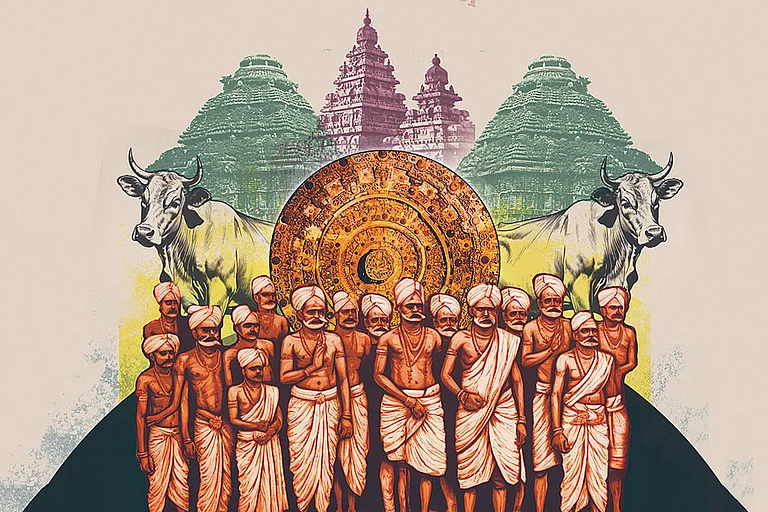
On stage and off it, Vijay frames TVK within a longer Dravidian arc. He references the DMK’s 1967 victory under C.N. Annadurai and the AIADMK’s 1977 triumph under M.G. Ramachandran, arguing both reshaped Tamil Nadu’s politics and relied heavily on youth participation. This addresses criticism that TVK’s leadership is dominated by younger members.
The party’s ideological direction was set at its first state-level conference in October 2024, where he named Periyar, B.R. Ambedkar, K. Kamaraj, Velu Nachiyar (queen of Sivaganga who waged a war against East India Company) and Anjalai Ammal (freedom fighter) as guiding figures. At the same event, he positioned the DMK as TVK’s political opponent and the BJP as its ideological adversary, suggesting little substantive difference between the national parties.
At last year’s anniversary event, Vijay reiterated his claim that public confrontations between the DMK and BJP were staged to create an illusion of opposition. Invoking Tamil Nadu’s self-respect movement, he insisted the state would not compromise on dignity or autonomy.
TVK remains a young party. On 22 January 2026, the Election Commission allotted it the whistle as its election symbol, previously used by actor-politicians such as Prakash Raj in the 2019 Lok Sabha elections and the late actor-comedian Mayilsamy.
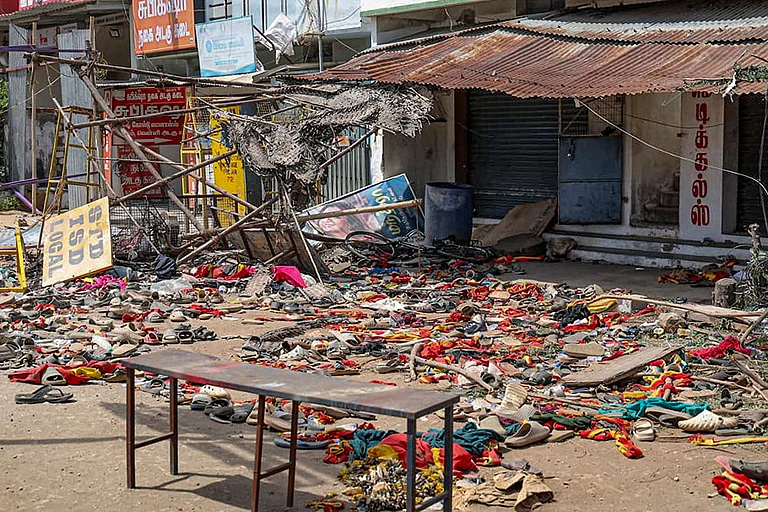
But that hasn’t stopped the party from stirring up controversies. Tamil Nadu had not witnessed a tragedy of this kind in recent political memory in south India. On 27 September 2025, during TVK’s political rally in Karur in central Tamil Nadu, a stampede resulted in the death of at least 41 people and more than 100 injured.
After an initial tweet, his first video message came three days later where he appears contrite, but was unwilling to concede that his presence there was responsible for the tragedy. TVK's refused to take any responsibility and blamed the ruling DMK and the police. His supporters including Aadhavan and Abhilesh, say this too and they believe it’s a law and order problem, placing the blame on DMK.
Around Vijay, a mix of political veterans and crossovers has assembled. N. Anand, known as Bussy Anand, a former MLA from Puducherry and long-time aide, serves as general secretary, overseeing the transition from fan club to party. Veteran AIADMK leader K.A. Sengottaiyan joined in November 2025 as chief coordinator of the high-level administrative committee and organisation secretary for Coimbatore, Erode, Tiruppur and Nilgiris. Nanjil Sampath, a seasoned orator with experience in the DMK, MDMK and AIADMK, followed in December 2025. Aadhav Arjuna, formerly of the VCK, became general secretary for campaign management, while C.T.R. Nirmal Kumar, previously with the AIADMK IT wing, took charge as deputy general secretary for IT and social media. Former DMK MLA S. David Selvin added local organisational experience.
Lessons from the past
Vijay’s rise invites comparisons with earlier actor-politicians. Vijayakant’s DMDK, formed in 2005, secured about 8.5 per cent of the vote in the 2006 Assembly elections and 10.5 per cent in the 2009 Lok Sabha polls. Viewed as an AIADMK spoiler, it joined the party’s alliance in 2011, winning 29 of 40 seats, before its fortunes collapsed to 2.4 per cent in 2016.
N. Ram calls Vijay’s entry significant but uncertain. “He is drawing crowds, but will those crowds convert into votes? And will votes convert into seats?” He argues Vijay lacks a robust political support structure, something the DMK has long exploited through trained cadres and exercises such as the Special Intensive Revision of electoral rolls. The AIADMK, he adds, still commands loyalty rooted in MGR and J. Jayalalithaa.
Ram notes that MGR developed ideological grounding within the DMK before forming his own party, while N.T. Rama Rao demonstrated political shrewdness before launching his. Vijayakant, despite limited success, “was a more serious political figure”: he contested consistently, articulated ideas and earned respect even with a single-digit vote share. Large rallies alone, Ram cautions, do not translate into votes. Vijay must move beyond personality-driven speeches to build collective leadership, clear policies and a coherent manifesto. Whether he can do so, “remains to be seen.”
On the ground, TVK’s promise is tested within families. R. Abilesh, 25, a mechanical engineer from Thanjavur working in Coimbatore, says household politics is shaped by everyday realities. While his grandfather remains a committed DMK supporter, he believes the rest of the family, including his grandmother, will back TVK.
Vijay’s support, though rooted in fan clubs, spans regions and age groups, particularly the young. For Abilesh, Vijay’s entry at the height of his popularity signals an intention to do “something good” for Tamil Nadu. He is drawn by TVK’s emphasis on secular social justice. “The previous parties have spoken the language of ideology but failed to practice it. Corruption has become systemic; funds meant for people often do not reach them, and Tamil Nadu has already given multiple chances to the DMK and AIADMK,” he says. “Voting for them again will repeat the same cycle.”
Giving Vijay a chance, he argues, is not a leap into the unknown. From Naalaya Theerpu to GOAT, Vijay has consistently addressed issues such as women’s rights, corruption, GST and governance, reflecting an understanding of society “beyond performance”. Abilesh does not deny past governments’ achievements, but believes corruption has hollowed them out, alleging that more than half of state funds are diverted before reaching the public.
Supporting TVK, he says, is not blind faith but belief in a new political force. When reminded of the Aam Aadmi Party’s own anti-corruption troubles, he replies: “TVK will work for the people. I have seen him donate money and ensure people had supplies during Covid.” He believes TVK would be open to supporting Congress and the VCK.
Vijay’s political associations, however, have been inconsistent. In August 2011, during the UPA regime, he met anti-corruption activist Anna Hazare at Jantar Mantar during the India Against Corruption protests. That same year, he and his father met J. Jayalalithaa, then AIADMK general secretary, offering the support of Vijay Makkal Iyakkam. In 2010, he met Rahul Gandhi when the DMK was part of the UPA, a meeting the DMK reportedly did not welcome. In April 2014, he met Narendra Modi in Coimbatore. During the 2021 Assembly elections, he cycled to his polling booth, a gesture understood as support for the DMK.
In Chennai, 25-year-old Hemanth Kishore, originally from Madurai, echoes this. A private sector professional and TNVFC member, he attended the Madurai and Vikravandi meetings. Vijay has been a childhood hero, but his support goes beyond cinema.
“We have to give him a chance to prove himself,” he says, arguing that power would allow Vijay to expand his welfare work. From a largely apolitical joint family of 11, Hemanth reflects shifting loyalties: he voted DMK in 2021 and was also influenced by K. Annamalai and the BJP. He has not joined TVK as a cadre but works with TNVFC’s social media team.
Sceptical, yet hopeful
If the young are supportive, some scepticism comes from older observers such as Professor Suresh Dhas, 70, economist and former head of department at Madras Christian College. Living in Chennai but from Kanyakumari, he describes himself as a cynical Leftist who has alternated between mostly AIADMK and DMK and now supports TVK.
In his view, ideological boundaries in Tamil Nadu have collapsed. “RSS is equal to BJP is equal to DMK,” he says. He traces the moment back to 1967, when DMK came to power and C.N. Annadurai became chief minister, evolving from the Justice Party as an upper-middle-class formation, later becoming a cinema party, strategically using stars like M.G. Ramachandran.
While critical of Vijay’s earlier roles, which he describes as misogynistic and lacking values, Dhas sees a political vacuum. Congress MPs are effectively in the pockets of DMK, parties like VCK have been co-opted, and the media ecosystem promotes Stalin uncritically, while CPI(M) is “completely compromised”. “So what is the alternative?” he asks. With no credible Left opposition, ordinary Tamil voters, he believes, have no real choice.
In that context, he sees Vijay as a possible parallel to Naveen Patnaik, who repeatedly won elections until aligning with BJP, which led to decline. Support for TVK, he insists, is not confined to Gen Z; people across age groups want to show solidarity. His frustration extends to economics: airports handed over to Adani Group have left him exasperated. “People are fed up. I am fed up,” he says. TVK offers not certainty but hope.
From the press gallery that hope looks both potent and limited. Senior journalist Kolahala Sreenivas notes almost all TVK supporters are Vijay fans, and doubts there are many beyond this base. “Parents can vote for what their children want,” he adds, highlighting family influence.
His organisation, Kolahalas TV, has tracked support through surveys, the first was in May 2025 and another earlier this year. “These studies reveal a clear urban–rural divide across the state: while northern Chennai shows little backing, areas like Villupuram demonstrate stronger support for TVK, indicating the party’s base is concentrated in certain urban and semi-urban regions.”
The fillip to Vijay's campaign was to begin on January 9 with the release of Jana Nayagan. This was a clever strategy as instead of Vijay getting crowds to the grounds, people would be paying to see Vijay and listen to what he has to say. However, the release has been stalled until the end of April.
On 22 December 2025, the producer was informed that the examining committee had recommended a U/A 16+ certification, subject to certain changes. The producers agreed. Subsequently, the production house was told that the film had been referred to another committee for review.
The production house approached the Madras High Court with a writ petition and obtained a favourable order. However, the CBFC appealed and secured a stay, and the Supreme Court declined to interfere with the interim order. Thereafter, a division bench directed a fresh hearing, following which the production firm chose not to pursue the litigation and instead agreed to a review by the revising committee.
This was a political battle being fought in the court and Vijay's team seemed unprepared for how the battle would shape up. The decision to withdraw the case appeared to be a retreat and now the ball is again in CBFC's court. Vijay's fans await his next move and the movie.
Published At:
Tags