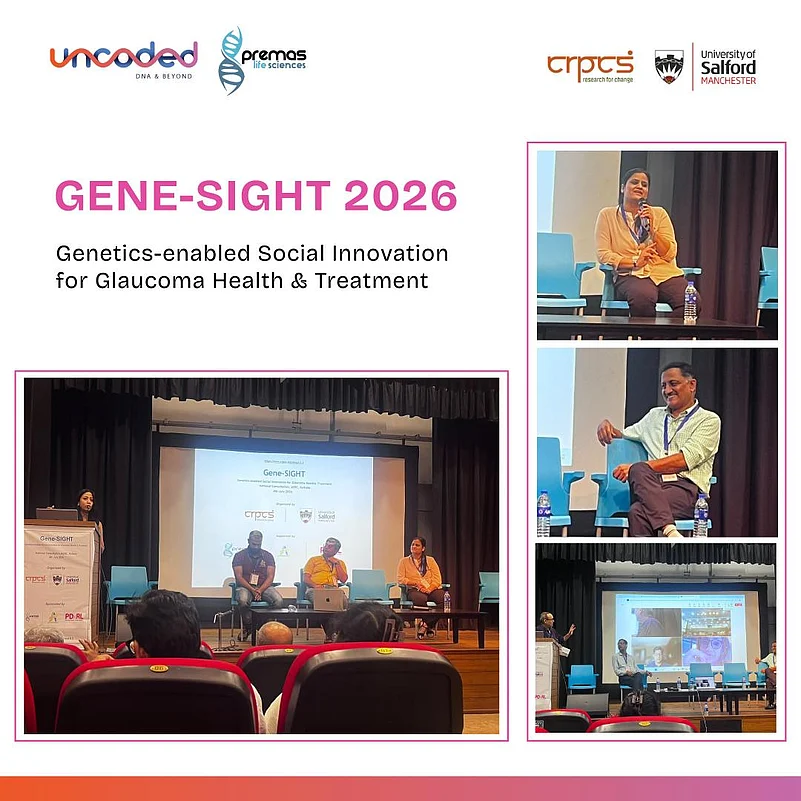
Kolkata, 23 July 2026 — Premas Life Sciences, through its precision genomics brand Uncoded, participated in the Genetics-enabled Social Innovation for Glaucoma Health & Treatment (GENE-SIGHT) programme held on 4th July 2026 at the Amartya Sen Research Centre, Kolkata. The programme convened ophthalmologists, geneticists, researchers, healthcare policymakers, industry leaders, diagnostic laboratories, and patient advocacy groups to explore how genetics can transform glaucoma care through earlier diagnosis, timely intervention, and improved patient accessibility.
The programme consisted of four themed panel discussions, each one informing the others. Premas Life Sciences took active part in two of these four panels. In the first panel academic genetic researchers discussed the strategies they choose to decide which project can lead to a patient benefit translation. In the second panel led by ophthalmologists and clinical glaucoma experts from different parts of India, they deliberated when and how genetics can help them manage their patients better. The third panel was industry focused, and here they actively contributed with two of their members taking part. The panel focused on how industry can solve the scaling problem when translating a project from lab to patients. Experts discussed the need for stronger collaboration between academia, clinicians, diagnostic laboratories, and industry to make genetic testing more affordable, clinically validated, and widely available. The discussion also highlighted the importance of generating robust clinical evidence, improving clinician awareness, standardising testing pathways, and ensuring that genomic technologies can be integrated into routine ophthalmic care, including consideration for often ignored challenges and costs associated with data analysis.
The last panel of the programme titled, "Policy: The Enabling Bridge," explored the policy interventions necessary to accelerate the adoption of genomic medicine. They played a key role in this panel, too. Panelists deliberated on strengthening public-private partnerships, expanding awareness programmes, supporting reimbursement pathways, developing evidence-based clinical guidelines, and creating an ecosystem that enables equitable access to advanced diagnostics across diverse healthcare settings.
A recurring theme across all panels was that glaucoma continues to be one of the leading causes of irreversible blindness, with many patients remaining undiagnosed until significant vision loss has already occurred. The panellists agreed that integrating genetics into clinical decision-making offers an opportunity to shift glaucoma management from a reactive approach to a predictive and preventive model of care, especially for the heritable and aggressive forms of the disease.




Speaking on the clinical significance of genomics in ophthalmology, Prof Arijit Mukhopadhyay, the lead for the GENE-SIGHT project, said:
"Genetic insights are fundamentally changing our understanding of glaucoma. Identifying disease-causing variants before irreversible damage occurs enables clinicians to stratify risk, personalise surveillance, and intervene at a much earlier stage. Precision diagnostics will play a defining role in the future of glaucoma care, both from a patient benefit as well as from a health economy perspective."
Dr. Debjani Saha, AGM – Marketing, Premas Life Sciences, who moderated the Industry panel discussion, emphasized the importance of collaboration in translating innovation into patient benefit.
"Innovation creates impact only when it reaches patients. Achieving that requires meaningful partnerships between researchers, clinicians, diagnostic laboratories, industry, policymakers, and patient advocacy groups. Platforms such as GENE-SIGHT demonstrate how collaborative ecosystems can accelerate the adoption of precision healthcare."
Sharing the industry's perspective, Dr. Rashmi Shukla, Associate Scientist, Premas Life Sciences, highlighted the need for scalable genomic solutions that address real clinical challenges.
"The future of genomic medicine lies in developing targeted, clinically relevant solutions that are practical, accessible, and evidence-driven. Industry has an important responsibility to work alongside healthcare providers to bridge the gap between research and routine patient care while making advanced diagnostics more widely available."
Speaking during the policy discussion, Mr. Praveen Gupta, Managing Director, Premas Life Sciences, stressed that scientific advancement must be accompanied by accessibility and affordability.
"Genomic medicine has reached a point where it can significantly improve patient outcomes, but its true impact will depend on accessibility. Building strong collaborations between healthcare providers, policymakers, industry, and patient organisations will be essential to ensure that precision diagnostics become part of mainstream clinical practice across India."
The programme also highlighted Uncoded, indigenous precision genomics platform, and its focused efforts toward enabling targeted genetic interventions for inherited diseases. Through disease-specific genomic solutions, the brand aims to support clinicians with actionable genetic insights that enable early diagnosis, risk assessment, family screening, and informed treatment decisions.
In glaucoma, the organization is developing targeted genomic solutions designed to identify individuals at increased genetic risk—particularly in paediatric, juvenile, and familial glaucoma—where timely intervention can significantly improve long-term visual outcomes. By combining clinically relevant gene panels with high-quality genomic interpretation, they seeks to make precision diagnostics more accessible and applicable within routine clinical workflows.
The GENE-SIGHT programme concluded with a shared commitment among stakeholders to strengthen collaborations across healthcare, research, policy, and industry to advance genetics-enabled healthcare in India. As genomic technologies continue to reshape ophthalmology, initiatives such as GENE-SIGHT reinforce the importance of early diagnosis, preventive care, and precision medicine in reducing avoidable vision loss.
Through its continued participation in national scientific and policy forums, both the organizations remain committed to advancing accessible genomic innovation and supporting clinicians with precision diagnostics that improve patient outcomes and contribute to the future of preventive ophthalmic healthcare.
The above information does not belong to Outlook India and is not involved in the creation of this article.