Following a strategy meeting at Congress president Mallikarjun Kharge's residence on Saturday, November 28, 2026, INDIA bloc floor leaders decided to jointly oppose the Centre's proposed Constitution (132nd Amendment) Bill linking women's reservation with delimitation ahead of the special Parliament sitting starting November 30.
Kharge alleged that the legislation is aimed at ending democracy and keeping the BJP-RSS in power permanently, while violating Article 330 by using outdated 2011 Census data rather than upcoming Census figures—thereby denying Scheduled Castes and Scheduled Tribes a proportionate increase in reserved seats.
The bloc demanded maintaining the current Lok Sabha strength of 543, implementing the 33 per cent women's quota within the existing House, and freezing inter-state seat allocation for 25 years, even as allies DMK and NCP (SP) skipped the meeting after signalling support for the revised Bill.
INDIA bloc leaders on Saturday decided to jointly oppose the Constitution amendment bill on delimitation-linked women quota in Parliament, terming the move a bid by the BJP-RSS to permanently remain in power and end democracy in the country.
Kharge Accuses BJP-RSS of Bid to End Democracy and Harm SC/ST Interests
Addressing reporters after the two-hour meeting with floor leaders of opposition parties, Congress chief Mallikarjun Kharge claimed that the delimitation bill is against the interests of SCs/STs as they will not get increased seats according to their increased numbers and the bill threatens to "finish democracy".
He said Prime Minister Narendra Modi had earlier given the slogan '400-paar' during last general elections but by getting this bill passed, he intends to achieve the '800-paar' figure to permanently remain in power and alter the Constitution.


"Once the power goes into their hands, they will do anything to use this bill as a weapon to remain in power permanently. We will oppose this bill," Kharge told reporters.
The Congress chief claimed that India will become like China, where they raise hands in thousands to get a majority.
"They want to end democracy and give the government in the hands of the BJP/RSS forever. Manusmriti will be implemented, this is certain," he claimed.
Kharge also said that earlier too, the BJP planned to get this bill through, but failed due to the opposition's joint efforts.
"They are indulging in this 'natak'. We decided to together oppose this bill, as it is not in favour of SC/ST and they intend to finish democracy in the country," he asserted.
Opposition Demands Status Quo on Lok Sabha Strength; Sibal Questions Delimitation
The delimitation bill was discussed at the meeting of floor leaders of the opposition, with the clear demands that the current strength of the Lok Sabha should be maintained, women's reservation should be provided based on the current strength of the Lok Sabha and the current allocation of seats among states in the Lok Sabha should be maintained for the next 25 years.
The opposition leaders met at Leader of Opposition in the Rajya Sabha's residence here and deliberated on a joint strategy in view of the government's imminent move to reintroduce a constitutional amendment bill in Parliament, involving delimitation.
Besides Congress president Kharge, former party chief Rahul Gandhi, TMC's Abhishek Banerjee, Independent Rajya Sabha MP Kapil Sibal, RJD's Abhay Kumar Singh and Manoj Jha, CPI's P Sandosh Kumar, IUML's ET Mohammed Basheer, RSP's NK Premchandran, among others, participated in the meeting.
Congress general secretaries Jairam Ramesh, Priyanka Gandhi Vadra and K C Venugopal, among others, also attended the meeting
While non-INDIA bloc parties such as the DMK, AAP and BJD were also invited for the meeting, they chose to stay away.
"Look, we need to examine this from the perspective of what is going to happen at the national level and what lies ahead. At the national level, if this Bill is passed, the number of Lok Sabha seats could increase to around 850. The first question is whether a House of 850 members can function properly," Sibal said ahead of the meeting.
"But the most serious issue is that their objective is not merely women's reservation. We are ready for women's reservation. They can implement it immediately within the existing 543 seats. So that is not their real objective. Their real objective is to remain in power for the next 30-40 years. And for that, what matters most to them is the Delimitation Bill," he said.
"They will make appointments to the delimitation body in the same way they appointed Gyanesh Kumar to the Election Commission. In other words, another Gyanesh Kumar will be placed in this position. They will decide the boundaries of constituencies in states such as Uttar Pradesh, Haryana and Maharashtra according to their own preferences," he said.
Special Parliament Session to Introduce Constitution (132nd Amendment) Bill
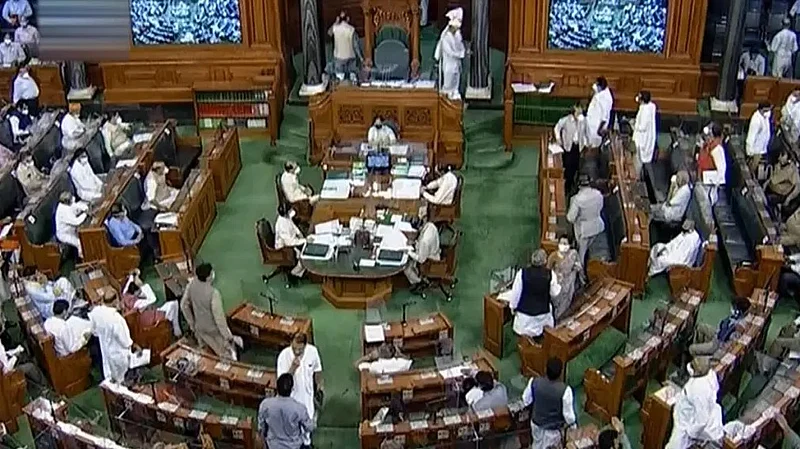
A special sitting of Parliament has been convened from November 30. The Lok Sabha has been reconvened on November 30 and the Rajya Sabha on December 2.
The sittings will conclude on December 3, subject to exigencies of government business.
The Centre is set to introduce a fresh constitutional amendment Bill in the Lok Sabha on Monday to roll out one-third reservation for women by increasing each state and Union territory's seat allocation in the House and the strength of their legislative assemblies by 50 per cent, and freeze the revised allocations and boundaries until 2051.
The Constitution (132nd Amendment) Bill, 2026, slated for introduction in the Lok Sabha on Monday, seeks to raise the House's maximum strength to 850, with up to 815 members from states and 35 from Union territories. It also proposes to raise the ceiling on the size of a state Assembly from 500 to 650.
The objective of the present Bill is to give immediate effect to one-third reservation for women, including women belonging to the Scheduled Castes and the Scheduled Tribes, in the House of the People and the Legislative Assemblies of the States and the Union territories, through a delimitation exercise, the Bill's Statement of Objects and Reasons says.
It says the exercise shall provide for an increase of 50 per cent, in the number of seats in the House of the People and the Legislative Assemblies of the States and Union territories, over and above the number of seats existing immediately before such delimitation.
Shifting Political Alliances and the Numbers Game in Lok Sabha
On April 17, the earlier constitutional amendment Bill fell 54 votes short of the required two-thirds majority in Lok Sabha, with 298 MPs voting in favour and 230 against. The government did not proceed with the accompanying bills.
The opposition has undergone a churn since then.
Twenty Trinamool Congress MPs broke away in June and announced their merger with the NDA-supporting Nationalist Citizens Party of India (NCPI).
Disqualification proceedings against them are pending before Lok Sabha Speaker Om Birla.
The NCP (Sharadchandra Pawar), which has eight MPs and opposed the April Bill, said on Friday that it would back the fresh proposal if it provided for a uniform 50 per cent increase.
The DMK, with 22 MPs, has also backed the bill.
The BJP is confident of securing the required two-thirds majority, banking on the Trinamool rebels and support from some other parties that opposed the Bill in April.
The Lok Sabha has 540 sitting members and three vacancies. If Trinamool MP Kalyan Banerjee's suspension remains in force, 539 members, including the Speaker, can attend the proceedings.
The Bill would need 359 votes if all 538 members other than the Speaker vote. Absent members would lower the two-thirds threshold.