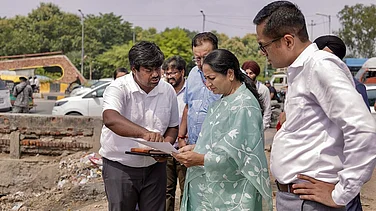
Bhagwant Mann said he does not favour FIRs against farmers over paddy stubble burning.
Punjab farmers are demanding a Rs 3,000-per-acre incentive for managing paddy residue.
Punjab recorded 5,114 stubble-burning incidents in 2025, an 86 per cent fall from 2023.
Punjab Chief Minister Bhagwant Mann has said he does not favour filing FIRs against farmers for stubble burning and called for a cash incentive for paddy growers who manage crop residue without burning it, days before the paddy harvesting season begins in the state.
Mann made the remarks on Friday after inaugurating the two-day Kisan Mela of Punjab Agricultural University (PAU), as farmers prepare to harvest paddy. Paddy growers have been demanding a cash incentive of Rs 3,000 per acre for managing stubble. Stubble burning in Punjab and Haryana is often blamed for increased air pollution in the Delhi-NCR region. Due to the short window for sowing the Rabi crop after the paddy harvest in October and November, many farmers burn their fields to quickly clear the crop residue.
According to PTI, Mann said Punjab farmers were being blamed for spreading air pollution in Delhi through paddy straw burning and questioned whether emissions from other states were also being taken into account.
"The Centre says Punjab has contributed 180 lakh metric tonnes of paddy to the central pool. But they (Centre) do not consider how much of that stubble comes from the 180 lakh MT. They (Centre) suggest registering FIRs," Mann said.
Mann said he had conveyed to the Centre that farmers did not want to burn paddy stubble because the smoke affects them directly. He reiterated that farmers should instead receive financial incentives for managing their crop residue.

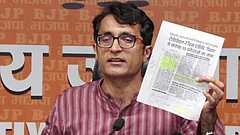


Mann Questions Focus On Punjab
Mann also referred to Maryam Nawaz, chief minister of Pakistan's Punjab province, saying she had told him that she would write to him about smoke affecting Lahore.
"Is it only our smoke in the air? Do the emissions from Haryana and Uttar Pradesh not contribute? They are merely trying to defame Punjab," he asked, expressing displeasure at the blame directed towards Punjab for air pollution.
Mann also spoke about the filing of FIRs against farmers for stubble burning.
"Parcha purcha tan dil nahin karda yaar, ein andante te parcha kiven kar daange, par lor hi na pave us hisab naal kar liyo. (I do not feel like registering FIRs against farmers. How can FIRs be filed against them?)," he asked.
Reported PTI, farmer leaders in Punjab linked Mann's recent remarks on stubble burning to the upcoming assembly elections and called on the state government to withdraw FIRs already registered against farmers.
Bharti Kisan Union (Ekta Ugrahan) general secretary Sukhdev Singh Kokrikalan urged the government to first cancel FIRs already registered against farmers for stubble burning. He also suggested that Mann's remarks were politically motivated given the approaching assembly elections.
BKU (Lakhowal) leader Harinder Singh Lakhowal also called for the government to provide cash incentives to farmers for managing stubble burning.
FIRs And Penalties For Stubble Burning
PTI reported that FIRs are filed every year against farmers who engage in stubble burning under Section 223 of the Bharatiya Nyaya Sanhita (BNS), relating to disobedience of an order promulgated by a public servant.
Those found guilty face fines as environmental compensation, while a "red entry" is noted in revenue records. Such an entry can prevent farmers from obtaining loans or selling their farmland.
The issue is linked to the short window available to farmers to sow the Rabi crop, particularly wheat, after the paddy harvest in October and November. Burning allows farmers to clear crop residue quickly before preparing their fields for the next crop.
Punjab Records Decline In Farm Fires
Punjab recorded an 86 per cent reduction in stubble fire incidents between 2023 and 2025. The number of incidents fell from 36,663 in 2023 to 10,909 in 2024 and then to 5,114 in 2025.
The state recorded 49,922 farm fire events in 2022, 71,304 in 2021, 76,590 in 2020, 55,210 in 2019 and 50,590 in 2018. Districts including Sangrur, Mansa, Bathinda and Amritsar have witnessed a large number of stubble-burning incidents.
The state government runs awareness campaigns at the village and block levels to educate farmers about the dangers of burning paddy straw.
Subsidised Machinery For Stubble Management
According to PTI, Punjab also makes crop residue management machinery available to farmers on subsidy under in-situ and ex-situ management methods.
Under the in-situ method, which involves mixing crop residue into the soil, machinery includes super seeders, smart seeders, happy seeders, paddy straw choppers, shredders, mulchers, hydraulic reversible mould board ploughs and zero-till drills.
Under the ex-situ method, which involves using stubble as fuel, balers and rakes are made available.
Individual farmers receive a subsidy of 50 per cent of the cost of the equipment, while cooperative societies and panchayats receive an 80 per cent subsidy.
The measures come as Punjab approaches the paddy harvesting season, with Mann calling for financial incentives for farmers who manage crop residue instead of burning it.