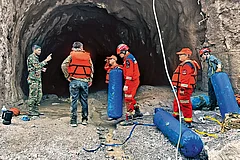
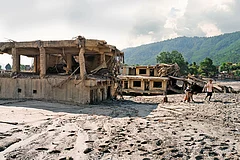
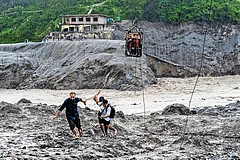
Images of workers rescued 10 days after the tunnel collapsed in Nepal sends cheer amidst the gloom. The death toll from the disaster in Nepal continues to rise as rescue operations to save those still trapped beneath the debris and floodwaters carry on. Once again, the Himalayan nation has been struck by a natural calamity with devastating human and economic consequences. The massive flood and debris flow that thundered down the Trishuli River valley near the Nepal-China border obliterated settlements, roads, hydropower infrastructure and critical trade links. Among the worst affected is Syabrubesi in Nepal’s Rasuwa district—a key gateway to Langtang and an important node connecting Nepal with China—which was virtually wiped out within hours.
The devastation that swept across Nepal and the Tibetan Autonomous Region has been one of the worst natural calamities since the 2015 earthquake. The speeding floodwater and slush have washed away people nearly 250 km away. Over 1,300 are confirmed dead and more than 5,000 people are still missing.
Although scientists are still investigating the precise sequence of events that triggered the disaster in Nepal on the morning of August 26, the broader context in which it occurred is neither new nor unexpected. The tragedy is a stark reminder of the growing vulnerability of the Himalayan region to cascading environmental risks.


Despite warnings of the Himalayas becoming one of the world’s most fragile mountain ecosystems, urbanisation and development leading to deforestation, unplanned infrastructure and extended road construction have combined to heighten disaster risks across the region. Every Himalayan nation has experienced the changing hydrological systems that have sustained hundreds of millions of people downstream and is now discernibly disrupted with lower volumes comparatively, too.
The disaster also exposes the limitations of existing disaster-risk management frameworks in the Himalayan region. Despite advances in remote sensing, satellite monitoring and early-warning technologies, significant gaps remain in transboundary data sharing, real-time monitoring of glacial lakes and coordinated emergency response mechanisms. But unfortunately, disaster governance in the Himalayas remains largely fragmented along national lines.
The priority should be towards the creation of a permanent architecture for transboundary disaster-risk reduction.
While Nepal’s army and police, and disaster agencies rushed into the unfolding situation, Nepal needed specialised rescue expertise, equipment, financial aid and relief supplies from abroad. Apart from major multilateral responders from the United agencies, including the United Nations Development Programme, United Nations Children’s Fund and the World Health Organisation who were forthcoming; India sent technical and medical teams, forensic experts and relief materials; China provided relief supplies and financial assistance, alongside engineers and have been supporting the cross-border rescue efforts. The United Kingdom, the United States, South Korea and Australia and a few others have also been forthcoming in supporting the rescue efforts.
The question that stares us in the face now is this: while neighbours and extra-regional powers have lent their expertise and resources to deal with the immediate crisis, why is it that states—both upper and lower riparians—so often lack an established structure of communication for precisely such eventualities? Even the sharing of basic hydrological and water-flow data has remained difficult between neighbours, despite the fact that rivers, floods and ecological systems pay little heed to political boundaries.
This gap becomes even more troubling when the Nepal disaster is viewed against the backdrop of a changing Himalayan climate. The catastrophe was not an entirely unforeseen event. Several factors like rising temperatures, accelerated glacial retreat, destabilisation of mountain slopes, changing precipitation patterns, among others, have been altering the region’s risk profile for years. What is increasingly apparent is that in the Himalayas, a hazard originating in one part of a river basin can rapidly become a crisis several hundred kilometres downstream. Regional mechanisms remain largely reactive rather than preventive. Countries tend to cooperate after a disaster, when the humanitarian imperative becomes unavoidable.
Upstream glacial activity, landslides, sudden changes in river discharge or the collapse of natural dams can have immediate consequences downstream. Conversely, downstream states possess hydrological and meteorological information that can contribute to a broader understanding of basin-wide risks. The security of one is therefore increasingly inseparable from the ecological security of the other, making it necessary measures to establish effective measures before disaster strikes.
The floods in Nepal is a warning about the inadequacy of existing regional institutions. The priority should not simply be confined to improving relief operations after a catastrophe, but towards the creation of a permanent architecture for transboundary disaster-risk reduction. This could begin with real-time sharing of river and rainfall data, joint monitoring of glaciers and vulnerable slopes, common early-warning protocols and designated communication channels between disaster-management authorities.
Larger Lessons from Nepal
The larger lesson from Nepal, therefore, is that the Himalayas cannot continue to be governed as a collection of national territories when their greatest emerging risks are inherently transboundary. The region needs to move from post-disaster cooperation to pre-disaster engagement. Such cooperation cannot await the resolution of larger political disputes. Water data and disaster warnings can be treated as instruments of humanitarian necessity rather than political concession.
The world is witnessing intense geopolitical competition but the imperative to understand nature and to work with it together has never been stronger. The several regional platforms have to go beyond political, economic, and security, towards sharing and exchange of knowledge, best practices, technological innovations, and scientific assessments of climate change. Ensuring the participation of the geographical, financial and technological advantaged to share with the vulnerable is the real challenge ahead. While there is no ambiguity over environmental cooperation being a prerequisite for ensuring a safer world, how can the reluctant powers be brought to the discussion table? Institutional structures should be in place to provide cooperation over life-saving information even when broader bilateral relations are strained. Natural disasters are inevitable but global and regional measures for prevention, mitigation and management need urgent attention to temper the consequences.
(Views expressed are personal)
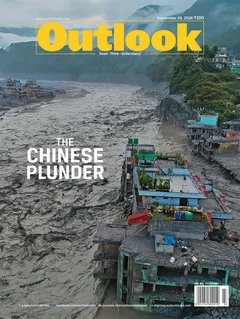
MORE FROM THIS ISSUE

Sreeradha Datta teaches international affairs at O.P. Jindal Global University. She is a non-resident SNR. Fellow with Institute of South Asian Studies, National University of Singapore