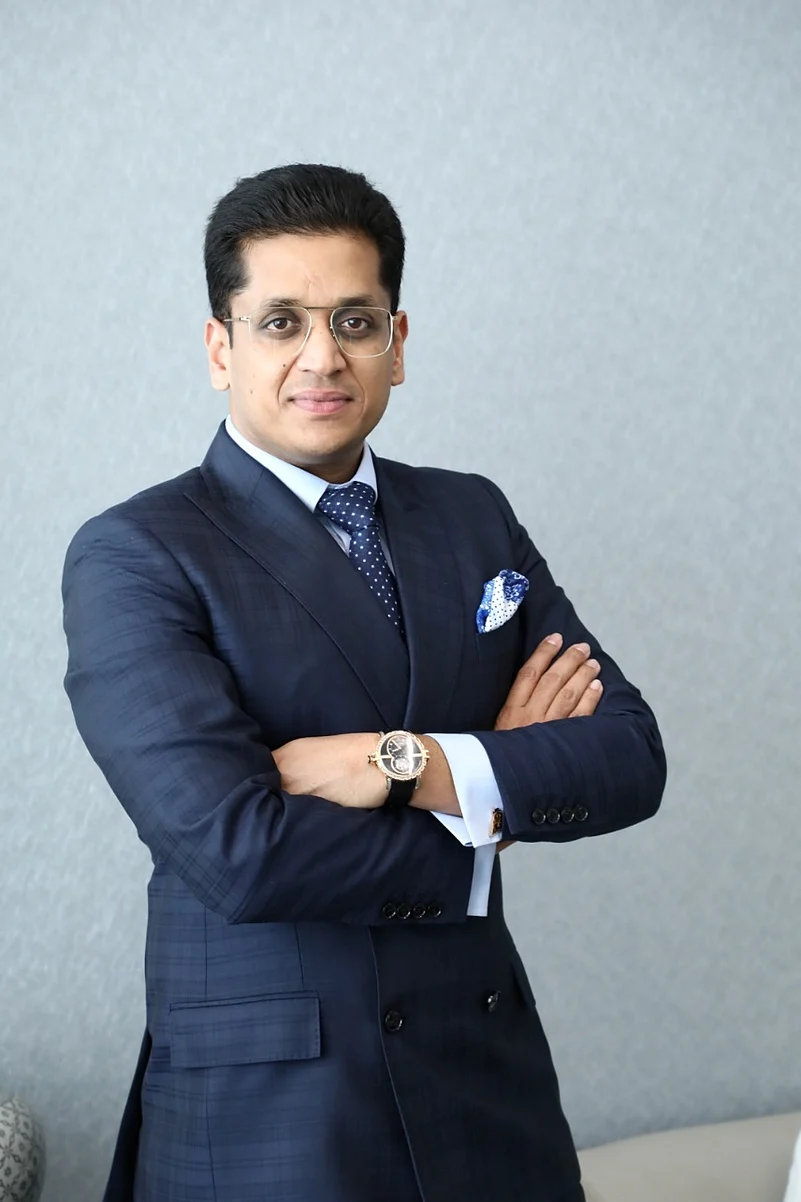
Pankaj Bansal leads M3M India and Smartworld Developers, two real estate companies with a significant presence across the NCR. Together, the businesses have delivered over 30.6 million sq. ft. across 34 projects, including more than 14,000 homes, while another 57.2 million sq. ft. is under development across 40 ongoing projects. Backed by a combined Gross Development Value (GDV) of over ₹1,28,731 crore, a fully paid land bank of more than 3,000 acres and a planned investment of approximately ₹10,000 crore during FY27, the Group continues to expand its residential and commercial portfolio. The Group remains net debt-free, is 100% promoter-owned, and holds an investment-grade rating, reflecting its strong financial discipline and long-term growth strategy. Under Bansal's leadership, the Group has strengthened India's branded residences segment through partnerships with The Trump Organization, Jacob & Co. and ELIE SAAB, building India's largest branded residences portfolio spanning nearly 6.9 million sq. ft. The company estimates that each project generates employment for around 5,000 people during construction, while its CSR initiatives continue to support education, healthcare and skill development in local communities.
For decades, India's most successful real estate companies were measured by land bank size, speed of expansion or footprint across cities. A new breed of entrepreneurs is redefining that yardstick, less concerned with developing projects than building long-lasting institutions contributing to India’s economic and urban transformation.
Amongst this cohort is Pankaj Bansal, Promoter of M3M India, whose leadership style is rooted in an India-first philosophy of disciplined growth, institution building and financial prudence than rapid geographic expansion or public market valuations. As India enters what many call its most defining urbanisation cycle, leaders like Bansal are shaping not just skylines but the economic ecosystems around them.




The Indian real estate sector has changed remarkably over the past decade, with regulatory reform, institutional capital and rising consumer expectations shifting the industry's focus from aggressive expansion toward governance, execution and financial sustainability. Bansal represents this shift well. Rather than chasing the fastest route to size or a stock market listing, he has built one of India's largest privately held real estate developers on a foundation of financial discipline, focused execution and a clear-eyed India-first vision, coming to represent a generation of entrepreneurs who see themselves as builders of institutions first and developers of projects second.
Where many developers chased growth by expanding across geographies, Bansal chose depth over breadth. He has kept the company's focus firmly on the National Capital Region, a decision that has allowed M3M to build deep market expertise rather than spread itself thin. That conviction has paid off. The company has delivered over 30.6 million sq. ft. across 34 projects, including more than 14,000 homes, while another 57.2 million sq. ft. is under development across 40 ongoing projects. M3M has recorded the highest residential delivery volume in the NCR for three consecutive years running, a track record that reflects not opportunism but consistency.
What distinguishes Bansal's leadership is his ability to combine entrepreneurial speed with institutional rigour. Real estate is a sector where market cycles turn quickly but development timelines stretch over years, and the ability to make fast, decisive calls on land acquisition, product design and partnerships is a genuine competitive edge. Under his stewardship, M3M has paired that founder-led agility with structured governance and professional management, building the kind of organisation that can scale without losing the instincts that built it.
Perhaps the clearest marker of Bansal's long-term thinking is M3M's balance sheet. In a sector long accustomed to funding expansion through debt-fuelled land banking, M3M has systematically reduced liabilities over the past two years to arrive at a net zero-debt position. That discipline has not slowed the company down; it has funded it. The recently announced ₹10,000 crore FY27 investment programme for construction and land acquisition is being financed entirely through internal accruals rather than fresh borrowing, giving M3M the flexibility to expand through market cycles on its own terms.
Bansal's India-first approach has not stopped him from thinking globally. Under his leadership, M3M has built partnerships with some of the world's most recognised luxury names, including The Trump Organization, Jacob & Co. and ELIE SAAB, to create India's largest branded residences portfolio, spanning nearly 6.9 million sq. ft. with a revenue potential exceeding ₹20,000 crore. M3M also holds the largest portfolio of Trump-branded residences anywhere outside the United States. The scale of this ambition is most visible in The Billionaire's Block at Smart City Delhi Airport in Sector 111, Gurugram, anchored by M3M Residences by ELIE SAAB, part of a broader ₹3,500 crore investment that the company positions as the world's first integrated ultra-luxury district built exclusively for billionaires.
For Bansal, real estate has never been only about individual projects. The scale of M3M's ongoing development activity, spanning residential, retail, office and destination commercial formats across the NCR, has made the company a meaningful generator of employment, from construction and skilled trades to sales, design and facilities management.
With a fully paid land bank of more than 3,000 acres, of which only about a quarter has been utilised so far, that contribution to the region's economic activity is set to continue well into the next decade. It is this connection between private enterprise and public benefit, jobs created, urban infrastructure built, city districts shaped, that positions Bansal as a city builder in the truest sense, and not simply a real estate developer.
Despite the scale M3M has achieved, Bansal has been clear that the company has no immediate plans to go public. It is a deliberate choice rather than a limitation. Public listings have long been treated as the definitive marker of corporate maturity in India, but Bansal's own trajectory suggests otherwise: that institutional scale, credibility and governance can be built just as effectively outside the public markets, through disciplined capital allocation and consistent delivery.
Moreover, staying private has given M3M the flexibility to make long-term bets, on branded residences, on integrated urban districts, on new city geographies like Noida, without the short-term pressures that public markets often impose. For Bansal, that flexibility is not a reason to slow down; if anything, it is what has allowed M3M to keep investing in India's growth story on his own terms.
Pankaj Bansal's story is emblematic of a broader change taking shape across Indian business: entrepreneurs who measure success not by how quickly they can scale or list, but by how durably they can build. As M3M evolves from a real estate developer into what the company describes as a global lifestyle enterprise, spanning hospitality, destination retail and integrated urban ecosystems, Bansal's own journey offers a template for what modern Indian leadership can look like: India-first in vision, founder-led in mindset, and institutional in ambition.