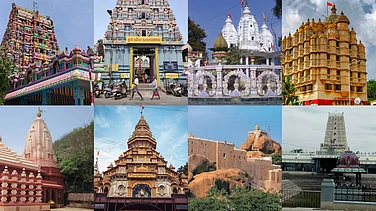
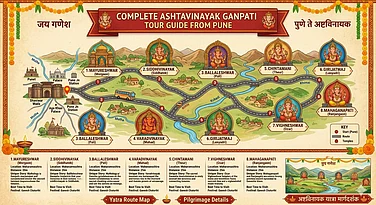
Ask someone from Mumbai what Ganesh Chaturthi looks like, and they'll talk about towering idols, drum processions, and streets so packed you can barely move. Ask someone from Goa, and you'll hear about home-grown clay idols, wooden canopies decked with garden produce, and quiet family rituals that stretch across generations. Ask someone from Karnataka, and the conversation shifts to Gowri Habba, twenty-one sacred leaves, and a very different rhythm altogether.
That's the beauty of Ganesh Chaturthi: it's technically one festival, but it wears a different outfit in almost every state it touches. As we head into Ganesh Chaturthi 2026, here's a look at how this festival transforms as it travels across India.
Maharashtra: The Undisputed Epicentre

If Ganesh Chaturthi has a hometown, it's Maharashtra. The festival here isn't just religious; it's civic, cultural, and deeply tied to history. The tradition of Sarvajanik Ganeshotsav, or community Ganesh festival, was popularised by freedom fighter Lokmanya Tilak as a way to unite people during the freedom struggle, turning what was once a private, home-based ritual into a massive public celebration.
That legacy is still visible today. Mumbai alone hosts over 12,000 public pandals, with the Lalbaugcha Raja idol drawing millions of devotees for darshan every year. Pune isn't far behind; the city that is considered the birthplace of public Ganeshotsav is home to the revered Dagdusheth Halwai Ganpati and the Kasba Ganpati, considered the presiding deity of the city.

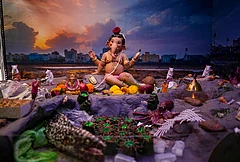
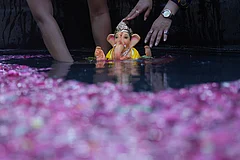

What makes Maharashtra's celebration distinct is the sheer scale of community participation, elaborate pandals, competitive drum-and-dance troupes called dhol-tasha pathaks, and immersion processions (visarjan) that can stretch on for over 24 hours in cities like Mumbai. Modak, of course, remains the star of the prasad table, alongside puran poli and other festive sweets.
Karnataka: Gowri Habba and the Quiet Grandeur
In Karnataka, the festival goes by a couple of different names, Ganesh Habba or Vinayaka Chaturthi, and it comes with its own build-up. A day before, families celebrate Gowri Habba, honouring Goddess Gauri, Ganesha's mother, welcoming her home before her son arrives the next day.
A distinctive ritual here is Patra Pooja, where the deity is worshipped with twenty-one different types of leaves, each carrying its own medicinal and symbolic significance. On the food front, households prepare kadle kai unde (a groundnut jaggery laddoo), karigadubu (a fried, coconut-jaggery-filled sweet), and payasam, alongside the more universally known modak.
Cities like Bengaluru and Mysuru host lively cultural programmes, bhajans, aartis, and community gatherings, while temple towns like Idagunji, home to an ancient Ganesha temple, become pilgrimage points during the season. Compared to Maharashtra's high-decibel street processions, Karnataka's celebrations tend to feel a little more devotional and home-centred, even in the bigger cities.
Goa: A Festival Rooted in Nature
Goa's Ganesh Chaturthi, locally called Chavath (also spelt Chovoth), might be the most nature-driven version of this festival anywhere in India. Families traditionally shape their own clay idols at home rather than buying ready-made ones, keeping the celebration deeply personal and eco-friendly by default.
The most distinctive feature of a Goan Chaturthi is the Matoli, a wooden canopy suspended above the Ganesha idol, decorated with an array of seasonal fruits, vegetables, leaves, seeds, and herbs from the family's own garden or the surrounding countryside. It's essentially a celebration of local biodiversity, built right into the puja setup.
There's also a strong harvest connection; on the second day of the festival, families offer Nave, the season's first paddy harvest, to Ganesha, tying the festival closely to Goa's agricultural calendar. Traditional sweets like neuri (a coconut-jaggery stuffed pastry) and patoleo (rice flour parcels steamed in turmeric leaves) dominate the festive kitchen, and folk performances like Dashavatar bring villages together in the evenings. Celebrations in Goa are also notably shorter and quieter compared to Maharashtra's multi-day, high-energy street festivities, with a strong emphasis on family and community rather than spectacle.
Andhra Pradesh and Telangana: Grand Idols, Grander Devotion
Known here as Vinayaka Chavithi, the festival takes on a scale of its own in these two states. Hyderabad's Khairatabad Ganesh idol has become something of a spectacle in itself — a towering clay structure that's grown to enormous heights over the years, drawing crowds purely to witness its construction and immersion.
Households typically worship two forms simultaneously, a clay idol known as Matti Vinayakudu and a turmeric idol called Siddhi Vinayakudu, reflecting a blend of earthy and symbolic devotion. The immersion day, called Vinayaka Nimajjanam, turns into a massive public event, with processions winding through the city toward lakes for the final farewell. Kanipakam, a temple town in the region, holds a 21-day Brahmotsavam that draws devotees from across the state, adding yet another unique regional layer to the celebrations.
Tamil Nadu: Simplicity Over Spectacle
Referred to as Vinayaka Chaturthi or Pillaiyar Chaturthi, the Tamil Nadu celebration leans toward quiet devotion rather than grand public displays. Clay idols are installed both at home and in temples, particularly at neighbourhood Pillayar shrines, and mornings during the festival often echo with the chanting of Vinayaka Suprabhatam.
The signature offering here is kozhukattai, steamed rice flour dumplings filled with jaggery and coconut, believed to be one of Ganesha's favourite foods (essentially a South Indian cousin of the modak). While public pandals do exist and add some festive grandeur, especially in cities, the overall tone of the celebration remains far more understated compared to states like Maharashtra or Andhra Pradesh.
Beyond the Big Four: How Other States Celebrate
Ganesh Chaturthi's reach doesn't stop at these four states; its footprint stretches across much of India, even in regions where it isn't the primary festival.
Gujarat observes the festival with devotion, though on a comparatively smaller scale, with home pujas and community gatherings rather than large public processions.
Delhi, being a cultural melting pot, sees a mix of traditions; some neighbourhoods put up large idols and elaborate pandals, while others prefer smaller, ritual-focused celebrations centred on Vedic chants and community gatherings.
West Bengal, where Durga Puja understandably takes centre stage, still sees Ganesh Chaturthi celebrated in households, schools, and art institutions, often observed by students and artists seeking Ganesha's blessings as the deity of wisdom and creativity. Interestingly, some Bengali-style celebrations swap out modak for traditional sweets like sandesh, blending the festival's rituals with local culinary identity.
Why the Regional Differences Matter
It would be easy to assume that Ganesh Chaturthi is simply "bigger" in some states and "smaller" in others, but that framing misses the point. What's really happening is that each region has folded the festival into its own cultural fabric: Goa ties it to harvest and biodiversity, Karnataka wraps it around maternal reverence through Gowri Habba, Andhra Pradesh scales it into architectural spectacle, and Maharashtra turns it into a citywide civic event rooted in historical memory.
None of these versions is more "authentic" than the other. They're simply proof of how a single festival, when it travels across a culturally diverse country like India, doesn't dilute; it multiplies into dozens of meaningful, locally rooted expressions of the same devotion.
Celebrating Ganesh Chaturthi 2026, Wherever You Are
Whether you're joining a massive street procession in Mumbai, setting up a Matoli in a Goan home, offering twenty-one leaves in a Karnataka household, or preparing kozhukattai quietly in a Tamil Nadu kitchen, the underlying sentiment remains unchanged, welcoming Ganesha as an honoured guest and bidding him farewell with the hope that he takes life's obstacles along with him.
As Ganesh Chaturthi 2026 approaches, it's worth remembering that the festival's real richness doesn't lie in choosing one region's version as the "correct" one; it lies in appreciating just how many beautiful ways there are to say the same thing: Ganpati Bappa Morya.