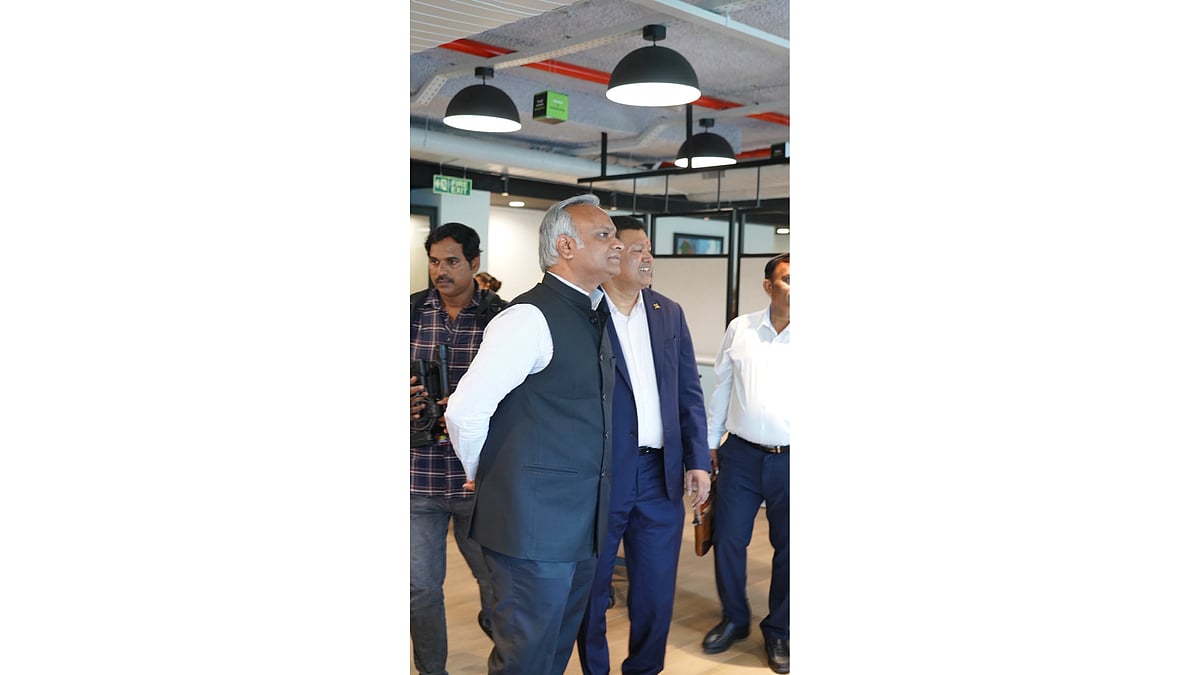
Karnataka Minister for Home, IT & BT and E-Governance Priyank Kharge today called upon industry leaders to partner with the state government in building Mangaluru into a major technology and economic growth centre, emphasising that the city has the potential to play a pivotal role in bridging Karnataka’s regional development gap.
Speaking at the inauguration of Deloitte’s 27th office in India, in Mangaluru, the Minister highlighted that Dakshina Kannada is Karnataka’s second-largest district contributor to the state’s Gross Domestic Product (GDP) after Bengaluru, accounting for 5.3 per cent of the state’s GDP. He said this economic strength, coupled with the region’s talent pool, educational institutions and quality of life, positions Mangaluru as a key driver of Karnataka’s next phase of growth.
“Mangaluru has tremendous potential to emerge as a major economic growth centre for Karnataka. Our objective through Beyond Bengaluru is to take opportunities to where talent already exists, rather than expecting talent to move to Bengaluru. We want businesses to recognise the potential of our regional cities and partner with us in building strong economic ecosystems,” the Minister said.
Acknowledging Deloitte’s decision to establish its presence in Mangaluru, Kharge said the investment was an important example of the kind of industry participation the government seeks to encourage through its Beyond Bengaluru vision.
“I want to particularly acknowledge Romal Shetty and the entire Deloitte team for making this happen. This is precisely the kind of industry partnership and commitment that the government’s Beyond Bengaluru policy seeks to encourage. I think Mangaluru has tremendous potential, and initiatives such as this will help unlock opportunities for the region. I would like to thank Romal and the entire Deloitte team,” he said.


Beyond Bengaluru: Taking Growth To The Regions
Highlighting the government’s Beyond Bengaluru strategy, Kharge said the state was working towards creating multiple economic growth centres by leveraging the strengths and capabilities of different regions.
He referred to the recent Karnataka Cabinet meeting in Mangaluru, held for the first time in the city’s history, where key growth opportunities for the region were identified and approximately ₹6,000 crore was committed towards its development.
The Minister also highlighted the Local Economy Acceleration Programme (LEAP), which seeks to accelerate regional economic development by identifying local strengths, enabling investments and creating employment opportunities.
“Mangaluru has an extremely agile talent pool, supported by some of the country’s finest educational institutions. It also offers a quality of life that is difficult to replicate elsewhere. I know of a Danish team from software firm EG that surfs at Sasihithlu beach in the morning and comes back to work at its office. Which other city has this advantage? These are the strengths we must build on,” he said.
He also pointed to the growing pressure on Bengaluru, noting that Karnataka attracts the highest number of migrants in the country. Developing other urban centres with strong employment opportunities, he said, would help distribute economic activity more evenly across the state.
Industry Partnerships To Drive Skilling And Employment
Emphasising the importance of industry participation in building a future-ready workforce, the Minister said Karnataka was implementing several skilling initiatives in partnership with industry, with companies contributing to curriculum design and ensuring that training remains aligned with emerging industry requirements.
He called upon companies such as Deloitte to work with educational institutions and the government to create industry-ready talent within the region.
“Why should a student studying in Mangaluru not be equipped to work with a company like Deloitte? This is a low-hanging fruit that industry and government can achieve together. We need to ensure that the talent coming out of our institutions is ready for the opportunities being created here,” he said.
Kharge also proposed exploring the establishment of a Centre of Excellence in Mangaluru, potentially focusing on health sciences, given the region’s established strength in healthcare and health services.
Strengthening The Startup Ecosystem
The Minister highlighted Karnataka’s flagship ELEVATE programme, which provides eligible startups with equity-free grants of up to ₹1 crore, and encouraged entrepreneurs from the region to leverage the programme to build and scale their ventures.
He also outlined the government’s regulatory sandbox initiative, which enables startups developing solutions to public-sector challenges, including urban mobility, to pilot their innovations in partnership with the government.
Under the initiative, successful pilots can be scaled across Karnataka and potentially taken to other states. The programme has already seen 16 startups enrol, with the government aiming to increase participation to 100 startups.
Reiterating the government’s commitment to regional development, Kharge assured industry leaders of its full support in facilitating investments, strengthening the talent ecosystem and creating new opportunities for businesses in coastal Karnataka.
“The next phase of Karnataka’s growth must come from our regions. We want businesses to see the opportunities beyond Bengaluru and partner with us in building strong, sustainable economic ecosystems across the state,” he said.