The Kerala Assembly Elections 2026 will be held on April 9, 2026, in a single phase, with counting of votes scheduled for May 4, 2026.
This assembly election is a though challenge for Pinarayi Vijayan and the CPIM.
Pinarayi's Pragmatism has often preceded ideology.
Red Eyes: A Decade Of Left Rule In Kerala
Pragmatism has often preceded ideology in Chief Minister Pinarayi Vijayan’s decision-making in Left-ruled Kerala

Summary
In 2018, when the Supreme Court pronounced its judgement allowing women of all ages to enter the Sabarimala Temple, the Communist Party of India (Marxist), then the ruling party in Kerala, saw in it an opportunity to firmly oppose what it viewed as rising conservatism in society. At a public meeting in Thiruvananthapuram, Chief Minister Pinarayi Vijayan declared that the government would implement the court’s order and help women who wished to visit the shrine. “We won’t change our stance even if we are defeated in the election. Our stand is for social renaissance, and that won’t change for a few votes,” he said, positioning himself at the forefront of the battle for gender justice at a time when most political parties and influential caste groups opposed the verdict.
Eight years on, however, that combative stance appears to have softened. After facing electoral setbacks, the Left government adopted a markedly different position, informing the Supreme Court—which is considering review petitions on the issue—that matters relating to faith should be addressed in consultation with religious leaders. In effect, critics argue, this marked a significant departure from its earlier, unequivocal stand. The Congress and the BJP ridiculed the government for making a U-turn and ultimately converging with the position they had taken when the verdict was delivered.
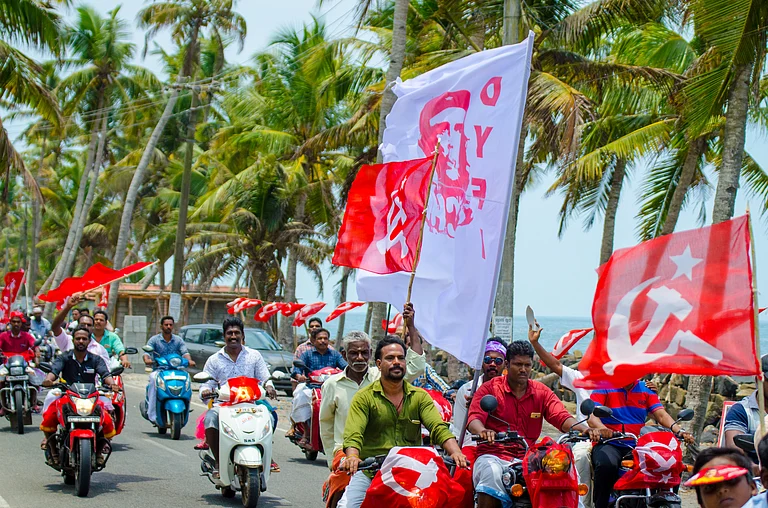
Those familiar with Pinarayi’s politics say, “There is no surprise in this. He is a pragmatist to the core—he takes positions as long as they serve the party’s electoral interests,” says a journalist who has closely observed him.
In the run-up to the 2016 Assembly election, Pinarayi met a few senior journalists separately at his flat near the party headquarters in Thiruvananthapuram. The 2016 election was crucial for the party for two reasons. First, the CPI(M) was out of power in Kerala, and a victory was essential to retain its relevance on the national electoral map. Second—and perhaps more importantly for the party—the election signalled the return of Pinarayi to parliamentary politics after nearly two decades. He had decided to enter the fray.
Yet, there was palpable confusion among Left sympathisers over who would helm the government in the event of a victory. The uncertainty stemmed from the presence of the popular leader and former Chief Minister, the communist veteran V. S. Achuthanandan, who was also contesting. Some within the party were even signalling that V.S. could be projected to lead if the Left won. Television studios and newspaper columns were abuzz with speculation over who would ultimately take charge. During one of those informal interactions, a senior journalist asked Pinarayi whether there would be confusion over leadership if the Left won. The journalist still recalls the reply as cryptic yet firm: “There won’t be any confusion for the party.” It was a pointed answer—suggesting that he would be the one to lead. That decisiveness, even in the face of apparent uncertainty, has come to define the past decade of Pinarayi’s rule in Kerala. That resolve has shifted only when pragmatism appeared to better serve the political objective—as seen in the case of the Sabarimala Temple.
Advertisement
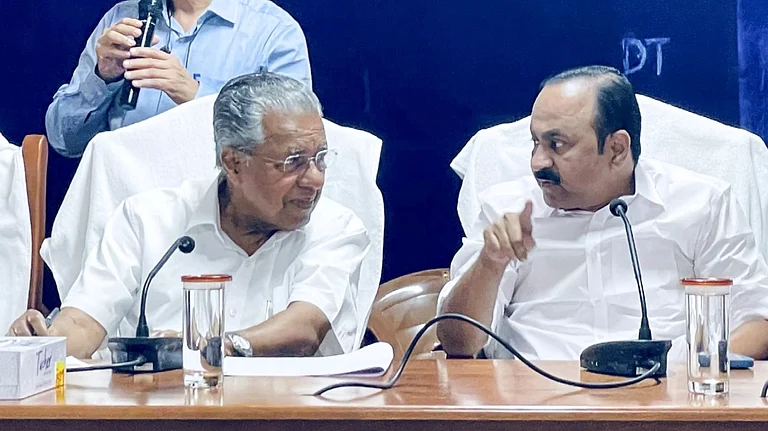
When Pinarayi became the CM, he recalibrated the policy trajectory of earlier Left governments, including in areas such as environmental protection laws.
Pinarayi is the only Left Chief Minister in Kerala to have been voted back to power. A decade on, as he prepares for another electoral battle to retain what is often described as the last major bastion of the Left in the country, the political landscape appears far more complex.
While his development-oriented initiatives have found resonance among the aspiring middle class, multiple challenges have emerged—the rise of the Sangh Parivar, a resurgent opposition following local body elections, and signs of internal dissent within the CPI(M) across different regions of the state.
The BJP for the first time in its history, won a Lok Sabha seat from Thrissur in the last general election. The iconic Thrissur Pooram festival became a political flashpoint, with allegations —including from Left allies—that sections of the police under Pinarayi’s watch created conditions conducive for the BJP win.
Advertisement

“After the Lok Sabha elections, which saw sections of Hindu Ezhava voters drifting towards the BJP, the CPI(M) and Pinarayi appeared to recalibrate their approach to appeal to Hindu sentiments. The endorsement of Vellappally Natesan, the leader of the SNDP Yogam, even after his communally loaded remarks targeting Muslims, is indicative of that,” says columnist P. T. Nasar. “This could further alienate Muslim communities from the government and the CPI(M),” he adds.
The Opposition’s gains in the local body elections need to be viewed in this broader context. Yet, even as the Congress-led opposition shows signs of revival, it continues to be constrained by internal rivalries and leadership tussles.
Against this backdrop, Pinarayi—known for his no-nonsense approach—finds himself in perhaps the most crucial political battle of his career, one that could determine not just his legacy but also the future trajectory of the Left in Kerala.
Advertisement
Pinarayi, who weathered many storms from both within and outside the party, had to wait long before being anointed to the helm of affairs. He served as the state secretary of the CPI(M)— a powerful position that allowed him to wield considerable influence over the party machinery and, when the Left was in power, over the government as well. His tenure as party secretary was marked by turbulent episodes, particularly his disagreements with V. S. Achuthanandan, over several policy and organisational issues.
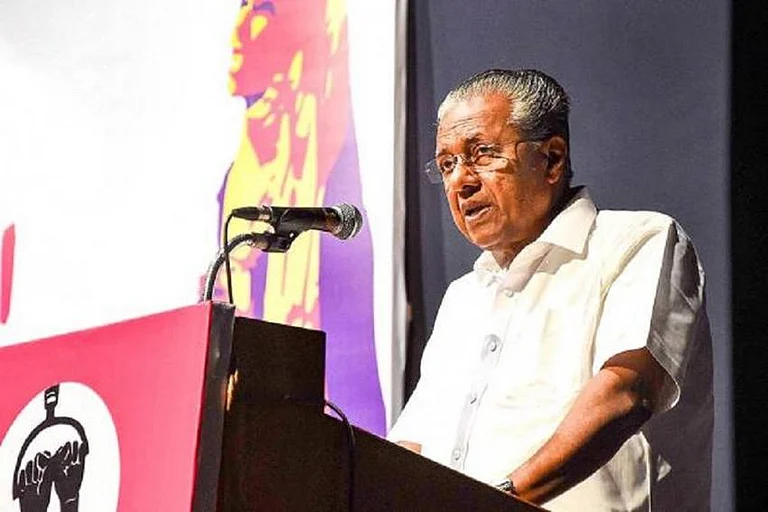
In 2016, as Pinarayi had predicted earlier, the selection of the Chief Minister after the Left Democratic Front’s electoral victory turned out to be smooth. Pinarayi was sworn in with his council of ministers, marking a shift in the way Left Front governments had functioned earlier—both in policy orientation and administrative style.
Hated by some and admired by others for his pragmatic approach, Pinarayi foregrounded development as a central plank of governance. Critics, however, argued that his emphasis on development reflected a tilt toward neoliberal economic logic that ignores marginalised sections, something the CPI(M) had traditionally opposed.
Advertisement
Soon after assuming office, Pinarayi restructured the Kerala Infrastructure Investment Fund Board (KIIFB) as a special-purpose vehicle to mobilise resources and finance large-scale infrastructure projects. “There was a realisation within the CPI(M) that it cannot fulfil its social commitments without changing the developmental path,” says Dr K. Raviraman, economist and planning board member. “In the last ten years, the leadership has been able to create a symbiosis between social development and infrastructure development on the one hand, and between government and private investment on the other. This was a paradigm shift—that is why I call it the New Left,” he adds.
Though neither Pinarayi nor the CPI(M) formally describe themselves as the “New Left”, the change in approach has been palpable. The Nava Kerala policy document, introduced by the chief minister himself at the party conference, signalled a departure from the earlier developmental trajectory the party had followed.

The party’s evolving approach is also evident in its stance on the Vizhinjam International Seaport. When the project —developed by the Adani Group—was proposed during the previous regime, the CPI(M) strongly opposed it, alleging that it was a “sell-out” to corporates. But after assuming office, the government shifted its stance, and the port is now touted as one of the administration’s milestones. Similarly, the long-pending National Highway expansion in the state is now nearing completion. The government claims the project progressed because of its active political intervention, particularly in facilitating land acquisition. At the same time, some of the government’s infrastructure ambitions have faced resistance. The proposed high-speed rail corridor, popularly known as the Silver Line Project, drew stiff opposition from sections of the public, environmentalists and economists who argued that it was ecologically risky and financially untenable.
After becoming the state secretary of the CPI(M) in the 1990s and holding the post for 17 years, Pinarayi came to command near-absolute authority within the party.
While many describe this growth-oriented strategy as a paradigm shift, some scholars disagree. According to Dr R. Ramakumar of the Tata Institute of Social Sciences, the policy shift associated with the Pinarayi government has deeper roots in ideological debates within the Left in Kerala. Ramakumar traces its origins to 1994, when communist veteran E.M. S. Namboodiripad argued that economic growth and job creation must be given greater priority while preserving Kerala’s achievements in the social sector.
Critics argue that the government has outlined a development programme that marks a clear departure from the party’s earlier emphasis on self-reliance and decentralised development. Instead, they say, private investment, public-private partnerships, and special purpose vehicles have been made the cornerstone of the new development policy. In effect, critics contend, the party has embraced several elements of the very development framework it had long criticised.
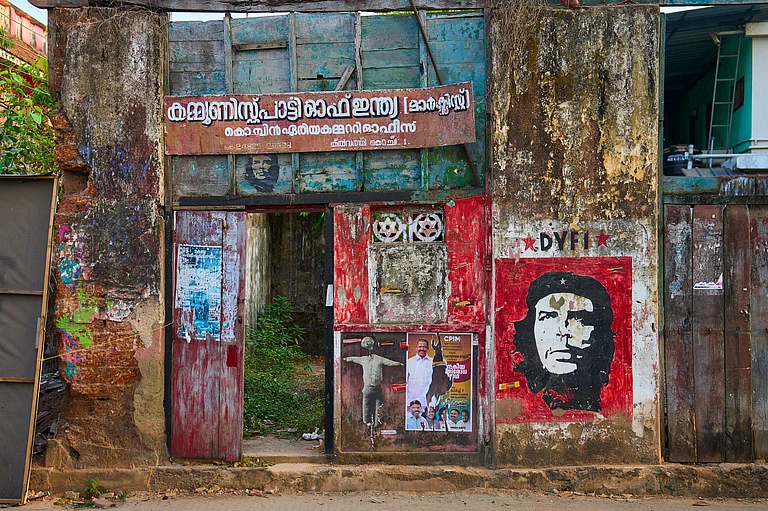
“This reorientation was most evident in the development of infrastructure. The reconstitution of the KIIFB as a para-government institution enabled public works to be sanctioned through executive decisions, bypassing the legislative sanction”, says K.T. Rammohan, former faculty member in the Department of Social Sciences, Mahatma Gandhi University. According to him, the new policy regime has pushed traditional industries to the margins, eroding livelihoods and local economies. Those who support the policy changes cite statistics that point to Kerala’s economic growth. The state’s Gross State Domestic Product (GSDP) grew by 6.19 per cent in 2024-25, placing it among the faster-growing states in the country. Critics, however, argue that the shift is visible not only in the economic sphere but also at the political level. They point to what they describe as a change in the state’s approach towards political dissent. Seven Maoists were killed in police encounters in recent years, prompting the CPI, the second-largest constituent of the LDF—to publicly express its concern over the incidents. Critics also cite what they see as inconsistencies in the government’s political positioning. They argue that while the Tamil Nadu government strongly opposed certain Union government initiatives such as the PM-SHRI Scheme, claiming they carried the ideological imprint of the Sangh Parivar, the Kerala government initially tried to approve the scheme without placing it for detailed discussion in the cabinet, drawing criticism from sections within the Left, forcing the CPI(M) to withdraw.
“The CPI(M)’s focus has increasingly shifted towards catering to the middle class. This change became more pronounced over the last decade,” says senior journalist C. Gouridasan Nair. “Large construction projects and the widening of roads are increasingly being treated as the primary markers of development. But pursuing such projects often requires a degree of centralised, authoritarian decision-making. The CPI(M) has changed accordingly, with Pinarayi’s directives running through the party without much internal questioning,” he adds.
After becoming the state secretary of the CPI(M) in the 1990s and holding the post for 17 years, Pinarayi came to command near-absolute authority within the party. The only significant internal resistance, observers note, came from the late V. S.

Pragmatism often preceded ideology in his decision-making. When Pinarayi became CM, he recalibrated the policy trajectory of earlier Left governments, particularly that of V. S., including in areas such as environmental protection laws. The large-scale projects undertaken over the past decade have also raised serious concerns among environmentalists. Environmentalist Sridhar Radhakrishnan says that several environmental safeguards introduced by the V.S. government were quietly rolled back under the current regime. “What makes the Pinarayi government particularly detrimental to the environment is a policy mindset that treats ecological damage as an acceptable cost of development,” he notes.
Beyond both his critics and admirers, Pinarayi stands out as one of the most consequential political figures in Kerala. In more ways than one, he invites comparison with the late Chinese leader Deng Xiaoping, who advocated a pragmatic turn in economic policy and famously remarked that “it doesn’t matter whether a cat is black or white, as long as it catches mice”. Like Deng—and, arguably, many communist leaders—Pinarayi also appears to favour a tightly structured organisation in which hierarchy is firmly maintained, and the authority of the leader prevails, with little room for dissent.
N.K. Bhoopesh is an assistant editor, reporting on South India with a focus on politics, developmental challenges, and stories rooted in social justice
(This article appeared in Outlook's April 1st, 2026 issue titled ParaDime Shift, which looks at how the US-Israel attack on Iran has come home to India with the LPG crisis and is disrupting India’s energy ecosystem, exposing policy gaps, and testing the limits of its diplomacy.)
Published At:
Tags