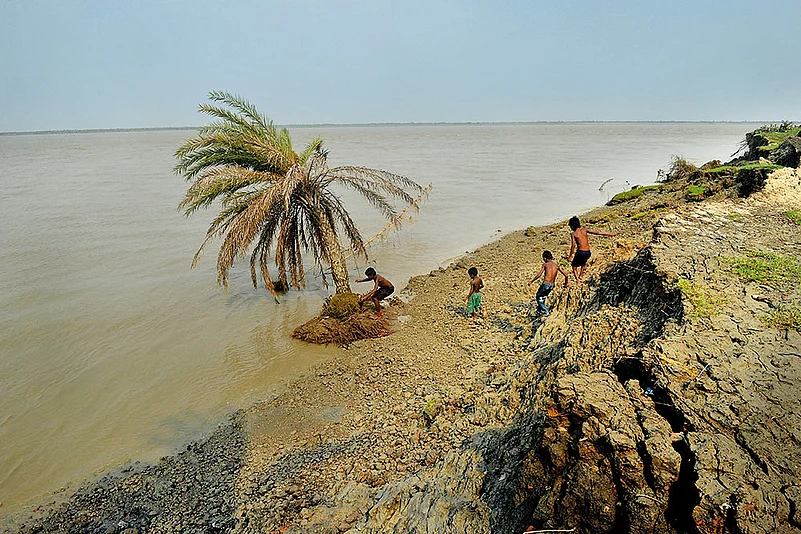
Evening is descending over Ghoramara island and people, wrapped in the gloaming, rush back to the bank of the Sagar river to catch the last boat out. “I don’t want to get stuck here at night,” says one, letting out a nervous laugh. “I had come here for a last visit because I know it is sinking and anything can happen at any time,” says 18-year-old Puja Maity, who lives across the delta in mainland Kakdwip, but has nostalgic childhood memories of playing with cousins during visits to relatives who lived here then. “They all moved out long ago when their homes started submerging. Each time I came here I would find something gone—a date tree by the shore which would shelter us during the rains, a mud hut along the banks of the river in which we would play hide and seek. Then, gradually, the backyard of my uncle’s house, their farmlands, paddy fields, shops and stores. I feel sad and keep coming back and each time I think maybe this is my last visit.”
The ongoing polls may be the last for Ghoramara, located on the edge of the sea in West Bengal’s Sunderbans. Unless there is a major political upheaval and there are snap polls, there will be no Ghoramara by next elections. “Time is ticking for us,” says Gouranga Dolui (27), who lives in a mud hut close to the shore. “The danger of sinking into the sea (Ghoramara is closest to the confluence of the delta rivers and the Bay of Bengal, next to Sagardwip) constantly looms over us. But we also didn’t want to leave without casting our votes, because if we shift now who knows if we will get the chance.”

That the sea was chewing away insidiously, incessantly at its edges was becoming clear as early as over 50 years back, when the first batch of islanders relocated to nearby island Sagardwip’s Bankimkhali area. Ecologists, oceanographers and environmental experts attributed the phenomenon largely to global warming. A recent study by Sugata Hazra, an oceanographer at Jadavpur University, says that during the last 30 years, roughly 80 sq km of the Sunderbans has disappeared. Ghoramara has submerged so much that it has shrunk from 120 sq km to under five sq km since 1969. The fact that Ghoramara island is surrounded by several rivers, including the turbulent Sagar and Muri Ganga, makes it more vulnerable. By some accounts, the entire island could be swallowed up by 2025.
Gouranga Dolui complains that politicians keep promising them land on Sagar island during poll campaigns but then nothing happens. “Rehabilitation takes time and has to be done in phases,” says a local politician and panchayat member. “We have to move forward on a need basis. Those who are already affected by land erosion or are in imminent danger have to be dealt with first. We have made arrangement for those who are in the direst need to shift to other locations.” Now, some 30 families spread over five villages jostle with each other in the central part of the island, staring hopelessly at the large expanse of water glinting in the fierce sun. Authorities say after the polls they will be shifted to Jamunanagar village in Sagar island and given plots of land for homes and farming. When the first lot was moved 40 years ago, each family had reportedly received nearly six bighas each; now only one-and-a-half bighas are being slotted.
According to panchyat pradhan and Trinamool Congress member Sanjib Sagar, attempts are on to try to salvage as much of land as possible to save the island. But it is a nearly impossible task. The northern and southern parts of the island—pummelled by unforgiving river waves—are damaged the most. The waters have breached all manmade ramparts—barricades of bamboo, sandbags, even cement and brick. Those whose anxious lives linger on in Ghoramara cling on to the hope that these efforts will pay off, even though they helplessly see parts of their lives drifting away with the tide. Priyanka Dolui, 17, speaks about a family which has had a member washed away. Her father-in-law chides her: “That’s not very common. I can remember just one or two such incidents.”
What the hungry tides have bitten off is land, and property on it—houses, shops, farms, orchards, gardens. Not that Ghoramara’s people have much beyond the bare necessities. “As it is, we are poor. We don’t have much,” says Aroti Khara, whose husband Lakkhan is a fisherman. They’re repairing their damaged house, and hold up their fishing net. “This net is our most precious possession. We don’t need anything more,” says Aroti, holding fast to their philosophy of survival—“Obostha bujhey byabostha” (taking it as it comes). Most people in Ghoramara subscribe to this, an age-old coping mechanism—‘Nothing is permanent. Don’t get attached.’
Those untouched by wisdom are the ones who are distraught by their loss. Like Mukti Chowdhury, overcome by tragedy, too devastated to even speak. Somehow, she drawls out her story: “Everything is sunk. I had a field full of crops growing. Right over there,” she points to the surging waters. Her 12-year-old son Binoy is almost in shock. He has come with his mother to check up on their locked, derelict house. But the river is only inches away, waiting forlornly for the inevitable. A villager sniggers, “They are delusional. What’s the point of that lock? Two months later, it won’t be there.” Just across from her house, what was once a neighbour’s home is now a battered mass of clay, bamboo and straw; common household goods are strewn about—a bottle of Parachute coconut oil, a comb, a toothbrush, discarded by the hurriedly departed.
Interestingly, the price of land in Ghoramara was once, claims a shopkeeper, as high as Rs 80,000 a kottah. “Now, the official rate is Rs 20,000, but I doubt if there would be any takers even if we give it away for free.” Unlike Mukti, he laughs stoically when he recalls the many acres he has lost to the foraging waters. “We used to be considered zamindars here,” he chuckles. “But Allah has taught us that zamin is nothing.” He points out that the mosque in which they prayed has also been claimed by the river. “It was Allah’s. He took it back.” So, when eight-year-old Salman returns to the rubble of what was once their home by the river, it’s not a solemn occasion. He just wants a game of hide-and-seek with his former neighbour and cousin, 12-year-old Sanjib Maity.
One new game devised by a group of displaced kids is to stand at the edge of the eroded banks to see how fast the earth crumbles under their tiny feet and how much mud they can kick back into the river. This time, they succeed in kicking back a lot of it, then fall in a group into the shallow waters, splashing about, delirious with laughter. One of the boys, a 10-year-old, is called Mrityunjoy. His name means ‘one who has conquered death’.
By Dola Mitra in Ghoramara