



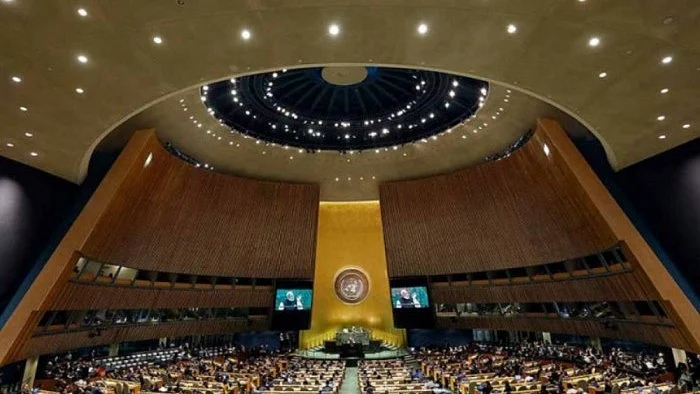
India voted against a draft UN General Assembly resolution introduced by Mexico calling for a global moratorium on the death penalty, which passed with 133 votes in favour, 33 against, and 16 abstentions.
New Delhi joined 32 other countries—including the United States, China, Japan, Iran, Pakistan, and Saudi Arabia—in opposing the resolution, maintaining that sovereign states have the right to determine their own legal systems.
Indian diplomat Bhavika Mangalanandan emphasized procedural safeguards in India's judicial system and objected to equating lawful capital punishment with extrajudicial or arbitrary executions.
India has voted against a draft UN General Assembly resolution calling on nations to establish a moratorium on the death penalty.
The 193-member UNGA adopted by recorded vote the resolution on Friday introduced by Mexico on ‘Moratorium on the use of the death penalty’, with 133 countries voting in favour of the resolution, 33 against and 16 abstentions.
India, along with Bahrain, China, Egypt, Iran, Iraq, Japan, Kuwait, Maldives, Oman, Pakistan, Qatar, Saudi Arabia and the US, voted against the resolution.
The resolution expressed deep concern about the continued application of the death penalty and reaffirmed the right of all countries to develop their own legal systems, including determining appropriate legal penalties in accordance with international law.
It called upon all States to establish a moratorium on executions, with a view to abolishing the death penalty. It also called upon States which have abolished the death penalty not to reintroduce it.


The resolution expressed deep concern that, despite the global trend towards limiting the application of the death penalty, there was a significant surge in reported executions in 2025.
The resolution called upon all States to progressively restrict the use of the death penalty and not to impose capital punishment for offences committed by persons below 18 years of age or whose age above 18 years at the time of the commission of the crime cannot be accurately determined.
It also called for restricting the use of the death penalty on pregnant women or on persons with mental or intellectual disabilities, as well as on older persons, and to reduce the number of offences for which the death penalty may be imposed, including by removing the mandatory application of the death penalty.








