Media framing turns some victims into national symbols while others become mere statistics based on class, caste, and geography.
High-profile cases like Nirbhaya drive reforms, but marginalized ones like Hathras suffer procedural apathy and diluted outrage.
Reporting on queer and trans victims often sensationalizes identity, shifting focus from violence to spectacle and risking ethical lapses.
The Hierarchy Of Sympathy: How Media Narratives Influence Justice In Crimes Against Women
In crimes against women, justice is shaped not only in courtrooms but in newsrooms where narrative determines whose suffering becomes national conscience and whose fades into procedural silence

Summary
It often begins the same way: a breaking alert, a photograph sourced from social media, a timeline reconstructed from CCTV clips, and within hours, panel discussions asking how yet another crime against a woman could occur. Hashtags emerge, outrage circulates, and the story gathers emotional momentum; narrative anchors take shape, and these play a huge role in whether a case sustains national attention or dissolves into fragmented updates. As the news cycle moves on, only some cases retain velocity while others fade into procedural silence.
Violence against women in India is relentlessly visible. Yet visibility is not the same as attention, and attention is not the same as empathy. Between incident and memory lies media framing—the subtle architecture through which certain victims become symbols while others remain statistics.
Consider the arc from the 2012 Delhi gang rape case—widely referred to as the Nirbhaya case—to the 2020 assault and death of a Dalit woman in Hathras. The former was framed as an attack on a nation’s daughter—a young woman who could belong to any urban, aspirational family. The latter, quickly contextualised through caste and rural geography, was filtered through layers of social categorisation. Both were brutal crimes, but their narrative trajectories diverged sharply.

“In cases like Nirbhaya, the framing of a ‘Universal Daughter’ created a Mandamus-type pressure on the State,” says Rohit Naagpal, a Delhi-based criminal lawyer. “This led to immediate legislative reform and fast-tracked justice. Conversely, in Hathras, when the narrative shifts to caste or rural geography, the victim is ‘categorised’ rather than ‘humanised’. Socially, this dilutes public outrage and allows for institutional apathy,” he says.
Naagpal also points to what he calls “forensic and procedural erosion”. Media attention, he argues, often functions as a “secondary investigating officer”. High social capital ensures the chain of custody is maintained; every lapse risks exposure. In marginalised jurisdictions, however, the absence of sustained scrutiny can enable “procedural irregularities”: from delayed FIRs to compromised evidence handling. The hurried cremation in Hathras became emblematic not merely of insensitivity but of the literal destruction of evidence, which would never be tolerated in an urban, high-profile case, Naagpal reminds us.
Advertisement
Crimes against women are not only investigated, they are storified. Some stories acquire momentum, legal urgency, and public memory. Others fragment into updates, then into archives.
Public outrage, like media attention, is rarely neutral. Some crimes against women become national ruptures; others remain local tragedies. The difference is not always in the brutality of the act, but in the narrative scaffolding built around the victim. Class, caste, geography, sexuality, and perceived respectability quietly shape how grief is distributed, how justice is pursued. In the telling of gender-based violence, and the narrative scaffolding around it, sympathy itself acquires a hierarchy.

This hierarchy becomes most visible not in what is reported, but in how it is reported. The victim’s biography often precedes the crime: where she studied, what she wore, whom she loved, how she lived. Narrative replaces evidence as the emotional anchor. When victims fit familiar social templates—the student, the professional, the daughter returning home—coverage expands into collective mourning. When they fall outside normative expectations, the tone shifts subtly toward explanation, context, or moral framing.
Advertisement
The distortion deepens further in cases involving queer and trans persons, where identity itself frequently becomes the headline, says Chennai-based lawyer Amba Salelkar, who works primarily in the area of law and policy around gender, disability and mental health. In the reporting around the 2023 murders of three trans women in Hyderabad, early headlines repeatedly highlighted their transgender identity and gave far less attention to the dynamics of intimate partner violence that investigators later pointed to. The framing often leaned on descriptors such as “transgender angle” or “lifestyle details”, shifting focus from the act of violence to the identity of the victim.
Salelkar points to a recurring pattern in how such cases are constructed. “The issue arises when a victim being gay or trans becomes the hook of the story, and takes away or takes precedence from this being an act of violence. This is different from it being labelled as a hate crime. That would entail a finding or assertion that a person may have been targeted on account of their gender identity or sexuality. More commonly, a victim’s identity is used as a headline, or as a lurid detail, to attract readers. The second is the casual approach to ‘deadnaming’ a person, or misgendering them, while reporting on them,” she says.
Advertisement
Salelkar also notes that this narrative instinct risks turning gender identity into spectacle rather than context, especially in a media ecosystem that is still learning how legal protections, terminology, and ethical reporting intersect when queer and trans persons are victims of crime. Often, ethical lapses emerge through detail rather than overt sensationalism. This shift is not merely in the rhetoric; it also shapes how audiences interpret vulnerability and culpability.

Popular culture, too, participates in this framing cycle: Mainstream storytelling often continues to rely on archetypes—from the volatile antagonist in Fatal Attraction to the calculated manipulator in Gone Girl—where female violence is explained through personality rather than structural context. Shows like Baby Reindeer demonstrate how easily narratives about victimhood and culpability blur when familiar gender scripts are unsettled—often leaving audiences debating character psychology more than structural violence. The series complicates the conventional framing of stalking by presenting obsession through emotional ambiguity rather than moral certainty.
Advertisement
Post-2012, Indian laws were amended to recognise wider and more nuanced definitions of violence against women, set penalties for inefficient police action, and create stricter punishments for perpetrators—including, significantly, the death penalty. But a decade later, there are still significant dangers for women in India. The crime rate against women has increased by over 50 per cent in the past decade.
From the rape and murder of a trainee doctor at RG Kar Medical College and Hospital in Kolkata in 2024 to other crimes that surface briefly in local reportage, like the recent double murder in Sarita Vihar, Delhi, there is a recurring pattern in how gender-based violence is narrated. The persistence of these crimes is matched by the persistence of their storytelling patterns. Each new case enters the public sphere already searching for narrative coordinates: the “ideal victim”, the acceptable grief arc, the familiar moral frame. Where these coordinates are absent, the story struggles to hold attention. News coverage, operating under the pressures of immediacy and engagement, risks replicating the same interpretive shortcuts.
The consequence is subtle but profound. Crimes against women are not only investigated, they are storified. Some stories acquire momentum, legal urgency, and public memory. Others fragment into updates, then into archives, then into silence.
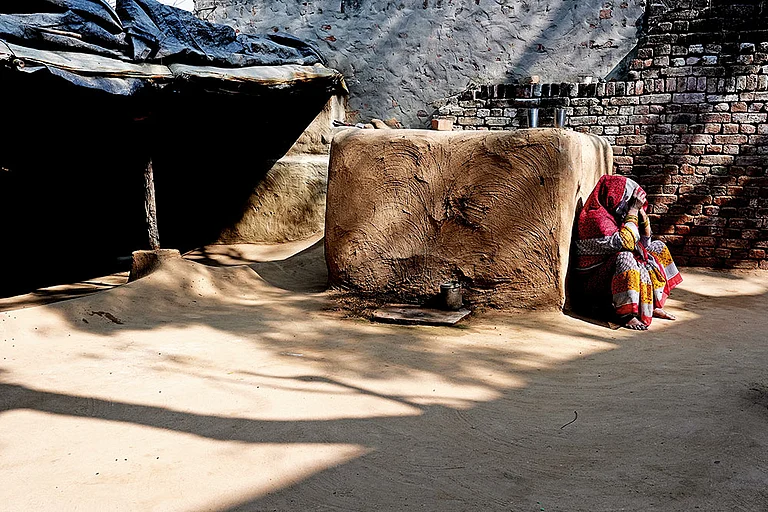
And somewhere between “breaking news” and collective amnesia, empathy itself learns whom to recognise—and whom to overlook.
Lalita Iyer is an Associate Editor at Outlook and the author of Sridevi: Queen of Hearts, The Whole Shebang, Raising Mamma and other books.
This article is part of Outlook's March 11 issue Femme Fatale which looks at how popular media has shaped narratives of violence against women over the years and rewrites the language of male gaze in media which commodifies and condemns the women who make headlines.
Published At: