“Whether or not it is the Truth is no longer relevant. The point is that it will, (if it hasn’t already) - become the Truth. Phoolan Devi, the woman has ceased to be important. (Yes of course she exists. She has eyes, ears, limbs, hair etc. Even an address now) But she is suffering from a case of Legenditis. She’s only a version of herself. There are other versions of her that are jostling for attention. Particularly Shekhar Kapur’s “Truthful” one, which we are currently being bludgeoned into believing.”
For Phoolan, Who Wasn’t A Devi
Goddesses are a myth. Phoolan was real.

—Arundhati Roy in ‘The Great Indian Rape-Trick I’, on the film Bandit Queen by Shekhar Kapur based on Phoolan, whom he never met because he didn’t think he needed to meet her. The film was based on journalist Mala Sen’s book India’s Bandit Queen: The True Story of Phoolan Devi.
“But is it? The True Story? How does one decide? Who decides?” Roy asks in her piece.
The ones who told her story were mostly men. Women wrote her differently. With curiosity. Not with judgement. Not so much, at least. We try. But we are dismissed more often than not. Phoolan suffered the same.
Curiosity led me to her village in Uttar Pradesh many years later, after Phoolan was shot dead in Delhi. It was dusk when I arrived. I saw the wilderness in that haze. The brutal landscape of the ravines where a woman was raped by upper-caste men, cast as promiscuous by the media, where she killed, sought revenge and is still remembered in village songs that try to correct the story handed down to us. Where is the truth then? Who tells it?
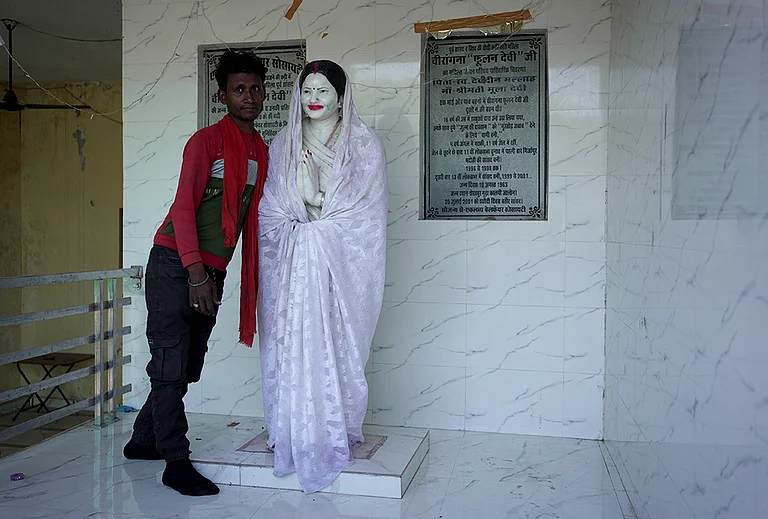
There is a statue in her village. They say it is of Phoolan Devi. The placard refers to her as the Braveheart.
The figure is clad in a sari and cast in white marble with black hair tied in a bun and parted through the middle, which is filled with vermilion. The lips are painted red. The hands of the figure are folded and adorned with gold bangles.
This is how she is presented. A tamed version.
To some, she was brutalised. To others, a brute. It was a fascinating story. Everyone wanted to tell it. In the telling, it ceased to be hers, like the statue erected in her village.
This is the third time I have written about that statue. I believe in repetition and revision. Redemption is not mine to offer. As a journalist, I am curious about narratives, how they are framed and who shapes them.
Advertisement
I want to know more about the statue.
Is that Phoolan? This is the imagined “good girl” who surrendered and became a political leader to serve the people. Maybe that’s why they sing the songs here. To counter the narratives and give her cultural justice.
I remember asking that question. Phoolan surrendered in Bhind, Madhya Pradesh, in 1983, on her own terms. In 2001, she was shot dead by a Thakur man who said he was avenging her past. In between, she spent 11 years awaiting trial, secured bail in 1994 and was elected to the Lok Sabha in 1996. These are facts. Facts are never enough.

The rape-romance became her story. Everything else was cut. A story, when it must be served, is expected to carry morality, sensationalism, a touch of fantasy. Truth is often more than that, or less.
Advertisement
They say, “The moral of the story is…” but why must we redeem or condemn? Why this hunger for a moral? She was raped, so that explains who she became. Or she was promiscuous, had many lovers, was never really in control, was crazy.
Why do we tell stories with such misplaced ambition? Why do we place such a premium on self-righteousness?
How do we correct half-truths?
Why are women still judged for how they look? Why must they measure up to patriarchy’s idiotic standards? Why is much of the media still unable to write about women?

Perhaps it will take forever. I am not going to wait for that long. I don’t have that kind of time. Or patience.
In India’s Bandit Queen, written by Mary Anne Weaver for The Atlantic, she listed the epithets that were applied to Phoolan. The Beautiful Bandit, the Bandit Queen.
Advertisement
“… was really a wisp of a girl: less than five feet tall, with flat high cheekbones, a full flat nose, and slit eyes. She looked like a Nepalese boy,” she wrote.
Even when countering the disappointment expressed by men who had imagined Phoolan to be a femme fatale or trying to describe the dacoit legend of the Chambal, the writer succumbed to the very traps men have laid for us. I wonder why she used a Nepalese-boy aesthetic? Was it to make readers see her more clearly or was it to strip her of her gender and her looks?
Weaver had quoted a syndicated columnist and a critic, Sunil Sethi.
“Phoolan’s two great gifts are rabid cunning and fatal charm—an irresistible combination and a great achievement in a woman who is so brutal,” Sethi told her.
In his piece on Phoolan in India Today magazine published in February of 1983, Sethi wrote: For eight centuries India’s dacoits have been imbued with roguish romance. But none was more romantic—or roguish—than Phoolan. “For every man this girl has killed, she has slept with two,” a police inspector told me at the time. “Sometimes she sleeps with them first, before she bumps them off.”
Advertisement
He then went on to describe her.
‘Instead, the “daredevil dacoit queen,” the “black beauty of the bandit world” or the dasyu sundari (dacoit beauty) known to sport bell-bottom trousers and bobbed hair, turned out to be a drab-looking, highly moody, childishly petulant and disastrously short-tempered girl on a rampage. There was little about her to suggest the high-minded and seductive woman out to avenge her honour and redeem the humiliations of a tormented past.
… It is hard to believe looking at her slight short figure - she is under five ft in height and her ravaged face - that this is the woman who terrorised large sections of the population in two states. It is hard to imagine this scruffy, edgy, nervous girl as someone who toted a gun - her wrists seem too painfully thin to even carry one around.
…In Phoolan Devi’s case, the original motivation to turn to violence seems to be abetted by another factor: sex. Most newspapers keep primly referring to her series of lovers - the present one is Man Singh - as “paramour”, as if she were some kind of Madame Bovary of the Chambal ravines.
…The gradually built-up myth that has grown about a woman defending her honour is as fake as the tales of her sensational looks; the impression of her as an original, innovative, wildly daring and fearsome victor in life is nothing but a cover-up, more likely than not, for a neurotic, highly-strung, evil-tempered and foulmouthed victim of life, a casualty whose life has been made more bleak by the clout and celebrity her offences have brought her.
Few draw the line between her early rejection by husband and family and the drift into promiscuity. Married at 13 to a man nearly 20 years older, the impoverished girl was soon thrown out.’
Caste, class, gendered violence and elusive justice are part of her story. Promiscuity is a choice. We deny women that choice in our narratives. So what if she had more than one lover?
These descriptions feel patronising. What was the writer trying to do? Salvage her from a reputation shaped by media fantasy, or was he unable to accept her as an equal in a male-dominated world of dacoits?
Gustave Flaubert’s Madame Bovary was published in 1856 and banned by the French government. Flaubert went on trial for the book’s sexuality. He had written of desire and a woman’s ‘adulterous longing’. That was unacceptable to society. It remains so. Phoolan’s ‘promiscuity’ need not be justified by drawing a neat line to her early rejection by husband and family. It requires no such defence. This media-crafted redemption, shaped by a harsh male gaze, is nonsense.
These are the times of the Epstein files. A male professor wrote to us in defence of public intellectual Noam Chomsky, whose name appears in the files. He called it an error of judgement. It should make all of us angry.
It is Women’s Day on March 8.
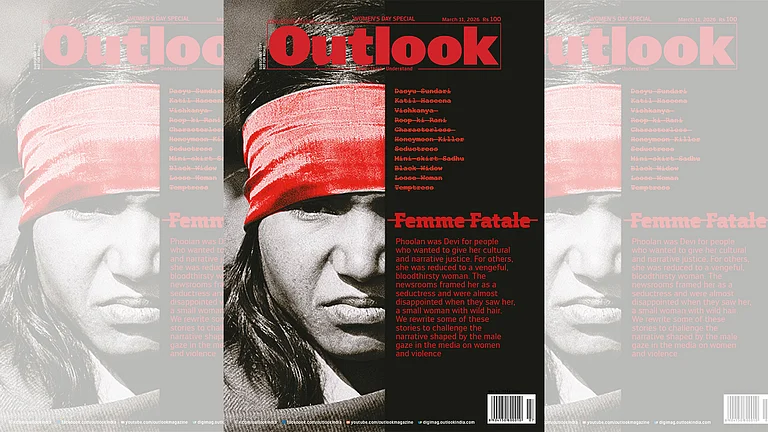
We did away with the tokenism of celebrating women, revisited the stories of women who committed crimes or were subject to violence, including murder, and challenged the gaze.
In 2020, in Hathras, a Dalit girl was gang-raped and her body, burnt. When I went to report, I was told she was having an affair with a Thakur man. I was told I was naïve, that it was a property dispute. A man in the village told me to leave. He glared and said it wasn’t safe for me. Local headlines were full of such insinuations, each one blunting the force of the crime. The truth was she was brutally raped.
I have thought about the statue for a long time. It was cast by men, for men and has become of men. I have thought about the way we tell stories for a long time.
This issue is a correction, an intervention. Phoolan was a woman. Not a Devi. We don’t need such surnames changed after husbands, fathers, etc.
Goddesses are a myth. Phoolan was real.
Chinki Sinha is editor, Outlook Magazine
This article is part of Outlook's March 11 issue Femme Fatale which looks at how popular media has shaped narratives of violence against women over the years and rewrites the language of male gaze in media which commodifies and condemns the women who make headlines.
Published At: