Western powers exported nationalism to fracture the Ottoman Caliphate and installed sectarian monarchies plus Israel and Pakistan.
US Cold War tactics (Afghan Mujahideen, Dual Containment) and 2026 strikes on Iran keep West Asia in engineered religious conflict.
Strait of Hormuz crisis now threatens India-Pakistan energy security, exposing America’s fake secular promises.
Not So Strait: How America Is Stoking Global Religious Extremist Frenzy
The current catastrophe in West Asia and the surrounding Arab world is not an accident of history, but a direct consequence of Washington’s relentless pursuit of hegemony

Summary
The architecture of modern geopolitics is often framed as a triumph of the secular nation-state, yet a deeper look into the past 150 years reveals a far more paradoxical evolution. The very “nationalism” that emerged in Western Europe as a tool to dismantle the hegemony of the Church has, through centuries of imperial engineering, been weaponised to create its polar opposite: the modern religious state. From the dismantling of the Ottoman Caliphate to the 2026 missile sirens echoing across the Persian Gulf, the “boil” of West Asia and South Asia is the result of a deliberate, centuries-long transition from imperial unity to fractured, religiously defined entities.
The US often pretends to install Enlightenment principles such as democracy and women’s rights. However, in the current unfolding crisis, this pretension has fallen like a pack of cards. The killing of over 150 girls in a school in Minab town of southern Iran, and prior to that, instigating a civil uprising against the Iranian regime with the help of the pro-Shah monarchic faction, and, most importantly, the allegation of Iran possessing nuclear power—even while extending fullest support to sectarian monarchies across Arabia—exposes the USA’s malicious narratives. US President Donald Trump is now reported to have declared this war against Iran a biblical war—or Armageddon, which, in the New Testament, is the final battle between good and evil forces before the Day of Judgement.
This is nothing but stoking a regressive global religious-extremist frenzy!
In the late 19th century, the “Sick Man of Europe”—the Ottoman Empire (Turkey)—represented the last bastion of a transnational Islamic polity. For the West, its existence was an obstacle to the unfettered flow of capital and the strategic control of the Suez Canal. To dismantle it, European powers played a masterstroke of political alchemy: they exported European “nationalism” to a region that had historically functioned under the Millet system of religious coexistence.

At the onset of World War I, British agents like T. E. Lawrence (1888-1935) were instigating the Arab Revolt, promising the Hashemites—a prominent Arab dynasty descending from the Prophet Muhammad’s great-grandfather, Hashim ibn Abd Manaf—a sovereign Arab kingdom. In reality, the Sykes-Picot Agreement (1916) had already carved the region into spheres of influence. The “nationalism” promised to the Arabs was a mirage; it served only to fracture the Ottoman front, leaving behind a vacuum that would eventually be filled not by secular republics, but by territorial disputes defined by sectarian and religious lines. Arab leaders were misled by diplomatic promises from Britain and its allies during 1915-17. What did they get by the mid-20th century, post-World War II?
Advertisement
In 2026, things are no different. The Arabs are yet to learn from the not-so-distant history of the Western deception played out against them.
The Sykes-Picot (1916) was the centrepiece of a triple betrayal that effectively criminalised Arab sovereignty:
The McMahon-Hussein Correspondence (1915-1916): The British promised the Arabs an independent kingdom in exchange for revolting against the Ottomans.
Sykes-Picot (1916): The British and French secretly agreed to keep that same land for themselves.
The Balfour Declaration (1917): The British promised a “national home for the Jewish people” in Palestine—land they had already promised to the Arabs and claimed for themselves.
With these acts of deceptions of the 20th century, the West, having attained “non-religious” linguistic-territorial nationalism in the 19th century, destroyed the Ottomans, installed religious, in fact, sectarian, monarchies across the Arab world, and the Zionist state, Israel, in Palestine, in the 20th century. In South Asia too, the “Muslim Zion” called Pakistan was created, and Kashmir was turned into a permanently boiling territory of conflict. In the name of containing Soviet Communism, they instigated the Afghan Mujahideen. The subcontinental majoritarianism in South Asia is a colonial legacy.
Advertisement
Subsequently, having destroyed Iraq, Syria, Libya and Lebanon, the US-Israel axis is doing the same with Iran, and the sectarian Arab monarchs are the shameless allies of the supposedly democratic West.
The mid-20th century saw the culmination of this architecture of division. Following World War II, the Western powers facilitated the creation of the State of Israel in 1948, a project often described as a chauvinist movement (Zionism) that established a state based on religious and ethnic identity. Simultaneously, a mirror image of this phenomenon occurred in the Indian subcontinent. In 1947, just a year before the birth of Israel, the British oversaw the Partition of India. This birthed Pakistan, a state conceived by some thinkers as a “Muslim Zion”—a land for a dispersed religious minority seeking a sovereign home.

While Western Europe had spent centuries pushing the Church out of politics, its imperial exit strategies in the East purposefully institutionalised religion as the primary marker of statehood. These partitions were not isolated events, but twin pillars of a specific British imperial strategy. Both were predicated on the “Two-Nation Theory”—the idea that two distinct religious groups could not coexist within a single democratic framework and thus required separate “homelands”. In both instances, the nationalism that had been secular in Europe was re-engineered as “Religious Territorialism” in the East.
Advertisement
The mechanics of displacement in both regions were strikingly similar. In 1947, approximately 15 million people were displaced across the new India-Pakistan borders, while in 1948 the Nakba (catastrophe) saw the displacement and massacre of approximately 700,000 Palestinians. Both plans prioritised creating “pure” religious majorities in specific zones, which inevitably led to sectarian violence and the enduring instability we see today. Furthermore, both Pakistan and Israel served as Western-aligned bulwarks—Pakistan against Soviet expansion toward the Indian Ocean, and Israel against Pan-Arabism and later, Iranian influence.
The current instability of 2026 finds its more recent roots in the late 20th century, specifically the disintegration of the erstwhile Soviet Union. To hasten the Soviet collapse, the US turned Afghanistan into a laboratory for radicalised religious fervour. Through Operation Cyclone, the US weaponised Islamic fervour by funding the mujahideen to drain the Soviet Union. When the Soviet Union disintegrated in 1991, these “holy warriors” (the mujahideen) did not disappear; instead, they became the vanguard of a new, decentralised religious power.
Advertisement
This strategy extended to the Kashmir crisis, where the fallout of the 1947 “Muslim Zion” project intersected with Cold War interests. The West increasingly framed the Kashmiri territorial dispute as a “flashpoint of religious extremism”, a shift that justified a continued security presence while managing Pakistan as a frontline state for Western interests. With the Soviet threat gone, the US doctrine shifted to the “Management of Religious States”, using “Dual Containment” to target Iran and Iraq and establishing a permanent military footprint in the Gulf.
As of March 2026, we see the logical conclusion of this century-old drift. West Asia remains “on the boil” as the American West continues to navigate the fires it helped light. The current escalation—marked by direct US-Israeli strikes on Iranian facilities and retaliatory missile barrages over the UAE and Qatar—is the final stage of the “architecture of 1916”. Following the massive joint US-Israeli “Operation Epic Fury” on February 28, aimed at Iranian nuclear and leadership infrastructure, the region is no longer simmering; it is erupting.
The reported death of Iran’s Supreme Leader (Ali Khamenei) has created a power vacuum that threatens to collapse the very religious state structures the West has spent decades trying to “contain” or “reform”. The religious monarchical states created or supported by the West have now matured into regional powers, their conflicts fuelled by the very sectarian identities that were once tools of imperial leverage. The ultimate irony remains: the very powers that claim to uphold secularism (the US, the UK, and France) are the ones that historically codified religion into the borders of West Asia and South Asia.

The strategic “boil” has reached a critical flashpoint in the Strait of Hormuz, which is effectively paralysed by an Iranian blockade following Operation Epic Fury. This 21-mile-wide ‘chokepoint’ has become a maritime graveyard, providing an ultimate stress test for India and Pakistan. For India, the vulnerability is acute. While it has diversified crude oil sources via Russia and America, it remains dangerously exposed to the Gulf for gas. Approximately 50 per cent of India’s crude oil and 80-85 per cent of its LPG pass through the Strait of Hormuz. With over 150 tankers anchored and refusing to enter due to a lack of insurance, domestic fuel costs are skyrocketing, threatening the social contract of the state.
For Pakistan, the crisis is existential. As a state founded on religious identity, it is caught in a theological and tactical vice. Already struggling with hyperinflation, the closure of Hormuz has severed its primary energy supply. Unlike India, Pakistan lacks the foreign exchange to pivot to expensive Atlantic-basin oil. Furthermore, the instability in Iran is spilling over into Balochistan, threatening to ignite the very religious nationalism the West once used as a tool of containment.
India’s right-wing supremacist politics and its foreign policy appear to be face-to-face with similar problems. Economic indicators of this drift are stark as of early March 2026. Brent crude hovers between $90 and $100 per barrel, and insurance premiums have reached multi-year highs.
Ultimately, the wreckage of early 2026 serves as a damning indictment of US foreign policy, which has inherited and expanded upon the cynical imperial blueprints of the 19th century. The current catastrophe in West Asia and the surrounding Arab world is not an accident of history, but a direct consequence of Washington’s relentless pursuit of hegemony. By weaponising religious extremism in Afghanistan to settle Cold War scores, and by providing the unconditional military and diplomatic shield that allows for the continued dispossession in Palestine, the US has systematically dismantled the possibility of regional stability.
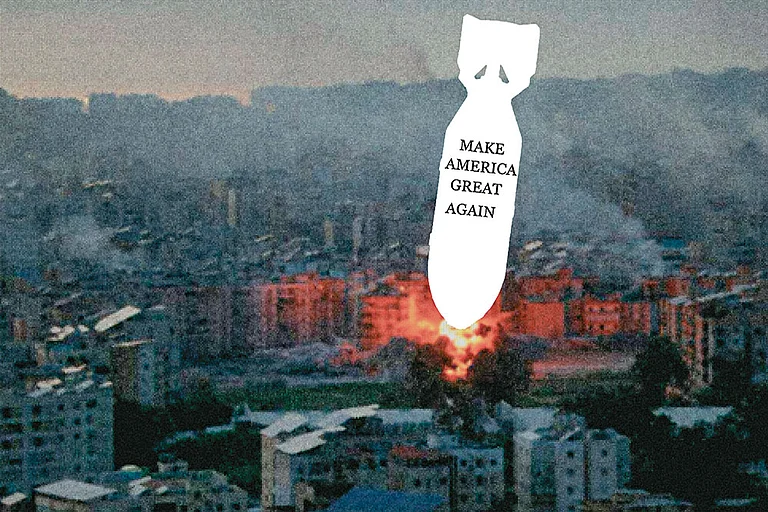
It is the US that has kept the West Asia “on the boil” for decades, utilising a strategy of managed chaos to ensure that no sovereign power can challenge its energy interests or its geopolitical anchors. From the instigation of the Kashmir crisis to the high-intensity strikes of Operation Epic Fury, Washington has consistently prioritised the maintenance of fractured, religious states over the secular ideals it purports to champion. As the Strait of Hormuz burns and the global economy staggers, the blame rests squarely on the American architecture of intervention that has sacrificed the peace of an entire region at the altar of its own global dominance. The “Muslim Zion” and the State of Israel remain locked in a cycle of fire, a permanent testament to a Western-engineered tragedy that the US continues to fuel for its own ends.
(Views expressed are personal)
Mohammad Sajjad is professor, Centre Of Advanced Study In History, Aligarh Muslim University.
This article is part of Outlook 's March 21 issue Bombs Do Not Liberate Women which looks at the conflict in West Asia following US and Israel’s attacks on Iran leading to the assassination of Ayatollah Ali Khamenei, while the world wondered in loud silence, again, Whose War Is It Anyway?
Published At: