US–Israeli strikes that killed Iran’s supreme leader have escalated the conflict into an open war, with Donald Trump signalling regime change as a possible objective.
Iran, unable to match US military power, is trying to raise the cost of war by threatening global energy routes and destabilising the wider region.
As oil prices surge and geopolitical tensions rise, analysts warn the war could reshape West Asia’s balance of power and further weaken the international rules-based order.
War In West Asia: What Is Trump’s Endgame?
The Iran war looks like a high-stakes attempt by the US and Israel to reshape the balance of power in West Asia

Summary
US President Donald Trump believes his moment has arrived. By dismantling Iran’s theocratic regime, in place since the 1979 revolution that had openly called for Israel’s extinction and long threatened US interests in the region, Trump believes he has sealed his legacy. No American president had dared to wage an open war with Iran. Yes, there was shadow boxing, crippling sanctions, covert strikes and cyber warfare. But never this.
This time the US crossed the line. Within hours of the US-Israeli strikes, Ayatollah Ali Khamenei was dead. Iran’s most powerful symbol was gone. Trump moved quickly. He publicly called for the “unconditional surrender” of Iran’s Islamic Revolutionary Guard Corps. He also said that he would decide who should rule Iran to prevent a more hardline leader from taking control.
Confidence is pouring out of the White House. Much of Iran’s military and political leadership has been wiped out. Its air defence network lies in ruins. Its nuclear installations have been hit, but not destroyed. Its naval fleet was largely out of action, with one of its warships, IRIS Dena, torpedoed in the Indian Ocean, off the Sri Lankan coast. Key command structures have collapsed. On paper, Iran’s military options look thin. And yet nothing about Iran is ever that simple.
It is a vast country with a population of over 93 million. “Iran is fighting an existential threat by a war ‘imposed’ on it in the middle of negotiations. This is the second time. There is no question of surrender,” says an Iranian official in Delhi. Iran—unlike Iraq under Saddam Hussein, and family dictatorships in other Gulf Arab states—had over the years “built a complex military and paramilitary structure with relatively well-defined roles to allow the ‘Islamic Republic’ a degree of resilience against sudden collapse or implosion,” says Adil Rasheed of the Delhi-based Manohar Parrikar Institute for Defense Studies and Analyses. “To what degree the system is resilient or effective is a subject for debate, but it outwardly appears more formidable compared to other regimes in the region,” he adds.

Iran knows it cannot withstand a sustained assault by the US and Israel. Tehran’s strategy is to raise the cost of war to intolerable levels. By targeting shipping lanes, energy infrastructure and its Gulf neighbours that host US bases, Iran is attempting to destabilise West Asia and internationalise the battlefield, forcing global powers and regional governments to pressure Washington and Jerusalem to halt the campaign. The underlying calculation is that if Iran cannot stop the war militarily, it will make the economic and strategic consequences so severe that the region and the world will be compelled to intervene.
Advertisement
Every hour the war continues, the cost will escalate for the US. In contrast, Iran is spending a fraction of what the US does.
The rumblings have already begun. “This will bring down the economies of the world,” Saad al-Kaabi, Qatar’s energy minister, was quoted as saying. “If this war continues for a few weeks, the GDP growth around the world will be impacted. Everybody’s energy price is going to go higher.” Since the war, energy infrastructure across the region, including refineries, have been targeted; tankers are unable to navigate dangerous waters and the effect on the fuel trade is heavy. Oil prices have crossed $100 per barrel and if the war continues, it could hit the $150 mark, according to Kaabi. Disruption in the Strait of Hormuz, the world’s most critical oil artery, has affected energy supplies. Insurance premiums for oil tankers are soaring and energy markets are jittery. Kuwait has reduced its oil inputs, and other oil-producing nations are likely to follow if the war continues as storage facilities overflow without exports. Air travel has come to a near halt in the region.
Advertisement
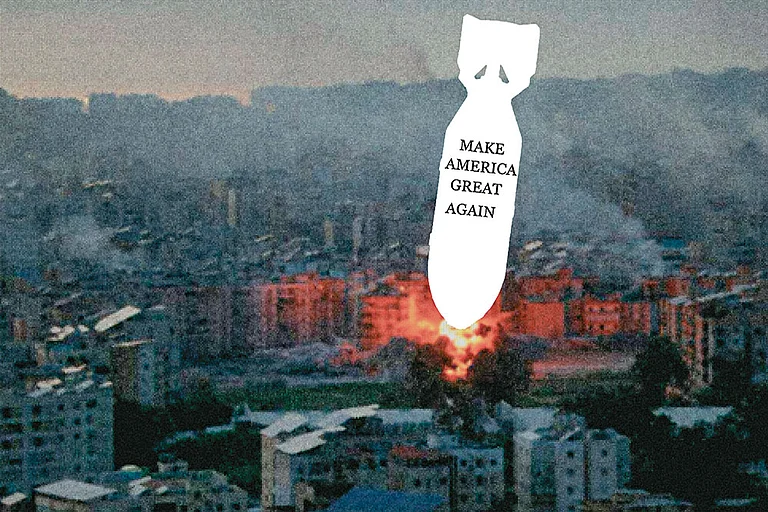
The US is now looking to escort tankers crossing the Strait of Hormuz that are no-go zones, though Iran is not touching vessels bound for China. South Asia, including India, are affected; cooking gas prices are already up. The US has given ‘permission’ to New Delhi to buy Russian oil, which created a major embarrassment for the government.
War costs for the US are mounting by the day. According to the Washington-based think-tank, the Center for Strategic and International Studies (CSIS), in the first 100 hours of the war, the US spent as much as $3.7 billion. Every hour the war continues, the cost will escalate. In contrast, Iran is spending a fraction of what the US does. But America is the world’s richest economy and Trump will always find the funds to continue the war till the end goal is reached.
Advertisement
The problem is that Trump has been shifting the goalposts. Is the war about nuclear deterrence or regime change? Trump has offered various reasons—from ensuring that Iran never has nuclear weapons to destroying its missile capabilities, and regime change. But regime change without boots on the ground is easier said than done. Iran does not have an organised opposition waiting in the wings. The son of the late Shah has a following among the Iranian diaspora, but little support inside Iran. The CIA is preparing to use Kurdish fighters in bordering Iraq to further weaken the regime, raising the possibility of prolonged chaos and civil war, as was the case in Iraq. “We are not surprised. This is from the Israeli playbook. It is not just the Kurds, but also the Azeris, Baluchis and other minorities. Mossad and the CIA have done this before, using the ISIS and Daesh to attack Iran,” said an Iranian diplomat who did not wish to be named.
Advertisement
The overall winner so far is Israel’s Benjamin Netanyahu, who has admitted that he has waited 45 years for this moment. Since the overthrow of the Shah that ended Iran’s pro-Western alignment, the Islamic Revolution positioned itself as an ideological challenger to Israel and the US. After the 2023 Hamas attack on Israel, Israel’s military might was on full display. The Israel Defense Forces have struck at Iran’s proxies from Hamas in Gaza to the Hezbollah in Lebanon, while Shia militias in Iraq and the Houthis have been weakened. With Bashar al-Assad out of the way in Syria, Israel has emerged as the dominant military power in West Asia. Iran was the only major country standing in its path, and that too is now considerably weakened. Increasingly, this looks like a high-stakes attempt with US backing to reshape the balance of power that has defined West Asia since 1979 and possibly redraw the map of West Asia to fulfil the Zionist dream of the promised land. US envoy to Israel Mike Huckabee has spoken of Israel’s “biblical right” to the land and has long referred to the occupied West Bank as “Judea and Samaria”.
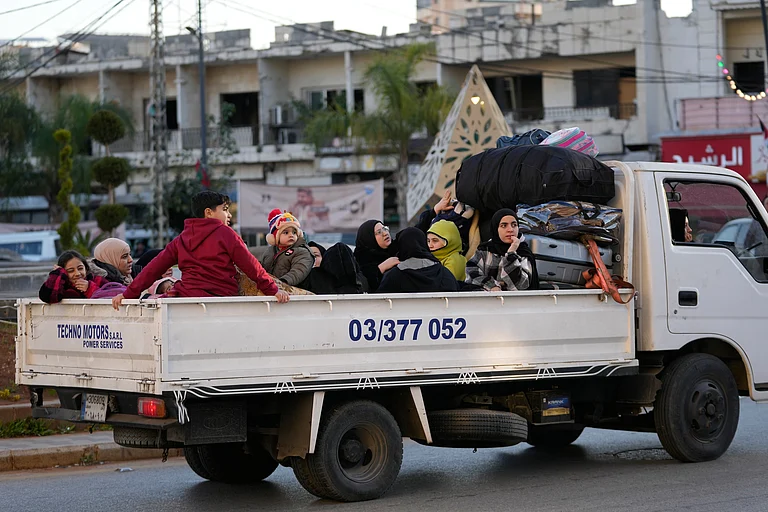
What seems preposterous today may be a reality next, considering that the law of the jungle is in full play. Trump has disdain for the UN and the rule-based system that has been in place since the end of the Second World War. In Venezuela, the US captured the president of a sovereign country and put him behind bars in New York. In Gaza, Israel broke all the rules of combat, hitting hospitals and civilians. The world watched silently at the violation of international law.
“Iran is the latest and the most consequential effort by the US and Israel to tear apart the international legal order set up in 1945, which is or was highly imperfect, but which at least set minimum moral and legal standards against which to judge and possibly restrain the behaviour of states. Might is right has become the norm of a new lawless anarchical age,” says Philip Golub, professor of International Studies in the American University of Paris.
The global economy will go into a tailspin if the war is prolonged. Iran’s neighbours must step up their diplomacy to force Trump’s hand. “To bring the war to an end, we need a robust diplomatic initiative from the regional states, principally Saudi Arabia, Türkiye, the UAE and Qatar. Just as Netanyahu pushed the US president to war, similarly, the other major states should be the promoters of peace. They should make it clear to Trump that the war is not serving any useful purpose. Instead, it poses a grave threat to global energy security through high prices and curtailed supplies due to damage to oil production facilities in the Gulf,” says Talmiz Ahmad, former ambassador of India to Saudi Arabia.
Trump’s endgame is difficult to guess. Trump’s MAGA base is not happy. And most Americans are more concerned with domestic issues like inflation, which is likely to get worse if the war drags on longer. The president who dodged the Vietnam War as a young man and campaigned on stopping never-ending wars, now enjoys projecting America’s military might. Even as the bombs fall on Iran, Trump is already hinting at the next target, Cuba, predicting its regime could soon fall.
Seema Guha Is A Senior Journalist Covering Foreign Affairs.
This article is part of Outlook 's March 21 issue 'Bombs Do Not Liberate Women' which looks at the conflict in West Asia following US and Israel’s attacks on Iran leading to the assassination of Ayatollah Ali Khamenei, while the world wondered in loud silence, again, Whose War Is It Anyway?
Published At:
Tags