




The agenda was full to overflowing at the eighth dharma sansad, organised by the vhp in Ahmedabad last week. First up was a reiteration of its commitment to the construction of a Ram temple at Ayodhya. Year 2001 is the deadline to start construction work, and a 'mass-awakening' movement will be undertaken by the vhp. At least until the next general election, the vhp wants to reassure its supporters and potentially restive cadres that, unlike the bjp, it has not forgotten its old promise.
'The saints will chalk out an agitational programme on the issue of Ram temple,' said Dr Pravin Togadia, the vhp's international secretary general. The resolution was discussed at the meeting of the vhp's kendriya margdarshak mandal (central guiding body).
The dharma sansad also passed a resolution concerning the acquisition of Hindu religious property by different governments, seeking to 'stop the interference...in the religious matters of the Hindus.' Said Togadia: 'When no churches or mosques are being managed by the government why should we allow them to manage the Hindu temples?'
Many sadhus are terrified by the Madhya Pradesh government's move to bring all temples under the government control. 'The MP government is planning to bring a bill to acquire all the temples and give compensation of Rs 1,000 each to all sadhus and pujaris. This is not tolerable,' says Acharya Giriraj Kishore.
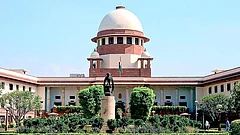


Unfolding a two-pronged reform programme, the margdarshak mandal passed a resolution to 'root out' untouchability and all other discrimination on the basis of caste. The vhp announced its decision to rope in different akharas for charity work, particularly to counter the Christian missionaries active among the tribals. Said Togadia: 'Around 5,000 sants will be requested to open hospitals, schools etc. Each will adopt a district or tehsil to remove untouchability.' Citing a Supreme Court ruling of January 1977, the vhp has demanded that conversion be declared illegal and unconstitutional.
But the reforms ring hollowóthe ideological ground of varnashram dharma on which the rss and its organisations stand, justifies discrimination on the basis of caste and also justifies it as the creation of god. Asked about inter-caste marriages, Togadia parried: 'Tokenism doesn't pay in the longer run. We don't want to stop there.'
But Acharya Dharmendra, one of the aggressive acharyas of the vhp, could not conceal his hatred for the mingling of unequal castes: 'Jab do nasio ko milake ek nasl banai jaati hai to Rajiv Gandhi jaisi khoobsoorat aulad paida hoti hai (Beautiful children like Rajiv Gandhi are born when two different races mix together and produce a new race). But they remain confused all their lives; they are neither here, nor there.' He drew an interesting parallel with dogs, saying, 'There are so many species of dogs, some are Alsatians and the others are gali ke kutte. All these qualities (sic) will always remain but there should not be any hatred among them'.
The venue where the dharma sansad was held was named after Sant Ravidas, a lower-caste saint-poet of the Bhakti period. 'We don't believe in tokenism,' Togadia had said. There were too many Acharya Dharmendras around, unfortunately, ready to bely that assertion.








