



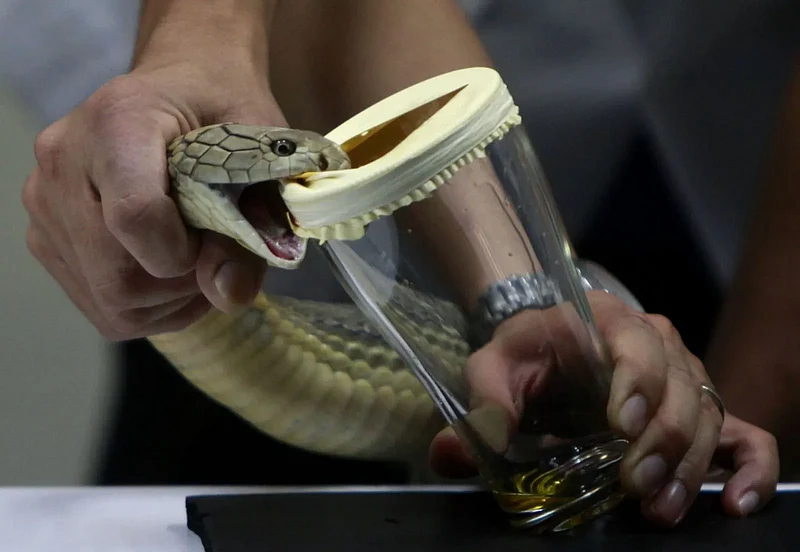
India's fight against snakebite is set to get a potential boost, with a team of researchers developing a new antivenom specifically designed to counter the venom of two pit viper species found in the Northeast, where the country's existing snakebite treatment has significant gaps.
The development could address a long-standing limitation of India's commercially available polyvalent antivenom, which is designed primarily to neutralise the venom of the country's four major venomous snakes — Russell's viper, spectacled cobra, common krait and saw-scaled viper.
Several other medically important species found in different parts of the country, particularly the Northeast, are not adequately covered by this formulation.
The new equine F(ab')₂ bivalent antivenom has been developed against the Pope's pit viper (Trimeresurus popeiorum) and the red-tailed bamboo pit viper (Trimeresurus erythrurus). Venom samples used in the research were collected from Mizoram and Meghalaya.
The research team was led by Prof. Ashis K. Mukherjee, Director of the Institute of Advanced Study in Science and Technology (IASST), Guwahati, an autonomous institute under the Department of Science and Technology. The project brought together researchers from IASST, Premium Serums and Vaccines Pvt Ltd, Pune, Amrita Research Center, Delhi-NCR, Mizoram University and Aaranyak, Guwahati.
Laboratory and preclinical investigations showed that the new antivenom offered significantly better protection against the two pit viper venoms than the existing Indian polyvalent antivenom. It also reduced disturbances in blood coagulation and damage to local tissues and organs associated with these bites.



However, the formulation is not yet ready for clinical use. Prof. Mukherjee said further clinical and regulatory testing would be required before it could be routinely administered to patients.
The development is significant because India's snakebite treatment strategy has traditionally centred on the Big Four, which account for around 90% of snakebites in the country. The national polyvalent antivenom is estimated to be effective in about 80% of snakebite cases, according to the National Action Plan for Prevention and Control of Snakebite Envenoming.
But India's diverse snake population presents a more complex challenge. Venom composition varies across species and geographical regions, and an antivenom developed using venom from one set of snakes may not offer adequate protection against others.
This is particularly relevant in the Northeast, which has a rich diversity of venomous snakes. The two pit vipers targeted by the new formulation are among the medically important species in the region, but their venoms are not specifically covered by the conventional Big Four antivenom.
For patients in remote areas, the consequences can be serious. Delays in identifying the snake species, limited access to specialised treatment and the absence of an effective antivenom can complicate management and increase the risk of bleeding disorders and tissue damage.
The problem is not unique to India. Snakebite envenoming remains a major but neglected public health challenge across tropical and subtropical regions, particularly in Asia, Africa and Latin America.
According to the World Health Organization (WHO) estimates, around 5.4 million people are bitten by snakes worldwide every year, resulting in 1.8 million to 2.7 million cases of envenoming. Between 81,000 and 138,000 people die annually, while many more suffer permanent disabilities, including tissue damage and amputations.
One of the biggest challenges globally is ensuring that antivenoms are effective against the venomous snake species prevalent in a particular geographical region.
Differences in venom composition, even among populations of the same species, can affect how well an antivenom works.
Researchers have for several years been calling for region-specific antivenoms, arguing that India's dependence on a single polyvalent formulation targeting the Big Four venomous snakes leaves significant gaps in snakebite treatment. A 2021 study published in PLOS Neglected Tropical Diseases, which examined spectacled cobra venom from seven populations across six biogeographical zones, found that the commercially available antivenom failed to adequately neutralise venom from several populations. The researchers from the Indian Institute of Science (IISc), Bengaluru, emphasised the need to account for geographical variations in snake venom while developing antivenoms.
The WHO has also flagged shortages, high prices, inadequate quality control and the use of poorly matched antivenoms as major barriers to treatment. Its strategy aims to reduce snakebite-related deaths and disabilities by 50% by 2030.
Against this backdrop, the Indian research assumes wider significance. It underlines the need to move beyond a one-size-fits-all approach and develop antivenoms based on the snakes responsible for serious envenoming in different regions.
The findings, published in the International Journal of Biological Macromolecules, also highlight the importance of bringing together research institutions, universities and industry to translate laboratory discoveries into potential treatments.
For India, the next challenge will be to take the candidate through clinical evaluation, regulatory approval and manufacturing, while ensuring that an effective product eventually reaches hospitals and health centres in remote snakebite-prone areas.







