Every summer, 17-year-old Aarav from Delhi dreads stepping outdoors. Relentless heatwaves and hazardous air pollution force him to stay indoors, leaving him anxious and withdrawn. Miles away, in flood-ravaged Assam, 15-year-old Riya still wakes up terrified months after swollen rivers washed away her family's home. In the western part of the country’s drought-hit Maharashtra, a young farmer lies awake night after night wondering whether another failed monsoon will destroy his crops and push his family deeper into debt.
These stories may be different, but they point to the same growing reality. Across India, climate change is no longer affecting only people's homes, livelihoods and health. It is also taking a silent toll on their minds.
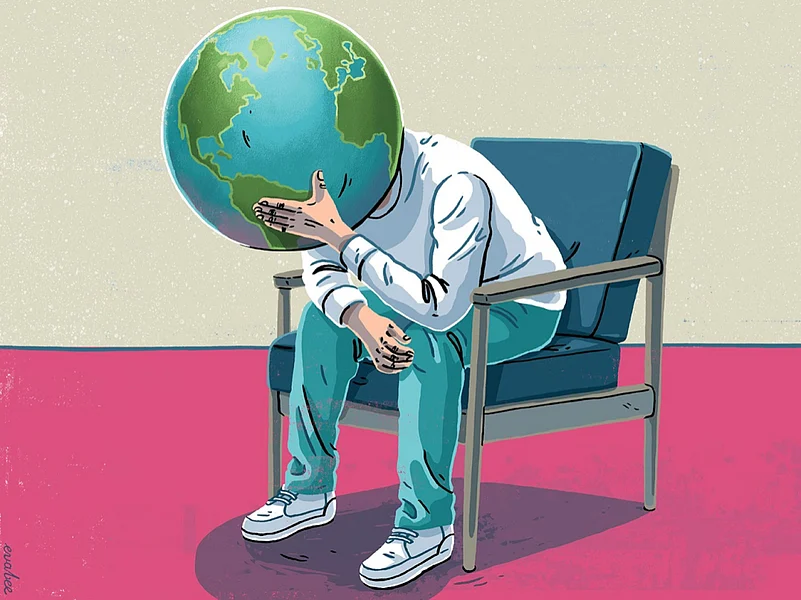
Mental health experts describe this growing emotional distress as eco-anxiety—a persistent fear, worry and helplessness about climate change and its consequences. Prof. S.K. Satheesh of the Indian Institute of Science (IISc), Bengaluru, one of the India's leading climate scientists has now added his voice to the concern, arguing that the issue deserves far greater attention.
In an editorial published in the latest issue of Current Science, Prof. Satheesh warns that eco-anxiety is emerging as an overlooked public mental health challenge, particularly in climate-vulnerable countries such as India.
Known internationally for his work on climate science and atmospheric aerosols, Prof. Satheesh says the psychological effects of climate change can no longer remain outside discussions on climate policy.




"Eco-anxiety is not currently regarded as a psychiatric disorder but as a normal emotional response to the escalating climate crisis," Prof. Satheesh writes. However, he cautions that if these fears remain ignored, they can gradually develop into chronic stress, depression, emotional exhaustion and a poorer quality of life.
According to him, eco-anxiety is different from the trauma experienced after a flood or cyclone. Instead, it develops slowly as people repeatedly witness heatwaves, floods, droughts, cyclones, forest fires, pollution and other environmental disasters. Constant exposure to disturbing news reports and social media images reinforces the feeling that the future is becoming increasingly uncertain.
The American Psychological Association defines eco-anxiety as "the chronic fear of environmental cataclysm that comes from observing the seemingly irrevocable impact of climate change and the associated concern for one's future and that of next generations."
Children and young adults are among the most vulnerable.
The editorial cites studies showing that more than half of young people across the world worry about the future of the planet. Many report that these fears interfere with sleep, concentration, studies and everyday life.
The United Nations Children's Fund (UNICEF) has also described climate change as a child-rights crisis because children are disproportionately affected by its psychological consequences.
Indian studies paint a similar picture. Surveys reviewed by Prof. Satheesh indicate that many young Indians experience anxiety, sadness and stress linked to environmental degradation and climate change.
Fresh evidence from India further reinforces these concerns.
A study published in the International Journal of Indian Psychology by researchers from CHRIST (Deemed to be University) in 2024 found that eco-anxiety is becoming a significant psychological concern even among young adults who have no diagnosed anxiety disorder.
The study, titled "Exploring Eco-Anxiety and Eco-Coping in Young Adults in India", was conducted by Dr. Vartika Jain, Dr. Alphonsa Jose, Dr. Eldhose N.J. and Dr. Daisy John.
Interviewing young adults aged 18 to 24 years from different parts of the country, the researchers found that climate change commonly triggered emotions such as fear, sadness, helplessness, frustration and guilt. Many participants worried about the future but also felt powerless to bring about meaningful change.
The researchers identified seven broad themes, including awareness of climate change, emotional responses, coping strategies, barriers to environmental action, personal experiences and concerns about the future.
Importantly, they noted that eco-anxiety need not always have negative consequences. With appropriate support, these concerns can motivate young people to adopt environmentally responsible behaviour and participate in climate action.
The emotional burden is not limited to cities.
For India's small and marginal farmers, climate uncertainty has become an everyday reality.
"Eco-anxiety, also referred to as climate distress, has become a common challenge among small and marginal farmers in India," said Pawan Kumar, Principal Lead, Agricultural Development and Extension at the S M Sehgal Foundation, engaged in promoting sustainable livelihood across the country.
According to Kumar, erratic rainfall, prolonged dry spells, floods, heatwaves and repeated pest attacks have made farming increasingly unpredictable.
"These uncertainties create constant stress and anxiety, as farmers remain unsure about the success of their crops and their future livelihoods," he explained.
Repeated crop failures, shrinking incomes and mounting debt often leave farming families under prolonged emotional and financial strain.
Kumar said farmers can become more resilient through timely weather forecasts, agro-advisories, crop insurance and wider adoption of climate-smart farming practices.
Prof. Satheesh also points to another growing concern—climate-induced migration.
Rising sea levels, groundwater depletion, desertification and coastal erosion are already forcing communities to relocate. According to estimates cited in the editorial, more than 45 million people in India could be displaced by 2050 because of climate-related factors.
Such displacement often means losing homes, livelihoods and social support systems, increasing the risk of anxiety, grief and long-term psychological trauma.
The editorial further notes that climate fears are often compounded by other uncertainties confronting young people, including food and water insecurity, geopolitical conflicts, inflation, economic slowdown and rapid advances in artificial intelligence that have raised concerns over future employment.
Against this backdrop, Prof. Satheesh argues that climate literacy should become an integral part of school education and public health programmes.
"Converting complex climate science into accessible knowledge helps reduce uncertainty and gives individuals a greater sense of control over their future," he says.
The World Health Organization has similarly stressed that climate education helps communities better prepare for climate-related health risks and strengthens resilience.
Experts also believe emotional support is critical.
"Climate change is one of the defining challenges of our time, and while it is a problem created and largely driven by adults, children are increasingly living with its consequences," said Sonali Khan, Managing Director of Sesame Workshop India.
She said parents, teachers and caregivers should encourage honest, age-appropriate conversations that acknowledge children's fears while helping them develop hope and resilience.
Through its 'Mera Planet Mera Ghar' initiative, Sesame Workshop India encourages children to adopt simple environment-friendly habits and understand that even small actions can contribute to protecting the planet.
"As the inheritors of our planet, children deserve the knowledge, confidence and tools to become environmentally conscious citizens who feel empowered to create positive change," Ms. Khan said.
The growing concern is reflected in international surveys. According to the European Youth Portal, 75 per cent of young people fear the future because of climate change. A landmark 2021 study published in The Lancet Planetary Health, involving 10,000 young people across 10 countries, found that 59 per cent were very or extremely worried about climate change, while nearly half said these concerns affected their daily lives.
For clinical psychologist and founder of Mind Zone, Dr. Sunil Kumar, the message is clear.
“As climate extremes become more frequent, protecting mental well-being must become an integral part of India's climate response. Alongside reducing emissions and strengthening adaptation, recognising and addressing eco-anxiety may prove essential for building a healthier and more resilient society,” he said.