With his elevation, the BJP’s long-standing ambition in Bihar has finally been realised.
Nearly five decades after emerging as a political force, BJP will now have its first Chief Minister in one of the most important states of the Hindi heartland.
Samrat belongs to the Kushwaha community (Koiri, Kurmi, Dhanuk groups), which is estimated to make up nearly 10 per cent of the state’s population.
Nitish Kumar’s Chosen One: Bihar Gets A BJP CM, As Samrat Era Begins
Power is now shifting from Nitish Kumar’s Kurmi leadership to Samrat Choudhary’s Kushwaha leadership.

Summary
On October 30, 2025, at a public meeting in Tarapur Assembly constituency of Munger district, Union Home Minister Amit Shah was campaigning for Samrat Choudhary. Addressing the crowd, he had said, “People of Tarapur, we have already given you a ready-made Deputy Chief Minister. Trust us and ensure Samrat ji wins by a huge margin. Modi ji will make Samrat ji a big leader—a very big leader.”
Last month, during Bihar’s Samriddhi Yatra, Chief Minister Nitish Kumar placed his hand on Deputy Chief Minister Samrat Choudhary’s shoulder and indicated that after him it would be Samrat who would carry the responsibility forward. Throughout the nearly month-long tour, Nitish repeatedly hinted, often indirectly, that Samrat Choudhary could be his successor.
Apart from these two moments, however, in recent weeks, several other names were floated in the media, often citing sources, giving the impression that the BJP might spring a surprise over its chief ministerial choice in Bihar, as it has done in other states. Although Choudhary remained the frontrunner among the possible candidates, uncertainty over the final face of the Chief Minister continued until Tuesday afternoon.
As the evening progressed, the focus increasingly shifted toward Samrat Choudhary, and before the day ended, his name was formally approved. Unlike earlier instances in other states, the BJP did not put forward a surprise candidate this time. Instead, the party chose the name that had been discussed the most and was also believed to be acceptable to its alliance partner JD(U) and its national president Nitish Kumar. With the announcement of Samrat’s name, speculation over the next Chief Minister of Bihar finally came to an end.
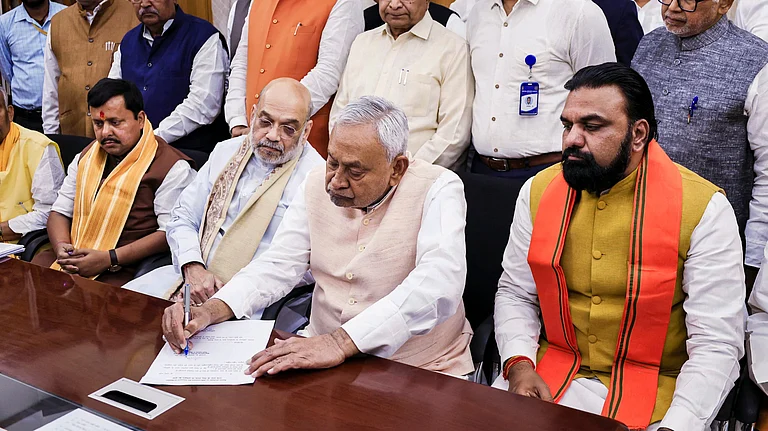
On April 14, the BJP selected Samrat Choudhary as the leader of its legislature party in Bihar, effectively confirming that he would become the party’s first Chief Minister in the state. He is scheduled to take the oath at Lok Bhavan at 11 a.m. on April 15.
Interestingly, on the same day, Samrat Choudhary remained alongside Chief Minister Nitish Kumar from the morning. When Nitish went to the Raj Bhavan to submit his resignation, Samrat was seen seated beside him in the front seat of the car.
Advertisement
He said, “Nitish Kumar has taught us how a government should be run and what is right for Bihar’s democracy. I want to assure everyone that just as Prime Minister Modi has envisioned a developed India and Nitish Kumar has envisioned a prosperous Bihar, all of us together will work to realise these dreams.”
No impact of ‘outsider’ tag
According to reports, Samrat Choudhary was not the first preference of the RSS for the Chief Minister’s post. The organisation was believed to favour a Dalit or extremely backward caste leader as Bihar’s first BJP Chief Minister. Even within the BJP, a section was not in favour of his name. One reason cited for this hesitation was the perception that Samrat Choudhary was an “outsider” within the party’s core structure. Despite this, how did he reach this position?
Advertisement
Observers say a major reason was that Nitish Kumar himself wanted Samrat Choudhary as his successor. Senior journalist Vivekanand Singh Kushwaha says, “Samrat Choudhary is becoming Chief Minister because Nitish wants him to. More than the BJP’s preference, Nitish’s choice has mattered here. Nitish Kumar has not left the Chief Minister’s chair for the BJP as such, but for Samrat Choudhary. This closeness between the two goes back to the time of Samrat’s father, Shakuni Choudhary.”
Samrat Choudhary’s political journey began in 1995 under the guidance of his father. At the time, Shakuni Choudhary was with the Samata Party. In the 1995 Bihar Assembly elections, when the newly formed Samata Party won just seven seats, one of them was Tarapur, from where Shakuni Choudhary was elected.
However, relations between Shakuni Choudhary and Nitish Kumar later deteriorated, and they parted ways. Shakuni Choudhary then joined the RJD. During that period, Samrat Choudhary became Agriculture Minister in Rabri Devi’s cabinet, even though he was not a member of either House at the time. Questions were also raised about whether he met the age requirements for the ministerial post, and he had to step down within six months. The following year, however, he contested from Parbatta Assembly constituency on an RJD ticket and won. That was his first election victory. Even in 2010, when the RJD won only 22 seats statewide, Samrat retained Parbatta. For this reason, many people believe his political career began with the RJD. But Vivekanand Singh Kushwaha argues that Samrat’s political journey actually began alongside Nitish Kumar during the Samata Party days, when both he and his father were involved in the movement to make Nitish Chief Minister, and Samrat even faced police lathi charges during that period.
Advertisement
Shifting parties
Samrat Choudhary later moved across several parties before joining the BJP. The year 2013 is considered a turning point in his political career. That year, he left the RJD. When Nitish Kumar broke ties with the BJP and needed support to save his government, Samrat reportedly helped bring along 13 RJD MLAs. It is often said that Samrat stood with Nitish at a time when he needed support the most.
However, this alliance did not last long. After the BJP’s defeat in the 2014 Lok Sabha elections, Nitish Kumar made Jitan Ram Manjhi Chief Minister, and Samrat became a minister in his cabinet. But nine months later, when Manjhi stepped down and formed his own party, HAM, both Shakuni Choudhary and Samrat joined him. Shakuni Choudhary later became the party’s state president.
In the 2015 Assembly elections, Shakuni Choudhary contested on a HAM ticket but lost and then announced his retirement from politics. Meanwhile, Samrat’s proximity to the BJP continued to grow. In 2018, he formally joined the BJP, and since then, his position within the party has steadily strengthened.
Advertisement

Strong governance record
Over the years, Samrat Choudhary has served as a minister under three Chief Ministers—Rabri Devi, Jitan Ram Manjhi and Nitish Kumar—and has handled more than five departments.
With his elevation, the BJP’s long-standing ambition in Bihar has finally been realised. Nearly five decades after emerging as a political force, the party will now have its first Chief Minister in one of the most important states of the Hindi heartland.
Apart from Samrat Choudhary, other BJP leaders whose names were discussed as possible contenders included Vijay Kumar Sinha, Nityanand Rai, Mangal Pandey, Dilip Jaiswal and Giriraj Singh. There were also names from Dalit and extremely backward caste communities.
Among backward caste leaders, Samrat Choudhary and Union Minister of State for Home Nityanand Rai were considered the strongest contenders. Both were seen as influential because of their social base in Bihar. Samrat belongs to the Kushwaha community (Koiri, Kurmi, Dhanuk groups), which is estimated to make up nearly 10 percent of the state’s population. Nityanand Rai belongs to the Yadav community, which accounts for around 14 percent. For nearly 35 years, Bihar’s politics has revolved largely around these social blocs—from the era of Lalu and Rabri’s Yadav politics to Nitish Kumar’s “Luv-Kush” social equation.
Observers believe Samrat Choudhary held an advantage over Nityanand Rai in caste arithmetic because the Luv-Kush combination has historically been more favourable for the BJP than the Yadav base, which remains strongly aligned with Lalu Prasad Yadav’s politics. The way the BJP projected Samrat Choudhary has also helped attract a significant section of the Kushwaha community toward the party. Seen from this perspective, his elevation can also be viewed as part of a longer-term political strategy.
Senior journalist Manikant Thakur, who has followed Bihar politics for nearly five decades, says Samrat’s appointment is part of a broader strategy to gradually move beyond Nitish Kumar’s dominance and establish the BJP more firmly in the state. According to him, the party promoted Samrat consistently so that he could gain Nitish Kumar’s confidence. Winning Nitish’s trust became the priority, even if some sections within the BJP were unhappy. It is this trust, he says, that made it possible for Nitish Kumar to transfer power after 22 years with relative ease.
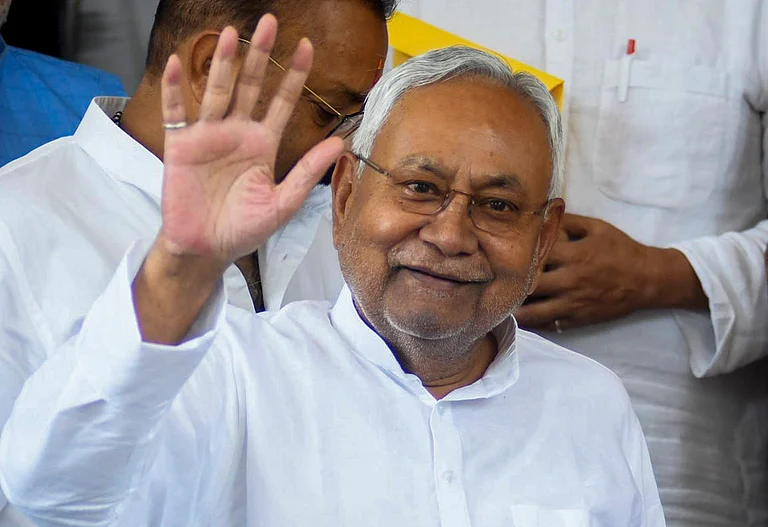
Samrat Choudhary’s rise within the BJP has been steady. When Nitish Kumar formed a government with the RJD earlier, the BJP appointed Samrat as Leader of the Opposition. When Nitish later returned to the NDA, Samrat became Deputy Chief Minister. After the NDA’s strong victory last November, he was given not only the Deputy Chief Minister’s post but also the Home portfolio, placing him clearly second in the power structure after Nitish Kumar.
Despite these developments, questions remain about how long Samrat Choudhary’s tenure will last and how much autonomy he will have, given the BJP’s centralised style of governance in other states. Political analyst Ashish Ranjan says it is too early to predict whether Samrat will have a long innings like Lalu Prasad Yadav or Nitish Kumar, but much will depend on his performance.
He also points out that this is the first time Bihar will have a BJP Chief Minister who is not a traditional party insider and who has been associated at different times with all three major political formations in the state. According to him, Samrat’s selection also reflects the continuing importance of backward caste politics in Bihar. Despite a strong mandate, the BJP did not risk projecting an upper-caste leader as Chief Minister, which shows how central backward caste representation remains to the state’s political reality.
In short, the dominance of extremely backward caste politics continues in Bihar. Power is now shifting from Nitish Kumar’s Kurmi leadership to Samrat Choudhary’s Kushwaha leadership.
Choudhary has remained at the centre of several controversies in the past, including questions around his date of birth, his D.Litt degree, and his public vow not to remove his muraitha (turban) until Nitish Kumar was removed from office. Despite this, he emerged as Nitish Kumar’s preferred choice and worked alongside him in government. He is now set to become the Chief Minister of Bihar.
Published At: