His move marks his presence across all major legislative bodies after decades in public life.
Analysts suggest his shift is being carefully managed to preserve influence and ease his exit from long-held authority.
Speculation intensifies over his resignation and successor, with names like Samrat Chaudhary emerging as frontrunners.
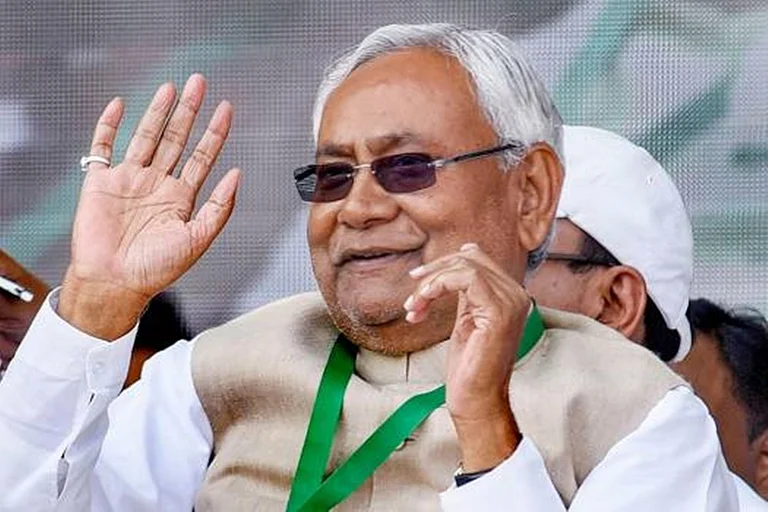
From Chief Minister To Rajya Sabha: The Final Phase Of Nitish Kumar’s Political Journey
As Nitish enters the Rajya Sabha after decades in power, questions grow over his political transition and succession in Bihar politics.

Summary
On April 9, when Nitish Kumar took the oath as a member of the Rajya Sabha in Delhi, he formally became part of Parliament again after nearly two decades, an institution he had first entered in 1989 after being elected from the Barh Lok Sabha constituency in Bihar. Although he was elected to the Lok Sabha six consecutive times, Friday marked the first occasion on which he entered the Upper House, thereby adding another chapter to his long parliamentary career.
With this, Nitish has now recorded his presence in all four legislative bodies he has been associated with over the years: the Lok Sabha, the Rajya Sabha, the Bihar Legislative Assembly, and the Bihar Legislative Council. He was elected twice from the Harnaut Assembly constituency and four times to the Legislative Council. During nearly twenty years as Chief Minister, he remained a member of the Legislative Council.
A prominent figure in Bihar politics since the 1990s, Nitish began his political journey during the JP Movement of 1974. Except for brief intervals, he has been among the few politicians in the country whose public life has remained closely tied to positions of authority for nearly twenty-five years. He served as a Union Minister in Atal Bihari Vajpayee’s government between 1999 and 2004, and has been Chief Minister of Bihar since 2005.
However, after 15 April, it is being widely speculated that he may step away from this long phase of active engagement with power, which is something that could itself become a difficult transition for him.
Former TISS Mumbai professor Pushpendra believes that remaining in power for such a long period inevitably shapes one’s habits. Being constantly surrounded by people, hearing slogans in his favour, moving with official convoys, and having bureaucrats and government machinery respond instantly to one’s word—these patterns become part of everyday life, whether one intends them to or not. According to him, Nitish has spent nearly twenty-five years in such an environment, and stepping out of it will not be easy.

There are also reports that after becoming a Rajya Sabha member, Nitish may be allotted a high-security Type-8 government bungalow in Delhi’s Lutyens’ Zone. Renovation work is already underway in three such houses in the Sunehri Bagh area.
Advertisement
Pushpendra argues that a Rajya Sabha MP is ordinarily not entitled to accommodation of this category. If such a residence is indeed being arranged, he suggests, it indicates that the BJP does not want the aura of authority associated with Nitish to disappear abruptly. Allocating him an ordinary MP’s accommodation would have made the transition sharper and perhaps more uncomfortable. It could also have sent the wrong signal to his supporters and voters. In his view, Nitish’s political transition is still incomplete. The BJP, he believes, is attempting to manage not just his personal transition but also the gradual shift of his support base and vote bank. For that reason, he may continue to be seen within the orbit of power at least until the next election.
Senior journalist Arvind Sharma, however, sees the situation differently. He believes Nitish has reached the final stage of his political journey, and his declining health may prevent him from fully registering the distance from power.
Advertisement
According to Sharma, preparations for a dignified political farewell are already underway. What remains now is his resignation from the post of Chief Minister. As for the aura of power, Sharma suggests that Nitish’s current condition is such that these questions may no longer matter to him in the way they once did. He compares him to leaders like George Fernandes and Atal Bihari Vajpayee, implying that he is unlikely to take on new political battles and may now spend his remaining years away from active contestation.
Meanwhile, speculation continues in Bihar over the formation of a new government and the choice of the next Chief Minister. Political suspense has deepened with each passing day. A recent statement by Minister Vijay Kumar Chaudhary regarding Nitish’s Rajya Sabha membership and possible resignation reflects this uncertainty.
After taking the oath, Nitish returned to Patna on the evening of 9 April. He was accompanied by Sanjay Jha and Vijay Chaudhary. Responding to questions about the formation of a new government, Chaudhary said that Nitish’s entry into the Rajya Sabha does not automatically mean there will be a change of government in Bihar. Governments are formed after resignations, not after taking membership, he remarked, adding that it was too early to draw conclusions.
Advertisement

Another layer of speculation emerged from a statement by TMC MP Shatrughan Sinha, who said he did not expect a new Chief Minister to be appointed so quickly. He suggested that Nitish should be allowed some rest, and so should everyone else. Calling Nitish a friend, he noted that Bihar has several capable leaders. He mentioned Tejashwi Yadav as one such figure, but also referred to Prashant Kishor, suggesting observers should keep an eye on him as well.
Amid all this, recent developments indicate that preparations for a new government in Bihar are gaining momentum. On the morning of 11 April, JD(U) working president Sanjay Jha and minister Vijay Chaudhary met Nitish. This was followed by a nearly two-hour meeting of JD(U) leaders at the Chief Minister’s residence, where discussions reportedly focused on the shape of the new cabinet. Later in the evening, both Deputy Chief Ministers arrived unexpectedly at the Chief Minister’s residence and met Nitish for about thirty minutes. Afterwards, Vijay Sinha went to Lok Bhavan and met Governor Syed Ata Hasnain. He left after a brief discussion without speaking to the media.
Advertisement
These developments up to 11 April have clarified the situation to a considerable extent. According to reports, the Bihar cabinet is expected to hold its final meeting on 13 April, which Nitish will attend. The following day, 14 April, he may resign from the post of Chief Minister. On the same day, the NDA is expected to meet and formally decide on the next Chief Minister. A new government could be in place by 15 April.
According to sources, despite ongoing speculation, Samrat Chaudhary continues to be the frontrunner in the race for the Chief Minister’s post. Notably, Nitish himself has on several occasions indicated support for his name during the Samriddhi Yatra.
Published At: