



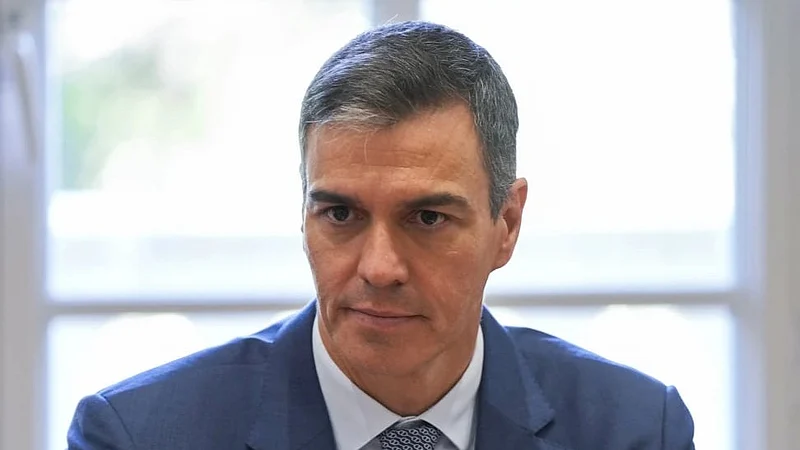
Pedro Sánchez is seeking to extend eight years of Socialist-led government
Alberto Núñez Feijóo's Popular Party leads opinion polls at around 31%
Santiago Abascal's Vox, polling near 18%, could join a coalition
A political survivor, a careful administrator and a populist hardliner are shaping Spain's choice on Sunday, November 29.
Pedro Sánchez wants to hold on to power, Alberto Núñez Feijóo wants to take it from him, and Santiago Abascal could decide whether Feijóo gets there.
The snap election on 29 November could end eight years of Socialist-led government. It could also bring the far right into the national government for the first time since democracy was restored.
Opinion polls reportedly put the conservative People's Party (PP) first at around 31% and Sánchez's Socialist Party (PSOE) mostly a close second, despite a recent rise to almost 30%. Pollsters place Abascal's Vox at roughly 18%, helped by younger and male voters. Practically all surveys point to a PP-Vox coalition as the only likely route to a majority in the 350-seat lower house.
Can The Escape Artist Do It Again?
Sánchez, 54, has led Spain since 2018 and ranks among Europe's longest-serving leaders. A trained economist with a polished manner and command of English, he has become a favourite of the global progressive movement.


He has taken strong positions against US President Donald Trump, the US-Israeli war against Iran and Israel's military operations in Gaza. At home, he has stood by his pro-migration policies despite a wider turn against immigration across the developed world. Spain has been Europe's fastest-growing major economy for several years under his watch, yet anger over housing costs has persisted.
That anger brought the country to this vote. Parliament rejected Sánchez's decrees on rents and evictions on 2 October, and he responded by calling an early election. The measures followed protests over the eviction and subsequent death of 87-year-old Maricarmen Abascal, whose monthly rent in Madrid had risen from €570 to €1,650.
The election call was widely seen as a bid to harness the housing protests and repair political damage. Sánchez had been hurt by a migration crisis in Ceuta, a deadly train crash in January and corruption investigations involving his inner circle. Another train crash followed on 28 October.
The legal cases involve a former minister, senior party officials and his wife, who denies wrongdoing.
Sánchez has a history of defying the odds against rivals inside and outside his party. After the Socialists suffered heavy losses in regional elections in 2023, he called a general election the very next day. He campaigned on fears of the far right entering government, won another term and formed a new left-wing coalition.
So far, however, his effort to mobilise the left appears to be falling short.
The Low-key Man With A Powerful Machine
Feijóo, 65, offers a different profile. A civil servant who turned to politics, he has avoided scandal and presents himself as a moderate and effective centre-right administrator.
His reputation was built in Galicia, the rural and less-developed northwestern region he governed for 13 years while winning election after election. The region has long produced prominent politicians, including dictator Francisco Franco and former Prime Minister Mariano Rajoy. Rajoy's government, in office from 2011 to 2018, was the last led by the PP.
Feijóo wants less regulation and lower taxes. He shares Sánchez's firm support for the European Union, but is expected to repair relations with the United States and Israel if he wins.
He took charge of the PP in time for the last general election and failed to unseat Sánchez. The party has retained broad support since, putting pressure on him to turn it into power this time. Rivals may overshadow his quiet style, but he commands a finely tuned electoral machine entrenched in Madrid and many rural provinces.

The Would-be Partner With Demands
Abascal, 50, hails from the northern Basque Country and projects a tough, macho image. His ultranationalism was shaped in response to violence by the separatist group ETA, which disbanded in 2018.
Once a rank-and-file PP member, he joined others in breaking away to found Vox in late 2013. He soon became its leader and has kept a firm grip on the party.
His politics place him within the populist right spreading from the US to Europe. Abascal strongly defends Israel and has criticised Sánchez's stance towards it. He admires Argentina's President Javier Milei, attacks progressive causes such as feminist thought and dismisses climate change. He also seeks deregulation and tax cuts.
Vox wants tougher immigration controls and a recentralisation of state powers, and opposes expanding LGBTQ rights. Abascal blames immigration for cost-of-living pains, though his party is not openly hostile to the EU, unlike other European far-right parties.
Far-right parties have been kept out of government since democracy returned after Franco's death in 1975. Vox lost seats in 2023 and is now seeking a rebound strong enough to demand ministries as Feijóo's junior partner.
The Others Who Could Count
Voters who consider Vox too mild have another option in Se Acabó la Fiesta (The Party Is Over), led by a far-right social media influencer.
On the left, infighting has prevented smaller parties from rebuilding the alliance that helped keep the bloc in power in 2023. Frente Amplio and Podemos are competing for the same voters, which will hurt both and Sánchez's chances of another coalition. Parties further left are jointly polling at around 10%, and pollsters expect them to lose votes.
Regional parties from Catalonia, the Basque Country, Galicia and the Canary Islands could also help decide who governs if the result is close. For Sánchez, survival depends on his Socialists rallying and smaller left-wing allies beating those forecasts.








