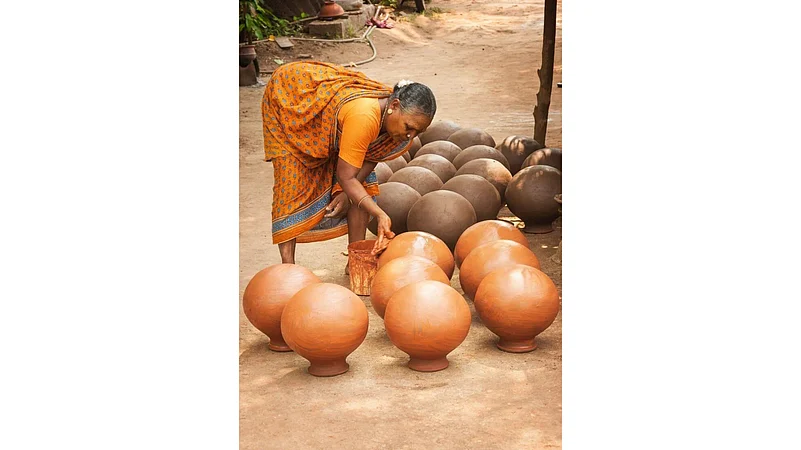
For generations, the humble clay pot has been valued simply for keeping water naturally cool. Now, scientists say this ordinary household vessel may possess another remarkable quality — the ability to reduce fluoride levels in drinking water.
A pilot study by researchers at the Government College of Dentistry, Indore, Madhya Pradesh has found that storing drinking water in locally made clay pots for 24 hours reduced fluoride concentration by nearly 64%, suggesting that an age-old tradition could become a simple, affordable and environmentally sustainable tool in the fight against fluorosis.
The findings assume particular significance for millions of Indians living in fluoride-endemic regions, where access to sophisticated water treatment systems remains limited. If validated through larger studies, the commonplace earthen pot—long regarded as a symbol of traditional living—could emerge as an effective household intervention against one of India's oldest and most persistent public health challenges.
The pilot study ‘Clay Pots for Reducing Fluoride Concentration in Drinking Water’ has shown that storing drinking water in locally made clay pots for 24 hours reduced fluoride concentration by nearly 64%. The findings suggest that an age-old household practice, backed by scientific validation, could complement existing efforts to tackle fluoride contamination, particularly in rural and resource-constrained areas where advanced water purification systems remain out of reach.
While sophisticated purification technologies such as reverse osmosis and membrane filtration are effective, they are often expensive, require electricity and regular maintenance, and are therefore difficult to sustain in economically weaker communities.
The findings revive interest in a traditional household practice that is inexpensive, environmentally friendly and already widely accepted.




Fluoride occurs naturally in groundwater as minerals dissolve from rocks and soil, although human activities such as the use of fluoride-containing pesticides also contribute to contamination. While small quantities of fluoride help strengthen teeth, prolonged consumption of water containing excessive fluoride can lead to dental and skeletal fluorosis — irreversible conditions that damage teeth, bones and joints and often result in lifelong disability.
The World Health Organization (WHO) recommends that fluoride concentration in drinking water should not exceed 1.5 mg per litre. India follows a stricter upper permissible limit of 1 mg per litre under the Bureau of Indian Standards (BIS), as fluorosis has been reported even at lower concentrations in several parts of the country.
Fluoride contamination remains one of India's oldest environmental health challenges. More than 230 districts across 19 States have reported fluoride-contaminated groundwater, exposing millions to the risk of fluorosis. In some regions, fluoride concentrations have reached as high as 48 mg per litre. Madhya Pradesh has recorded among the highest average groundwater fluoride levels in the country, making low-cost community-based solutions particularly relevant.
Unlike many other water-borne illnesses, fluorosis has no specific cure once skeletal deformities develop. Prevention through access to safe drinking water therefore remains the cornerstone of disease control.
Researchers have increasingly explored natural adsorbents capable of removing fluoride from water. Clay has emerged as one of the most promising because of its porous structure, large surface area and ion-exchange properties that enable it to bind contaminants. Since earthen pots are already widely used across India for storing drinking water, scientists investigated whether they could also function as passive fluoride-removal systems.
The pilot study analysed water collected from ten commonly used drinking water sources across Indore in July 2024, including municipal tap water, borewells, hand pumps and community storage tanks. Fluoride concentrations were measured before storage using the standard SPADNS spectrophotometric method.
Each sample was stored separately in identical locally manufactured clay pots for 24 hours at room temperature before being re-analysed. Fluoride concentrations declined consistently across all samples, falling from an average of 0.72 mg/L before storage to 0.26 mg/L afterwards — an overall reduction of nearly 64%. Statistical analysis confirmed that the decline was significant.
Laboratory analysis showed that the clay pots were made from black cotton soil and red clay containing nitrogen, potassium and phosphorus. According to the researchers, these minerals facilitate ion exchange, enabling fluoride ions to bind to the clay surface during storage.
Unlike chemically modified adsorbents, however, the present study shows that untreated, locally available clay pots may substantially reduce fluoride levels without requiring any additional processing.
The researchers cautioned that the findings are preliminary. The study involved only ten water samples and did not include a non-clay control container. Moreover, the baseline fluoride concentrations were already within or close to recommended safety limits.
If validated through larger investigations, the traditional clay pot may prove to be more than just a natural water cooler—it could become an inexpensive, sustainable tool in India's fight against fluorosis.
The study authors included Dr. Amrita Bansal, Dr. Richa Nagar, Dr. Ashwini Kurli, Dr. Alfas Razi MP, Dr. Shilpi Gilra Gupta and Dr. Puneet Gupta from the Departments of Public Health Dentistry, Prosthodontics and Crown & Bridge, and Periodontology of the Government College of Dentistry, Indore, Madhya Pradesh