Eknath Shinde’s faction voiced concerns over BJP’s poaching of leaders, exposing internal cracks in Mahayuti, Ajit Pawar was cornered ahead of the local body polls, yet the alliance trends towards winning over 200 seats out of 288 local bodies on December 21.
Controversial unopposed wins in Anagar and Dondaicha highlighted the dominance of entrenched local power networks and ‘Bahubali’ politics, according to political observers. Communal Campaigns, unprecedented alliances were seen during poll campaigns.
While MVA lagging in local body polls, a Shivsena (UBT)–MNS alliance seeks to unite Marathi voters ahead of the crucial BMC elections.
Background Explainer: Maharashtra Local Body Election At Glance
Maharashtra 2025 local body elections have been marked by high-stakes political maneuvering, poaching of leaders, and intense grassroots contests. BJP-led Mahayuti shows strong gains, while MVA and Uddhav Thackeray’s Shivsena (UBT) face challenges amid evolving alliances. Controversial seats, communal narratives, and linguistic politics have dominated the electoral backdrop ahead of the crucial BMC polls.

Summary
The political landscape of Maharashtra saw one quake after another ahead of the local body elections. From cracks within the BJP-led Mahayuti, HMO Amit Shah and Deputy Chief Minister Eknath Shinde’s November meeting, Ajit Pawar’s son’s involvement in an alleged land scam deal, to an unprecedented poaching of leaders- from corporators to former MLAs and MLCs, the state witnessed high-voltage drama ahead of local body polls.
Voting for these elections to 288 local body constituencies took place in two phases on December 2 and December 20. With voting over, trends are coming in showing the BJP set to become the single-largest party in these local body elections in Maharashtra.
A Look at the Key Events Ahead of the Maharashtra Local Body Polls
Eknath Shinde met with Union Home Minister Amit Shah ahead of local body polls in November 2025. The meeting reportedly lasted 50 minutes, during which Shinde reportedly spoke about the BJP's alleged poaching of regional leaders of the Shiv Sena (Shinde faction). He also raised the issue of the poaching of Shiv Sena (Shinde faction) leaders, many of whom are from his own stronghold, Thane, as Ravindra Chavhan, the BJP leader from Maharashtra, welcomed many former corporators from the Shinde faction, whom Shinde supporters alleged were poached by the BJP. Before the Shinde-Shah meeting, Shinde’s ministers also boycotted the cabinet meeting on Tuesday, November 18, which unveiled cracks in the alliance that had been taking place since the announcement of the local body elections. But Shinde has been cornered for a long time; even with the Urban Development portfolio, he remains restricted: any project exceeding Rs.500 crore requires the chief minister’s clearance, restricting his autonomy.

Mahayuti’s other ally, Ajit Pawar, has increasingly found himself cornered by Devendra Fadnavis within the alliance. His decision to hold a key meeting in Raigad without Shiv Sena (Shinde faction) MLAs deepened doubts about his loyalty to the alliance, even as Fadnavis subtly tightened his grip on major decisions in the coalition. The pressure had intensified further with scrutiny mounting over his son Parth Pawar’s controversial land deal. Caught between safeguarding his political relevance and managing growing pressure from the BJP leadership, Ajit Pawar has become the focal point of the alliance’s turbulence.
In November, ahead of local body polls, hundreds of grassroots leaders across Maharashtra have jumped parties, triggering unprecedented churn. The political landscape resembled a Game of Thrones, as electors struggled to keep track of who represented which party. Unlikely alliances have surfaced, such as Nilesh Rane of the Shinde-led Shivsena backing a Shivsena (UBT) candidate in Kankavali, while several NCP (Ajit Pawar) leaders are supporting NCP (Sharad Pawar) candidates in multiple constituencies.
Advertisement

“Local body elections often throw up unusual and even unlikely alliances because their political dynamics are very different. Realignments at the grassroots are not new — but the scale and brazenness of leader-poaching this time is unprecedented,” said senior journalist Prakash Akolkar, who has reported on Maharashtra politics for five decades. “Democracy and the integrity of elections exist only on paper now,” he adds.
Local Body elections and Victory celebrations of ‘Bahubalis.’
Maharashtra’s local body elections for 242 municipal councils and 46 nagar panchayats were held on December 2 and December 20. Results are being announced today, December 21.
However, there are a few constituencies that saw unopposed, controversial elections, which political observers in Maharashtra liken to ‘Bahubali politics’.
In Anagar village of Solapur district, Ujjwala Thite wanted to contest the municipal council elections from the Ajit Pawar faction of the NCP and had prepared accordingly. However, she has alleged that the Patil family—which has held power unopposed in the village for years—subjected her to intense harassment. She said she even struggled to obtain the required documents from administrative officials for filing her nomination, as her opponents exerted pressure on the administration.
Advertisement

At a press conference, Thite detailed how she was targeted. As a single woman, she had to travel to the district collector’s office at five in the morning under heavy police protection to submit her nomination form. Her movements were being monitored, opposition workers followed her constantly, and her rivals blocked all the roads leading out of her village with large vehicles. Despite these hurdles, after she finally submitted her nomination, it was rejected on ‘technical grounds, and Prajkta Patil, her opponent candidate from the BJP, who hails from a politically powerful Patil family, is considered the winning candidate (unopposed) by local BJP leaders. Ujjawala Thite challenged this ‘unopposed victory’ of her opponent; the final verdict by the sessions court of Solapur is pending in this case.
During the nomination process in Jamner Municipal Council, videos emerged showing supporters of the BJP candidate creating a ruckus and exerting heavy pressure on the NCP–SP candidate to withdraw the nomination. In Dondaicha, Dhule, celebrations erupted among supporters of BJP minister Jaykumar Rawal after his mother, Nayankunwar Rawal, was declared elected unopposed as municipal council president by her minister-son, despite the election itself and the official announcement of her unopposed victory still pending.
Advertisement
Fresh Marathi vs Hindi Row
After the recent Arnav Khaire death, the Marathi-versus-Hindi conflict has flared up again in Maharashtra. The death of the 19-year-old, who died by suicide after allegedly being confronted for speaking Hindi on a local train, has intensified political tensions. BJP targeted both Uddhav and Raj Thackerays for their ‘Marathi vs Hindi’ politics and held them responsible for Khaire’s death.
Khaire was allegedly assaulted on a local train by a group of 3–4 men who demanded that he speak Marathi. His family told the media that the incident left him deeply shaken, especially since he himself was a Marathi-speaking youngster whose repeated pleas to be allowed to leave were ignored. He reportedly died by suicide later that evening after returning home from college.
BJP leaders held many agitations in Mumbai, demanding justice for Arnav Khaire while attacking Shivsena (UBT) and MNS.
Opposition parties have accused the BJP and RSS of deliberately fostering linguistic discrimination and division for political gain. Shiv Sena (UBT) has also alleged that the BJP is using linguistic strife as part of a larger electoral strategy.
Advertisement
‘Batenge toh Katenge’ 2.0: BJP’s Maharashtra Playbook
During the Loksabha 2024 elections, muslims of Maharashtra were evidently supporting Maha Vikas Aaghadi, especially Shivsena (UBT) and overwhelmingly voted for it. BJP back then, brought the ‘Batenge toh Katenge’ narrative in their electoral campaigns to isolate muslims and consolidate the Hindu vote bank. The opposition heavily criticised the narrative, and the BJP altered it for the assembly elections, coming up with ‘Ek hai toh safe hai’. And now for high-stakes BMC elections, the BJP is actively campaigning with its ultra edition - ‘No ‘Khan’ can become a mayor of Mumbai’ launched by Mumbai BJP president Amit Satam.
For almost 3 months, Satam has been reinforcing the ‘No Khan mayor’ narrative across the platforms - from his own social media handles to media interviews. Though Satam later clarified in one of his media interviews that he pointed out ‘Khan mentality’ and not a surname. Satam further stoked communal rhetoric, claiming that if Khan became Mumbai’s mayor, “every street in the city would be renamed as Mohammad Ali Road.”
Harun Khan, Shivsena (UBT) MLA from the adjoining Versova constituency, was targeted by Satam, who did not mention his name, but stated, “If electors are not awakened, the Versova pattern will be repeated in Mumbai.”
BJP minister Mangalprabhat Lodha targeted Congress’s Muslim leaders during one of his programs in Mumbai, alleging they had signed a mercy petition for Yakub Memon, the 1993 blasts convict executed in 2015. During his address, Lodha made Islamophobic remarks, and his supporters raised slogans, including ‘Desh ke gaddaron ko goli maro saalon ko’.
Brand Thackeray
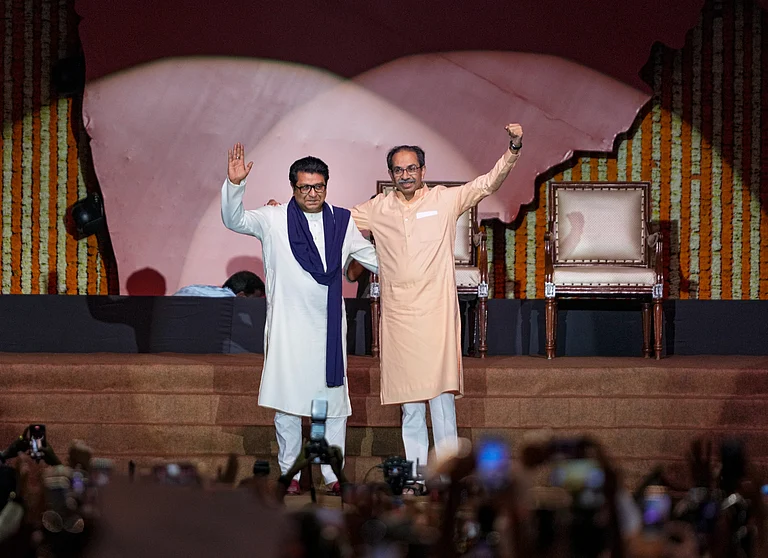
Over the past six months, Uddhav Thackeray and Raj Thackeray have repeatedly shared public platforms, signalling a rare alignment in their political priorities. From leading protests against the now-withdrawn government resolution mandating Hindi in primary schools, to demonstrations over alleged ‘vote-chori,’ and even jointly paying tribute to Shiv Sena founder Balasaheb Thackeray on his death anniversary — the two cousins have appeared together at multiple high-visibility events.
While no formal alliance has been announced, the rounds of dialogue on seat sharing itself has energised party workers on both sides, who see an opportunity to revive a broader Marathi regional front that once dominated Mumbai’s municipal politics.
“As a Shiv Sena activist, I am thrilled that both Thackeray brothers have come together for the betterment of Maharashtra. It’s a moment of pride for us, and we see that Hinduhridaysamarat Balasaheb’s dream is coming true. There is lawlessness in terms of women’s safety under the present government, it's not addressing the issues of farmers, youth, students and the safety of women. We believe that Thackerays will change this picture, our party (Shiv Sena - UBT) gained more popularity even outside Maharashtra.” Ayodhya Poul Patil, a Shiv Sena activist and state co-ordinator of the Party’s Social Media, told Outlook.
Seat-sharing discussions have progressed between Shivsena (UBT) and the Maharashtra Navnirman Sena (MNS). Shivsena (UBT) is showing positive signs of offering 75 seats to MNS out of 227 seats in the BMC, according to sources. Though the final seat-sharing formula is yet to be announced, a couple of more rounds of negotiations may take place. This alliance will be crucial to consolidate Marathi votes.
However, the Congress has made it clear that the MNS will not be part of the INDIA alliance. The party’s central leadership remains firm in its reluctance to accommodate the MNS. NCP(SP)’s Sharad Pawar is now initiating a dialogue about MNS’s inclusion in the MVA or India Bloc.
Shivsena Then and Now (Shivsena UBT) and Its Relevance
Shivsena, founded in 1966 by Balasaheb Thackeray, emerged as a powerful regional party rooted in Marathi identity and Hindutva politics. Thackeray, a fiery orator and charismatic leader, built the party by championing the rights of Bhumiputra (sons of the soil) and shaping Mumbai’s political landscape for decades. His leadership transformed the Shiv Sena into a formidable force that influenced Maharashtra’s governance, culture, and street politics. For years, since the 1990s, Shiv Sena became extremist with Hindutva ideology, and joined the NDA in the past for power.
In 2019, Shiv Sena broke away from the NDA, and Uddhav Thackeray joined the INDIA Block, known as the Maharashtra-based Mahavikas Aaghadi. However, Political analysts say that Shiv Sena paved the way for the BJP’s growth in Maharashtra from Balasaheb Thackeray’s era.
After Balasaheb Thackeray’s death in 2012, his legacy continues to define the party’s ideology and Maharashtra’s political narrative. Though Maharashtra has seen extreme political turmoil with the party splits of Shiv Sena and NCP, Uddhav Thackeray has remained a consistent popular leader of the INDIA Bloc in Maharashtra.
The India bloc won 30 of 48 seats in the Loksabha election in Maharashtra under Uddhav’s leadership, but was defeated in the Maharashtra assembly elections. NDA formed a government in Maharashtra with a landslide victory in 2024.

“Recently, the Thackeray brothers sensed that the Marathi linguistic narrative was gaining momentum, especially after they joined the protest against Hindi imposition organised by the Marathi Abhyas Kendra. But their consistent commitment to language issues is not guaranteed, even if they come together and win the BMC elections. The fight will still have to continue — the BMC is shutting down Marathi schools, and lower-income Marathi communities continue to face cultural marginalisation by non-Marathi groups,” said Dr Deepak Pawar, Head of the Political Science Department at Mumbai University and Chair of the Marathi Abhyas Kendra.
The BMC is scheduled to poll on January 15, 2026 with the results be announced on January 16. Posters carrying the message “Marathi Manoos must be awakened to save Mumbai from the NDA” have appeared across public spaces in Mumbai.

Published At: