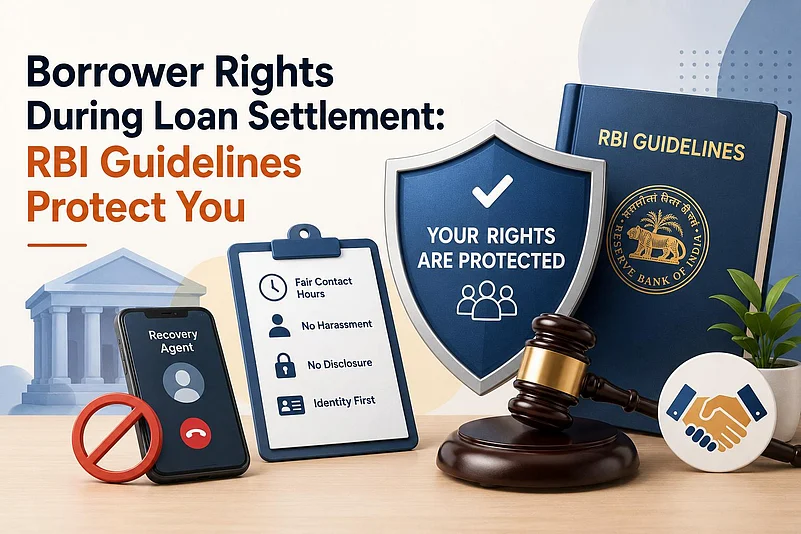
Most borrowers going through loan settlement believe they have no protection against an aggressive recovery agent. That fear alone stops many people from even considering settlement, they assume that once they fall behind, they've forfeited any right to be treated fairly. That isn't true. The RBI guidelines governing recovery conduct are specific, binding, and apply whether or not you're in the middle of a settlement. This isn't a general "know your rights" pep talk. It's what the rules actually say, with the sources behind them, so you can check what happened on your last call against what's actually allowed.
Is Loan Settlement Itself Legal Under RBI Rules?
Yes. Loan settlement, also called One-Time Settlement (OTS), is a recognised resolution mechanism under RBI's framework for handling loans that have turned into Non-Performing Assets (NPAs, loans marked overdue after sustained non-payment). There is no rule stopping a borrower from negotiating a reduced payoff with their bank. Settlement isn't a legal grey area, and it isn't something that quietly happens outside the system. Banks report it, document it, and issue paperwork for it, precisely because it's a sanctioned part of how NPAs get resolved.
Settlement is not something a borrower chooses out of preference. It exists for genuine financial hardship, and the RBI treats it as a legitimate way to resolve a difficult loan, not a loophole anyone is exploiting. Banks only agree to a settlement once they're reasonably convinced that recovering the full amount isn't realistic. That's also why the fear of being sued for settling is largely misplaced. Once a loan settlement is completed and the bank issues a No Dues Certificate (NOC, a letter confirming the account is closed), that particular liability is done.
Two things are worth being precise about here, because a lot of borrowers get this part wrong. First, "settled" is not the same as "erased." The account does get marked "Settled" on your credit report, and that stays for up to 7 years. It doesn't disappear, and it will affect how new lenders view your file during that period. Second, the debt itself, and the bank's ability to pursue you for that specific liability further, is closed once the settlement is honoured and documented. Those are two different facts, and confusing them is where a lot of the anxiety around settlement actually comes from.
What RBI's Recovery Guidelines Actually Cover
RBI's rules on recovery conduct, tightened and consolidated through directions that took effect on July 1, 2026, apply to every bank, NBFC, and outsourced recovery agent acting on their behalf. The rules exist because recovery, outsourced to third-party agencies at scale, had become a genuine source of harm for borrowers, not because collecting a debt is itself wrong. Banks are entitled to recover what they're owed. What they're not entitled to do is any of the following.
Contact timing. A recovery agent may only contact a borrower or guarantor between 8:00 AM and 7:00 PM. Calls outside that window are a violation, on any day, including Sundays and public holidays. There's no separate rest day carved out for borrowers, but the eleven-hour window applies identically every single day of the week.
Bereavement and emergency exceptions. Agents are expected to avoid recovery attempts during bereavements, medical emergencies, or major family occasions like weddings or festivals. A recovery call during a funeral isn't a grey area, it's a violation of professional conduct expectations.
No abusive conduct. Abusive language, threats, or intimidation of any kind are barred outright. This includes threats of arrest or legal action the bank has no actual intention of pursuing, which is a common scare tactic.
No third-party disclosure. An agent cannot tell your family, employer, or neighbours about your debt, or use that disclosure as pressure. Calling your workplace repeatedly to embarrass you into paying falls squarely outside what's allowed.
Identification. Every agent must carry valid ID and a written authorisation letter from the lender, and must identify themselves and the lender before anything else in the conversation. If someone calling you can't produce this, that alone is worth noting down.
Lender accountability. The bank or NBFC is directly responsible for how its recovery agents behave, even when the agency itself is a separate outsourced company. Outsourcing the work doesn't outsource the responsibility, and RBI holds the lender's own leadership accountable for repeated violations by its agents.
A useful way to think about the line: a bank calling once during business hours to ask about a missed EMI is normal recovery. A call at 9 PM, three calls in an hour, a threat to visit your workplace, or a mention of your loan to a family member who picked up the phone by mistake, that's conduct the RBI framework specifically prohibits, regardless of how far behind you actually are.
What to Do if These Rules Are Broken
If a recovery agent crosses any of these lines, here's the sequence that actually works, in order.
Document everything, as it happens. Note the date, time, the number that called or the agent's name if given, and exactly what was said or done. This record matters more than most people expect, because a complaint without specifics is much harder for a Grievance Redressal Officer or the Ombudsman to act on.
File a written complaint with the bank's Grievance Redressal Officer. Every regulated lender is required to have one, and this step has to happen before you can escalate further. Keep a copy of what you submitted and any acknowledgement you receive.
If the bank doesn't respond within 30 days, or the response doesn't satisfy you, escalate to the RBI Ombudsman. This is done through the Complaint Management System at cms.rbi.org.in, and it costs nothing to file. You typically have 90 days from the point the bank's response window closes, or from its last communication, whichever comes later, to bring the complaint to the Ombudsman.
Under the Reserve Bank – Integrated Ombudsman Scheme, 2026, the Ombudsman can award compensation of up to ₹30 lakh for a proven consequential financial loss caused by the lender's failure, and separately, up to ₹3 lakh for harassment, mental anguish, or the time and expense the complaint cost you. Together, that's a possible ceiling of ₹33 lakh, though the actual figure awarded depends entirely on the facts and evidence in your specific case. Compensation isn't automatic just because a complaint gets accepted. You need to show the deficiency in service and the harm it caused, but the ceiling on what you can be awarded is real, and it's meaningfully higher than the ₹20 lakh and ₹1 lakh limits under the earlier 2021 scheme. (See the RBI's official scheme FAQ for the exact clauses and process.)
How FREED Helps Borrowers Exercise These Rights
Knowing the rules is one thing. Acting on them in the middle of a stressful week, while you're also trying to keep the rest of your finances together, is another. FREED Shield exists for that gap between knowing your rights and actually using them.
Through FREED Shield, you can document and report recovery harassment, a call before 8 AM, a call after 7 PM, a threat, an unannounced visit, in a few clicks, without having to figure out the right words or the correct complaint format on your own at the exact moment you're least equipped to do it calmly.
Once you enrol with FREED's Loan Settlement Program, your relationship manager helps you with borrower rights and guides you in dealing with recovery harassment. FREED doesn't offer legal representation, and it won't claim to make every single call stop entirely, no service honestly can. What it does is help you understand where your rights actually sit, document what's happening in a way that holds up if you need to escalate, and help you put together a complaint to your lender with your consent, so you're not doing all of this alone while everything else in your life is already stretched thin.
FREED has counselled over 20 lakh people on personal loans, credit cards, and app loans, and charges a fee only when a settlement is successfully completed, with no upfront cost to get started.
The Bottom Line
RBI's guidelines exist precisely so someone going through settlement doesn't have to face recovery pressure unprotected. Knowing the specific rules, and having a practical, low-friction way to act on them, changes what the next 8 AM call actually feels like. It stops being something that happens to you and starts being something you have documented options against. If recovery harassment is part of your settlement process right now, FREED's team can help you put a stop to the pattern, not just the next call.
Disclaimer: This is a sponsored article. All possible measures have been taken to ensure accuracy, reliability, timeliness and authenticity of the information; however Outlookindia.com does not take any liability for the same. Using of any information provided in the article is solely at the viewers’ discretion.