Every year, as the monsoon clouds start clearing and the air fills with the sound of dhol and "Ganpati Bappa Morya", millions of homes across India welcome an unusual guest, a god with the head of an elephant and the heart of a child. Ganesh Chaturthi isn't just a festival of decorations and modaks; it's a celebration rooted in some of the most fascinating stories in Hindu mythology.
If you've ever wondered why Ganesha has an elephant head, why a tiny mouse carries such a large god, or why you're not supposed to look at the moon on Ganesh Chaturthi night, this article is for you. As we get ready for Ganesh Chaturthi 2026, let's revisit the stories that make this festival so much more than a ritual.
The Birth of Ganesha: A Mother's Creation
The most well-known story begins with Goddess Parvati, who wanted a guard of her own, someone loyal only to her. While Lord Shiva was away, she created a boy out of turmeric paste (or sandalwood paste, depending on the version) and breathed life into him. She asked him to stand guard at the door while she bathed, with strict instructions to let no one in.
As fate would have it, Shiva returned home and found a stranger blocking his own doorway. The boy, true to his mother's word, refused to let him pass. Shiva, unaware this was his own son, grew furious and, in the ensuing battle, severed the boy's head.


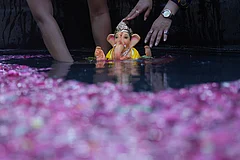
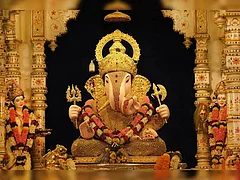
When Parvati emerged and saw what had happened, her grief and anger shook the heavens. To console her, Shiva promised to bring the boy back to life. He sent his attendants to fetch the head of the first creature they found sleeping facing north, and that creature happened to be an elephant. The elephant's head was placed on the boy's body, and he was brought back to life. Shiva named him Ganesha and declared that he would be worshipped before any other god, the remover of obstacles, Vighnaharta.
Why Ganesha Rides a Mouse
It seems almost comical, a god as large as Ganesha choosing a tiny mouse as his vehicle. But like most things in mythology, there's a deeper meaning behind it.
According to one popular tale, a mouse named Gajamukhasura (or in some versions, simply a proud and destructive mouse) was once a Gandharva who was cursed to become a rodent due to his arrogance. He caused chaos wherever he went, destroying homes and fields. Eventually, Ganesha subdued him and, instead of punishing him further, offered him a place by his side — as his vehicle.
Symbolically, the mouse represents desire and the tendency to nibble away at everything in sight, never satisfied. Ganesha riding the mouse signifies mastery over these very desires — a reminder that true wisdom lies in controlling one's cravings, not being controlled by them.
The Race Around the World: Ganesha vs Kartikeya
One of the most delightful stories involves Ganesha and his brother Kartikeya. One day, the gods presented a divine fruit (in some versions, a mango) to Shiva and Parvati, meant for whichever of their two sons could complete a race around the entire universe first.
Kartikeya, proud of his peacock's speed, immediately set off, flying across galaxies. Ganesha, however, knew he couldn't outrun his brother on his small mouse. Instead, he calmly walked around his parents, Shiva and Parvati, and bowed before them, declaring that they were his entire universe; after all, without parents, there is no world at all.
Impressed by his wisdom, Shiva and Parvati awarded the fruit to Ganesha. This story isn't just charming; it's often cited as an early lesson in devotion, intelligence over brute strength, and respecting one's roots, values that resonate deeply during Ganesh Chaturthi celebrations even today.
The Curse of the Moon
Here's a story that actually shapes a Ganesh Chaturthi ritual still followed today. Legend has it that after a hearty feast of modaks on his birthday, Ganesha was riding his mouse home when the mouse got startled by a snake. Ganesha toppled over, and his belly burst open, spilling out all the modaks he'd eaten.
Unbothered, Ganesha simply gathered the modaks back, stuffed them back into his belly, and tied the snake around his waist to hold it all together. But watching this scene from the sky, the Moon god, Chandra, couldn't help laughing at the sight.
Angered by this mockery, Ganesha cursed Chandra that anyone who looked at the moon on this night would be falsely accused of a crime they never committed. Realising his mistake, Chandra begged forgiveness. Ganesha softened the curse, saying the effect would only last on Ganesh Chaturthi night, and even then, one could counter it by listening to or narrating this very story.
This is why, even today, many devotees deliberately avoid looking at the moon on Ganesh Chaturthi and recite this tale as a precaution, a wonderful example of how mythology directly shapes living tradition.
Ganesha, the Scribe of the Mahabharata
Not all Ganesha stories involve battles or curses — some are about knowledge and dedication. According to legend, when the sage Ved Vyasa wanted to write the Mahabharata, he needed someone capable of writing at the speed of his thoughts. He approached Ganesha for help.
Ganesha agreed, but on one condition: Vyasa would have to narrate the entire epic without pausing, even for a moment. Vyasa accepted but placed a condition of his own: Ganesha would have to understand every verse before writing it down, not just transcribe blindly.
This clever condition gave Vyasa brief moments to compose complex verses whenever Ganesha paused to comprehend a tricky one. At one point, while writing furiously, Ganesha's pen (or quill) broke. Without stopping, he broke off one of his own tusks and continued writing with it — which is why Ganesha is often depicted with a single, broken tusk.
This story is often shared with children not just as mythology, but as a lesson in perseverance, dedication, and finding solutions even when things break down, quite literally.
Why These Stories Still Matter
It's easy to see Ganesh Chaturthi as just about clay idols, immersion processions, and delicious prasad. But each ritual and tradition connected to the festival is rooted in a story, and each story carries a lesson that has survived thousands of years for a reason.
The tale of his birth speaks to unconditional maternal love and protection. The story of the mouse teaches restraint over desire. The race around the universe reminds us that wisdom often beats brute effort and that family is the true centre of one's world. The curse of the moon is a lesson in humility — even gods aren't above making mistakes, and forgiveness matters. And the story of the Mahabharata shows us that true dedication finds a way, even when the tools we rely on fail us.
As we welcome Ganesha into our homes in 2026, these stories are worth retelling — not just to children learning about their culture, but to anyone who wants to understand why this elephant-headed god continues to be one of the most beloved figures in Indian mythology, generation after generation.