Media sensationalism in Kerala scandals often reduces women to tropes like "seductress," overshadowing evidence and national security issues.
Cases like ISRO espionage, solar scam, and gold smuggling highlight how journalism amplifies sexism and aids political rivalries.
Feminist interventions are reclaiming scandal narratives, shifting focus to consent, accountability, and institutional failures.
The Spectacle Of The Woman Accused: How Sensationalism Distracts From The Offence And Amplifies Suspicion
Media narratives—especially when women are involved—can end up amplifying suspicion and weaponising gender

Summary
In October 1994, when Mariam Rasheeda, a Maldivian national, was arrested from a hotel room in Thiruvananthapuram for allegedly overstaying her visa, it appeared to be a minor immigration violation. Within weeks, it would snowball into what became known as the ISRO espionage case—a scandal wrapped in allegations of national betrayal, intelligence leaks and international intrigue. The political fallout was swift and dramatic, eventually forcing then Chief Minister K. Karunakaran to step down.
But beyond the power struggles and unanswered questions lies another story—one about headlines, gender and the making of a spectacle.
Two Maldivian women—Rasheeda and Fousiya Hassan—were cast less as accused persons navigating a legal battle and more as stock characters in a morality drama. Newspapers splashed their photographs across front pages, embellished narratives with innuendo and framed the story with a mix of nationalism and voyeurism. The language was loaded; the tone breathless. The suggestion was clear: intrigue sells, and women at the centre of scandal sell even more.

In the frenzy of competitive journalism, due process blurred into dramatic storytelling. The women’s identities were reduced to tropes—the “mysterious foreigner,” the “seductress,” the “spy.” The presumption of innocence was eclipsed by speculation. What should have remained an investigation turned into a spectacle and what should have been a legal process became public theatre.
The alleged espionage case involving scientists of the Indian Space Research Organisation (ISRO) was among the most widely discussed scandals in the country in the mid-1990s. The investigation, initially led by the Kerala Police and later taken over by the Intelligence Bureau and the Central Bureau of Investigation (CBI), centred on allegations that sensitive information related to India’s space programme had been illegally transferred to foreign countries. The CBI later concluded that there was no case to be made. Scientist Nambi Narayanan, who had been arrested and allegedly tortured by the Kerala Police, was subsequently awarded compensation by court order.
Advertisement
Three decades later, the case is remembered for its political consequences and its eventual unravelling. But it also stands as a cautionary tale about how media narratives—especially when women are involved—can amplify suspicion, weaponise gender and leave reputations in ruins long before courts deliver their verdicts.
“Once a story becomes highly sensational, objectivity is the first casualty. Many of us get carried away. That’s what happened in the ISRO case as well. There were serious limitations in cross-checking the information provided by intelligence and investigating officers. Many of the stories turned out to be baseless. But in several instances, journalists felt they had little choice but to go along with what was officially fed to them,” recalls John Mundakkayam, a senior journalist who reported on the ISRO espionage case and later wrote a book on it.
His reflection underscores an uncomfortable truth: the media was not merely reporting the investigation—it was, in many ways, amplifying it. In the absence of independent verification, official narratives hardened into public belief. And for the two Maldivian women at the centre of the storm, that belief proved far more enduring than the allegations themselves.
Advertisement
Many, including journalists who covered the story, now believe the investigation lost its original focus when sections of the media veered into sensationalism, dwelling less on the evidence and more on the private lives of the two Maldivian women. As headlines grew more lurid, the narrative shifted from questions of national security to insinuations about character, morality and intimacy.

The ISRO espionage case—where sensationalist reporting often carried unmistakable sexual undertones and dwelt obsessively on the private lives of the accused women—was not an aberration in Kerala’s media landscape.
In the last decade alone, at least two high-profile cases that sent political shockwaves through the state revealed a similar pattern. In both, women at the centre of controversy were framed less as individuals facing legal scrutiny and more as characters in scandal narratives, their personal lives dissected with insinuation and moral judgement. The coverage, frequently tinged with sexism, did more than drive readership—it also provided convenient ammunition in bitter political rivalries, helping leaders settle scores with their opponents.
Advertisement
In 2013, a solar panel scam involved Team Solar, a company that duped investors of lakhs of rupees by promising solar partnerships, with allegations reaching to the then Chief Minister Oomen Chandy’s office. The accused, Sarita S. Nair, accused senior Congress leaders of sexual harassment, creating a huge political storm that led to the demand for the resignation of the Chief Minister.
Soon, the focus shifted to Nair’s personal life— her lifestyle, her appearance, and insinuations about how she had “seduced” political leaders. Breaking news tickers blazed with lurid details, constructing a narrative around the alleged “seductress” rather than the structural failures that enabled the scam.
The central question—how proximity to political power allows fraudsters to exploit public trust—was gradually pushed to the margins. Instead of interrogating networks of influence and accountability, the coverage turned into a character study steeped in gendered tropes. In the process, the systemic lessons of the scandal were overshadowed by spectacle.
Advertisement
In 2020, the seizure of 30 kg of gold smuggled through diplomatic channels at Thiruvananthapuram airport exploded into what came to be known as the Kerala gold smuggling case. The case peeled back an uncomfortable nexus between sections of the bureaucracy and officials linked to the UAE Consulate in the capital.
Allegations soon reached the Chief Minister’s Office, with senior bureaucrat M. Sivasankar facing charges and later being suspended. But as the investigation progressed, the spotlight shifted. The media lens moved beyond the mechanics of smuggling and the institutional lapses that enabled it, zeroing in instead on the personal equation between Sivasankar and Swapna Suresh, a key accused and former employee of the UAE Consulate.
What could have remained a story about governance failures and shadowy networks gradually morphed into something else—a saga thick with insinuation. Television debates and prime-time panels dissected WhatsApp messages, speculated about intimacy, and framed the scandal through the prism of a relationship. The woman at the centre became the narrative hook.
Accounts of “extravagant” lifestyles and “wayward” behaviour were aired with theatrical flourish, often untethered from the core questions of accountability. In the race for eyeballs, private lives became a public spectacle, and the structural issues at the heart of the case were pushed to the margins.
“The tendency to sensationalise cases involving women is prevalent in the media,” admits Sindhu Sooryakumar, Executive Editor of Asianet News, one of Kerala’s leading television news channels.
“We did err to some extent in our coverage of the Solar case,” she says candidly. “But when the gold smuggling case emerged, we issued clear directives to our reporters to refrain from dwelling on the private lives of those involved. The focus had to remain on the investigation and the institutional questions.”
With more women occupying decision-making positions in major newsrooms, she believes, the shift is gradual but visible. “As more women move into leadership roles, I think a positive change is underway,” Sooryakumar says, expressing cautious confidence about a more responsible editorial culture.
But Dr J. Devika of the Centre for Development Studies views this from another angle.
“Scandal-writing as a mode of political critique has existed since the early days of Malayalam journalism. The 20th-century ‘scandal public’ also emerges as a space that often reinforced the patriarchal instincts of politics. In response, a counter-public gradually took shape—a feminist public space that challenged the gendered narratives amplified by the media. This space evolved around a series of sexual violence cases that shook Kerala’s conscience.” She adds that women at the centre of high-profile cases have started to speak out, and their interventions have expanded feminist public spaces.

“Even when feminists appear powerless—when their publics are hijacked and reduced to scandal publics—they have also found ways to reclaim those spaces,” says Devika. “In several instances, what could have ended as mere scandal has been transformed into a feminist public.”
She points to the series of sexual abuse allegations that surfaced against Congress MLA Rahul Mamkootathil as one such moment. What began as yet another politically charged controversy risked being consumed by partisan mudslinging and sensational headlines. Instead, sustained interventions by women’s groups and activists sought to shift the focus—from gossip and character assassination to questions of consent, accountability and institutional response.
It is not only high-profile political cases involving women that descend into sensationalism and objectification.
When the story of Jolly Joseph—accused of killing six members of her own family—broke, it quickly became one of the macabre media spectacles. The gruesome details of what came to be known as the Koodathayi cyanide murders dominated television studios and newspaper front pages for weeks.
The case seemed to contain all the elements of a soap opera: betrayal, inheritance disputes, secret relationships, hidden identities and a carefully constructed double life. Instead of remaining a grim criminal investigation, it was packaged as binge-worthy drama.
Here, too, gender shaped the storytelling. The horror of the alleged crimes was repeatedly framed through the lens of womanhood—the “deceptive homemaker”, the “cold-blooded mother”, the “master manipulator”. The coverage reinforced the idea that when women transgress expected roles, the spectacle must be amplified.
A prominent Malayalam woman director was approached by a leading OTT platform to develop a series based on the Koodathayi case. She was asked to pitch an angle to the series.
According to a person familiar with the discussion, the director chose to approach the material from a perspective less shaped by mainstream media sensationalism. Instead of leaning into shock value and spectacle, she suggested the psychological terrain—the internal fractures, social pressures and personal histories that might have pushed a woman like Jolly Joseph toward serial killings.
The platform, however, did not take the proposal forward. The darker, more introspective lens was perhaps less attractive than a narrative that retraced the familiar path of melodrama and moral outrage.
“The problem with mainstream media is that they don’t seem to believe women can simply be criminals,” says Dr Asha Achy Joseph, a film studies professor. “There is a righteousness imposed on women—an expectation of inherent virtue. When that image shatters, the response is not analytical but sensational.”
She contrasts this with the treatment of male criminals. Over time, figures like Charles Sobhraj acquire a strange aura—stylised, mythologised in popular culture. Yet, women such as Phoolan Devi are persistently cast in the mould of the villain, their stories flattened, despite the complex social and structural forces that shaped their lives.
The difference, Joseph suggests, is not merely editorial. It reveals a deeper discomfort: society is more willing to narrate female transgression, either as moralised or monstrous. “The fact that even the accused have the right to dignity is often pushed aside and forgotten,” she adds
From the ISRO espionage case to the Kerala gold smuggling case, from sexual violence trials to the Koodathayi cyanide murders, the media landscape reveals a recurring pattern: when women stand at the centre of controversy, the story often slips from scrutiny to spectacle. Private lives eclipse public accountability. Suggestion overtakes substance. And the accused—whether victim or perpetrator—is stripped of nuance.
N.K. Bhoopesh is an assistant editor, reporting on South India with a focus on politics, developmental challenges, and stories rooted in social justice.
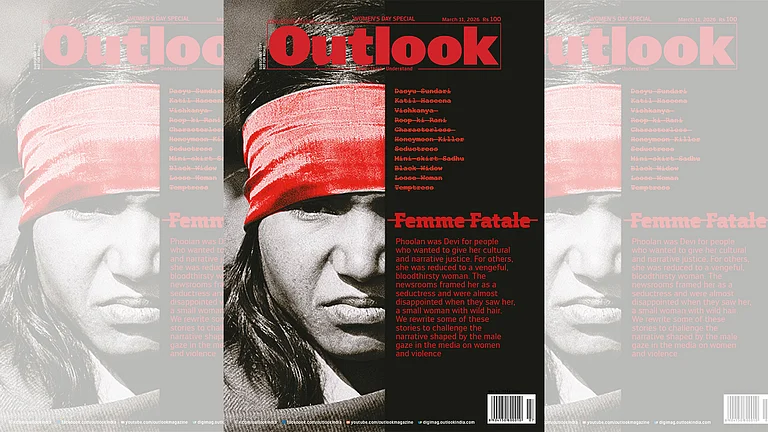
This article is part of Outlook's March 11 issue Femme Fatale which looks at how popular media has shaped narratives of violence against women over the years and rewrites the language of male gaze in media which commodifies and condemns the women who make headlines.
Published At: