The union government is reportedly planning to increase Lok Sabha constituencies from 543 to 816, with 273 reserved for women.
Opposition flags timing, census data gaps, and lack of clarity on horizontal reservation for marginalised categories.
Critics call it as BJP’s electoral strategy to lure women voters ahead of assembly polls in 4 states and union territory while NDA allies welcome the move stating ‘long-pending reform’
Inside Story Of The Centre's Push For 33% Women’s Quota In Parliament And The Concerns It Sparks
The move for implementation of the Women’s Reservations Act-2023 raises many questions: Caste enumeration, horizontal reservation and its timing that coincides with the upcoming assembly elections in four states and one UT
Summary
The union government is stepping with a big move in the direction of the implementation of the Women’s Reservation Act 2023. It reportedly intends to increase Lok Sabha constituencies from 543 to 816. Out of which- 273 (33 %) constituencies are meant to be reserved for women MPs.
The government is yet to formally propose this restructuring. However, some media reports suggest that the preliminary meeting was conducted by the home minister Amit Shah, with the NDA allies and an all-party meeting is likely to be conducted this week.
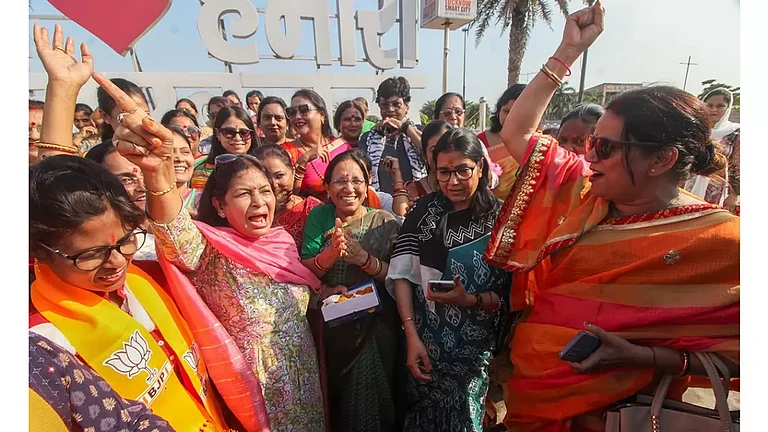
The union government’s move is welcomed by the NDA allies, however the opposition parties have raised many questions especially regarding the timing of this move that coincides with the assembly elections in 4 states and a union territory, where non BJP parties hold power especially in West Bengal, Kerala and Tamil Nadu.
It is being seen as the BJP government’s electoral agenda to lure women voters for upcoming assembly elections.
Media reports also suggest that the union government is considering 2011 census data for the implementation of the 33 % reservation for women in the parliament. This has also become a point of contention for the Opposition, as provisions in the act are vague about the horizontal reservation, lacking specifics. For example, provisions for reservation for SC, ST, OBC women within the 33 % women’s quota aren’t provided with the specifics. If at all this is implemented on the basis of the 2011 census, the adequate representation of SC, ST, OBC women will become questionable, without the recent data of women from these categories.
The Census in India was due in 2021, which was delayed due to the covid pandemic. The union home ministry’s recent advertisements in prominent newspapers suggest that the first phase of the Census exercise is likely to be conducted between April to September 2026. However, the questionnaire which will be used for this phase, doesn’t have the column for caste. The methodology of the caste-based census is yet to be specified by the union government.
Advertisement
The caste based census is important to know the real time caste based data of the population, necessary for all kinds of policy implementation including the reservation one. It is necessary for the horizontal reservation to ensure inclusive and diverse representation proportionate to the population of SC, ST, OBC categories.
However, NDA ally Shiv Sena (Shinde faction) has welcomed the move.
“Women’s reservation bill was pending for the last three decades upto 2014. Before 2014, whenever it was introduced in the parliament, it was stalled through various procedures by the opposition. After 2014, the bill was lapsed as the tenure of the Lok Sabha was ended. The NDA government introduced the bill again and it was passed with the NDA’s political will.” says Dr Neelam Gorhe, deputy chair of the Maharashtra legislative council.
Gorhe further elaborates upon the importance of women’s reservation. “Women’s status in the society is secondary, but if more women enter into politics because of reservation, it changes the development agenda. Women leaders prioritise issues like water, health, sanitation, poverty elevation, in the long run the socio-economic status of the society slowly changes on two accounts: one is women’s participation in politics and the development aligned with the sustainable development goals. At the Centre the Modi government and in Maharashtra the Fadnavis-Eknath Shinde government is already working in that direction. Many misunderstand that there is no reservation for SC, ST women, but it is very much there in the parliament and assemblies,” says Gorhe.
Advertisement

Gorhe’s statement about SC, ST women’s reservation in the parliament is partially true. However, the existing reservation for SC, ST women isn’t horizontal, meaning reservation within reservation: a long-standing demand of the women’s movement and political leaders like Mayawati. The existing reservation for SC, ST women in the Lok Sabha isn’t being granted from women’s quota.
“We welcome the move of increasing women’s participation in Parliament, however the union government has to implement women’s reservation act after the caste-based census, only then we will be able to know how it is planning to implement horizontal reservation, that is ensuring representation of SC, ST, OBC women within the women’s category. For that, the government has to provide scientific parameters and data which is only possible after caste enumeration.” says Sushama Andhare, deputy leader and spokesperson of Shiv Sena UBT.
“Without these structural changes, this move seems BJP’s political agenda, creating an illusion ahead of the West Bengal assembly election,” adds Andhare while criticising it as a “pro-voters move than a pro-women decision.”
Advertisement
Andhare herself comes from a marginalised community and has faced many challenges in mainstream electoral politics. "If there is no reservation for marginalised women within the reservation for women, where is my place? Where do I sit?” she asks.
Horizontal reservation in Parliament for women is important due to the Indian caste structure and the existing political class. Without reservation for marginalised women within the women’s quota, most women from affluent castes and classes, those who come with generations of political background will be able to benefit from the reservation.
The quota numbers
In Maharashtra 50 % reservation is in place for women for local body elections. The Union government’s 33% reservation in the Lok Sabha is proposed according to the Women’s Reservation Act-2023, but it is insufficient for the ideal equity among lawmakers. The number of women MPs in the current Lok Sabha and in assemblies of most of the states shows the massive gender gap. Activists also argue, if women constitute nearly 50% of the total population, why are they limited to 33 % in the Lok Sabha?
Advertisement
“Women benefited from the 50% reservation in Panchayat elections, and they have been performing well for the holistic development of villages, panchayats. They focus on education, civic issues, health, aanganwadis, women’s economic empowerment and collective development. Whereas men focus on development projects involving financial interests, therefore women’s leadership becomes "problematic" for men. Most of the men from all parties don’t want women to take their positions. This mindset reflects from bottom to top. Men will not easily give up their power or share it equally, therefore it is difficult to imagine 50 % reservation in parliament and assemblies,” says Bhim Raskar, founder of ‘Resource and Support Centre for Development, a non-profit working with women in politics at the Panchayat level for over three decades.
Raskar also brings in a different view point, “Why is the union government trying to increase the Lok Sabha seats and then reserving certain seats for women? Increased seats mean more expenditure burden on taxpayers. Also, it gives a message that though it will ensure women’s representation, it will not touch upon the seats for men-their power and positions will be intact. It is a patriarchal mindset, serving the status quo, the existing masculine power structure rather than equity or values," says Raskar.

‘Sampark’ Mumbai, an organisation that works with legislators in Maharashtra and evaluates their performance in the Maharashtra assembly and council, has observed that Women’s policy in Maharashtra exists on paper, it is not being properly implemented. Women’s issues are not being given proper attention even in the ongoing budget session in Maharashtra, according to Medha Kulkarni, Trustee, Sampark.
“In this backdrop, how is the reservation for women in Parliament the only factor going to contribute to women’s development? Increasing women’s representation is good, but whenever the BJP government introduces something, people become doubtful about its intentions, because this government doesn’t engage with various stakeholders through public consultations. This government is also anti-women and anti-Muslim. Most parties, especially the BJP are not addressing the issue of Muslim women’s representation within the party or electorally," says Kulkarni and emphasises that, “no new policy can be made or implemented unless the updated Census data is available.”
Opposition leaders are viewing the union government’s move as a political agenda ahead of assembly elections in four states and one UT. The union government’s move ,after the assembly elections were announced, is clashing with the model code of conduct, a concern raised by the Tamil Nadu Chief Minister M K Stalin. DMK is also raising another question: “If the BJP is truly concerned about women's political participation, it should first explain why women voters are being systematically deleted from electoral rolls across the country," asks a DMK activist.
“Tamil Nadu CM’s unequivocal support for women's reservation, without conditions, without delay is an actual women's empowerment. Women's reservation is a matter of democratic justice. It should not be held hostage to delimitation. If the BJP is genuinely committed to increasing women's representation, why was this historic measure tied to delimitation in the first place? And why is it now being reopened only when crucial assembly elections are underway? The 2023 law itself linked implementation to the first Census published after the Act and the subsequent delimitation exercise, so this sudden shift raises serious questions about political intent," says Yazhini PM, national Spokesperson of the DMK.
She further alleges that, “BJP's tactics are to court women voters when elections are at the doorstep. The pattern is familiar; prospective promises, conditional timelines, and now a sudden reversal of their own law. Why must women always wait? Why must their rights be packaged only as last-minute electoral offerings?"asks Yazhini.
Amid these unanswered questions, the quota for transwomen within the 33 % reservation for women, seems a far distant dream at this juncture, a criticism echoed by many experts.

Published At: