One thing that Punjab has managed over the decades is to remain an outlier in terms of political trends in North India. Presently, there are no alliances among political parties in Punjab, no INDIA bloc or National Democratic Alliance; there have never been exclusive vote banks based on caste or religion; the state seems immune to the large-scale ideological shift to right-wing conservatism and national issues like Article 370, Ram Mandir or citizenship have hardly been a part of the mainstream narrative in the state.
InDepth | Punjab Politics: Who Can Challenge AAP’s Dominance?
Despite being squeezed from all directions, AAP is still Punjab’s protagonist. But the question is: it’s AAP versus who? The Congress, BJP and Akali Dal are all fighting for relevance

There are state-specific issues, though—a pervasive drug epidemic, high youth unemployment, agricultural distress, angry farmers, Indo-Pak trade and sharing of river water—that have prompted debates in past elections. In addition, there are political parties, each with an interesting trajectory.
These unique aspects make the border state of Punjab a political potboiler, and these will play a critical role in the state elections due next year, scheduled two years after Operation Sindoor when the Pakistan-Punjab border was sealed and put on high alert.
The most interesting angle emerging for political scriptwriters is the manner in which the familiar players are looking to score a goal next year, although they are warming up at four different corners of the political battlefield.
A lot has changed since the last state elections in 2022. Take the Aam Aadmi Party (AAP), for instance. It emerged as a hero last time, contesting on all 117 seats, winning 92 and forming the government. But after the party’s poor show in the Delhi elections last year, morale is down. The party is heading into 2027 as an organisation trying to hold on to its last remaining fort. It is no longer campaigning like a confident incumbent, playing defence in the only state it still governs.
Nevertheless, it’s still the protagonist. But the question is: it’s AAP versus who? The battle for opposition leadership is intensifying among key parties. The Congress faces internal friction after recent leadership appointments. The Bharatiya Janata Party (BJP) is stepping up its outreach. The Shiromani Akali Dal (SAD) fights to regain its former political relevance. On top of that, there is the Akal Takht asserting itself in ways that ripple through every camp.
AAP Being Squeezed
AAP is being squeezed from several directions at once. It began in April when seven Rajya Sabha members—more than two-thirds of the party’s members in the Upper House—crossed over to the BJP.
Prominent among them were Raghav Chadha, once considered central to the party’s 2022 Punjab win, and Sandeep Pathak, the national general secretary (organisation) and top strategist for AAP. While those who exited alleged that the party had fallen into “corrupt and compromised hands”, the political break-up led to a fierce factional war with the camp of chief minister Bhagwant Mann, with both sides trading sharp accusations and political-vendetta charges.
Advertisement
AAP’s push toward Hindu religious symbolism has raised eyebrows even within AAP’s own ranks.
Party insiders say the leadership has grown noticeably more cautious since the defections. The departures of Chadha and Pathak, in particular, are said to have stung because both men were trusted with the party’s internal strategy, not just its public messaging, and their exit has left AAP’s Punjab unit warier about who else it lets close to real decision-making.
AAP Member of Parliament and Punjab chief spokesperson Malvinder Singh Kang, however, insisted that the party remained confident of its electoral strategy. “The people of Punjab voted for our governance and our agenda, not for a handful of individuals. Our connection is with the people and that remains intact,” Kang tells Outlook.
An Image Setback
AAP’s strategy rests on Mann as party chief Arvind Kejriwal named him the CM face well before the contest began, and the campaign has been built almost entirely around his popularity. Which is why a bitter stand-off with the Akal Takht has put the CM’s personal image under strain.
Advertisement
The Akal Takht branding Mann as “anti-Guru” after a video purportedly showing him sprinkling ‘liquor’ on images of Sikh Gurus and Jarnail Singh Bhindranwale marks one of the most tensed confrontations between a sitting chief minister and the Sikh religious authority in recent decades.
The fact that the confrontation has happened just a few months before the elections has interwoven religion directly into the state’s political discourse and opened a potentially significant challenge for a party which has, until now, largely succeeded in framing Punjab politics around governance and welfare, rather than Panthic issues. While the Akal Takht possesses no constitutional authority over an elected government, its moral authority among many Sikhs remains substantial, so it remains to be seen if it will lead to an immediate collapse in support or if the election narrative will begin shifting away from governance and towards questions of religious identity.
Speculation aside, the Akal Takht’s intervention stings and the declaration branding the sitting CM anti-guru cuts directly at the one asset the party has staked everything on, says a source. Though Mann himself has denied the allegations, saying religion is being used to defame him, party sources say there has been no serious talk within AAP of replacing Mann. But the fact that such reassurances have to be issued at all says something about how little room the party has left if the row deepens.
Advertisement
Mann’s popularity, built on direct welfare transfers and sustained visibility, is real, but it has never before been tested against an allegation that touches religious sentiment this directly.
While the party was still wriggling out of this situation, the government’s move of introducing a tougher law punishing sacrilege against the Sikh holy scripture, the Guru Granth Sahib, triggered another controversy. The Akal Takht says the law does not limit itself to criminalising acts of sacrilege but also encroaches on matters that should be decided by Sikh religious institutions.
Amid this comes an awkwardly timed push toward Hindu religious symbolism that has raised eyebrows even within AAP’s own ranks.
AAP’s Hindu Outreach
Punjab politics was long dominated by the Congress and SAD, while the SAD-BJP alliance emerged in the late 1990s as the main non-Congress coalition. AAP’s rise broke that pattern as it entered Punjab as an outsider, became the principal opposition by 2017 and then won a landslide in 2022 by riding anti-incumbency against both Congress and the Akalis. It came with a promise that governance could be delivered without dynasty or religion as its currency. The party’s current Hindu-outreach push therefore sits awkwardly with that identity.
Advertisement
Kejriwal and Mann have rolled out a string of Hindu religious initiatives—a planned Luv-Kush and Mata Janaki temple near Amritsar, the renovation of Patiala’s Kali Mata Temple, devotional programming around Lord Shiva, an expanded pilgrimage scheme and a new outreach initiative branded “Hamare Ram”.
AAP rejects suggestions that the outreach is a response to the Akal Takht controversy. “Our outreach to the Hindu community is driven by the expectations and concerns of the people,” says Kang.
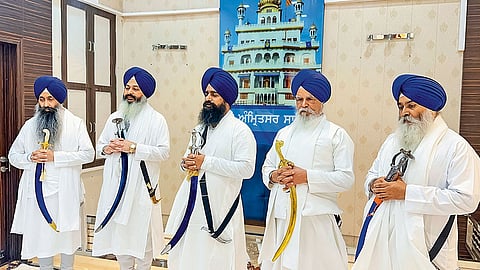
Religion and Politics: Meeting of Akal Takth secretariat over the anti-sacrilege law in Amritsar | Photo: Imago
Punjabi Hindus have rarely voted as a consolidated bloc, which makes the wager an uncertain one, and it sits awkwardly for a party that has spent years accusing the BJP of doing exactly this kind of religious signalling.
Political commentator Neerja Chowdhury sees the timing as one of the stranger aspects of AAP’s recent conduct. “Kejriwal has chosen to foreground religion at a time when even sections of BJP supporters are unhappy with the way religious issues have unfolded nationally. There is disappointment among many people over issues such as the handling of the Ayodhya temple funds,” she says. Whether Kejriwal’s Hindu outreach will produce any political benefit is something that remains to be seen, she adds.
Rejecting criticism that the party was borrowing from the BJP’s playbook, Kang says: “As a national party, we cannot ignore religion in a country like India. People have faith and politics cannot remain completely detached from that reality.”
BJP Stops Sitting on the Sidelines
If AAP is trying to find its footing, the BJP, no longer content playing a peripheral role in Punjab politics, is upping its game. It contested only a limited number of seats as SAD’s junior partner and never built an independent organisation in the state. That calculation has now changed dramatically. The party is preparing to contest a far larger share of seats while expanding its organisation by inducting leaders from rival parties and building its own social coalition.
The biggest boost came earlier this year when seven of AAP’s Rajya Sabha members joined the BJP, enabling the party to gain deep organisational knowledge of Punjab politics.
Those familiar with the BJP’s planning say the party’s objective is less about securing an outright majority than about transforming Punjab into a genuinely multi-cornered contest. A tally in the 30—40 seat range could allow it to emerge as the kingmaker in a hung Assembly while simultaneously ending the state’s traditional bipolar politics.
The BJP is confident of consolidating urban voters while also making inroads among Jat voters, says BJP Punjab in-charge R.P. Singh. “We have put in place an extensive polling-day organisation, with teams stationed at every polling booth and community leaders mobilised across constituencies. The state’s key leaders are already with us, and we are confident of the party’s grassroots network,” he adds.
The BJP is expected to campaign aggressively on two issues—national security and Punjab’s unresolved drugs crisis, while simultaneously expanding its reach among urban voters and OBC communities. Party insiders also believe a fragmented opposition could create opportunities for political realignment.
For AAP, the BJP’s changing posture complicates an already difficult election. The party is no longer simply defending its record in government. It is trying to hold together its own organisation, counter religious controversies and prepare for a contest in which the opposition may be divided but is increasingly better organised.
Congress and SAD: The Fight for Relevance
The Congress party in Punjab has familiar faces from almost all castes, making it a strong challenge in the 2027 elections. However, infighting is making it look extremely weak. Congress strategists think that the party should go into the Assembly elections with Jat leadership, but a faction also feels the leadership has been less considerate towards former CM and Dalit leader Charanjit Singh Channi, who has been waiting to lead the state unit.
While two Jat leaders— Amarinder Singh Raja Warring and Pargat Singh—were allowed to continue in their positions, Channi, who was made the chairman of the campaign committee, wants holistic control. This aside, veteran Manish Tewari being sidelined by the high command has not gone down well. Even after conducting several meetings, the party has not been able to pacify the situation.
How does Congress infighting impact AAP? While it is aware of how fractured oppositions in places like Maharashtra and West Bengal have historically let a dominant incumbent through the middle, but the bigger anxiety inside the party is squarely about the BJP and the Akal Takht row rather than the Congress.
The SAD, which once dominated Punjab politics, has been reduced to a marginal presence after its split from the BJP in 2020 in the wake of the farm-law controversy. Its traditional support base among rural and Sikh voters has been eroded by AAP’s rise. A renewed alliance with the BJP appears unlikely. In 2022, the BJP won two seats while the SAD recorded its worst-ever performance, winning only three.
The Contest Ahead
AAP’s own messaging has tried to fold all three rivals into a single narrative, saying they are united only in their opposition to Mann. AAP Punjab media in-charge Baltej Pannu said that the Congress, the BJP and the SAD had become “Teams A, B and C”, arguing that their only shared purpose was to target the CM. The remark was part of AAP’s effort to recast the backlash over the Akal Takht row as a coordinated political attack rather than a series of separate controversies, even as the party faced pressure on both religious sentiment and governance.
While Punjab’s politics has traditionally been largely bipolar, this time it appears to be moving towards a multi-polar contest, says Ashutosh Kumar, political scientist at Panjab University. Asked what will decide the outcome, Kumar points to what has been termed as the three Ds: dynasty, drugs and deras. “Dynastic politics has weakened, religious institutions continue to influence the political discourse and the issue of drugs remains unresolved,” he says. These, he argues, are likely to define much of the political debate as Punjab heads into 2027.
(This story appeared in Outlook magazine’s August 3 issue, 'The AI Divide', which focuses on how India's AI education ambitions are colliding with the reality of inadequate digital infrastructure, undertrained teachers and AI tools that are not built around Indian students' cultural context)
Published At: