The docuseries "Still, Minab" documents the tragic February 2026 missile strike on an Iranian elementary school that killed over 170 people.
The first episode centers on 11-year-old survivor Parastesh Zaeri, who remains unaware that her brother and classmates were killed in the attack.
Creator Helyeh Doutaghi uses the film to challenge Western media narratives and demand international accountability for civilian casualties.
Minab, Not To Be Forgotten: The True Story Of The Iranian School Strike
Helyeh Doutaghi’s docuseries Still, Minab stitches testimonies around the alleged US-Zionist shelling of an Iranian school

Summary
“Before the bomb hit, we had Quran classes,” recalls eleven-year-old Parastesh Zaeri, one of the few surviving students of a shelled Iranian school, in Still, Minab. Researched and written by Helyeh Doutaghi, the docuseries traces the ghastly missile strike on an Iranian elementary school to unravel how low nations and humanity can stoop. It’s about children left with a lifetime of scars, parents scrambling through a tattered language of showing their kids a world still redeemable.
On February 28, 2026, a strike on Shajareh Tayyebeh school in Minab during the alleged US-Israeli bombing campaign killed over 170 people, mostly children. Dozens of others were injured. Then came the usual UN condemnations and empty gestures of compassion while its probe into US culpability remains dangling. Iran directed blame to the US-Israel coalition; both nations denied responsibility. Trump initially suggested that Iran itself may have been responsible for the strike, despite no evidence whatsoever. On March 11, The New York Times reported that the school was hit by a US Tomahawk missile because of a targeting error. The newspaper, citing US officials, said preliminary findings indicated the US was responsible. The UN investigation is still ongoing.
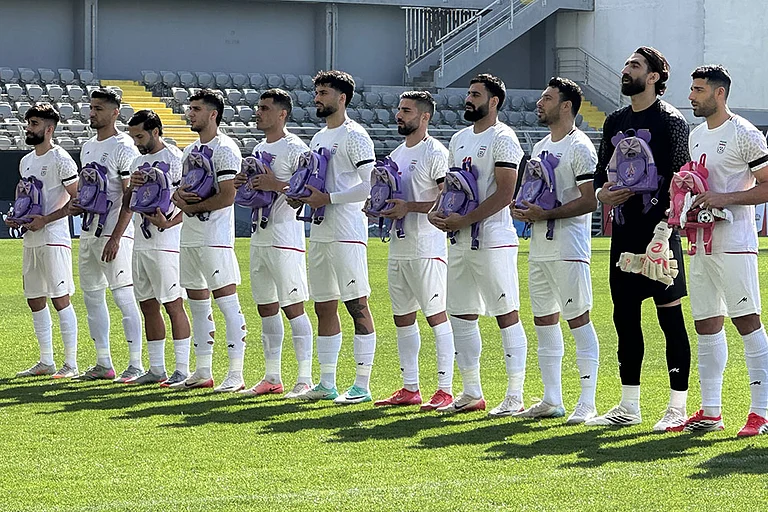
On April 11, Iran’s parliament speaker Mohammad Bagher Ghalibaf shared an image of an empty flight with pictures of the children killed, as well as their schoolbags. The delegation was headed to Islamabad for talks with the US. The symbolic picture carried a disturbing realisation of a massacre severed from any form of justice. The Minab massacre is no anomaly in US military history. It sits comfortably within a long genealogy wherein the US, in the guise of enabling democracy, has continually unleashed bloodshed.
Doutaghi is no stranger to fabrications and insidious charges. On March 28, 2025, Doutaghi, an outspoken advocate for Palestinian rights, was unjustly and discriminatorily fired by Yale Law School. The termination came after an AI-powered Zionist platform published a report labelling her pro-Palestinian activism “terrorism”. Following yet another surrender of a university to Trump, she has since been based in Tehran. Now, she’s devoted to conveying Iran’s truth sans any Western mediation.
Advertisement
Directed by Ali Farirzade, the first episode of Still, Minab, “The Angel’s Games”, circles Zaeri, who survived the alleged US-Israeli attack on her school, but does not yet know her brother was martyred. Voices of the ravaged seep through the series. As of the time this piece will go to print, the other episodes are yet to air.
Doutaghi asks us to reckon with the tangled grief and rage, the audacity and impunity with which the US-Zionist war machine has systemically stripped humanity to nothing. She also ties this to the murder of Palestinian children by Israel. The language of loss itself is rendered bereft when confronted with such atrocities. Yet, nations waive off any onus. Attacks rain on civilians caught rudderless. The miniseries is a direct plea to our conscience. As Israel continues to rampage through Palestine for over three years now, whether humanity even has a conscience worth appealing to is questionable. Still, Minab sends a jolt through complicity as a girl narrates the account of the double missile strike without an affected pause.
Advertisement

Zaeri had several graft surgeries following 33 per cent burns. But she maintains a bright, undimmed energy. Bedridden, she talks animatedly, still enthused about the future. She speaks with an infectious vigour. Perhaps it’s what keeps her parents going. It may be what gives a small dose of hope to face another day.
Her father suggests her state of denial regarding the carnage gives away the urgent need for therapy. Her being upbeat buys the parents time, while also causing an unavoidable disquiet. The incident has cast her emotional responses into a peculiar stew. Her mother doesn’t step before the camera, leaving him to trace the events. While the girl innocently relates her version of the attack, he adds and expands separately. He details the extent of the bombing. He fills in the chilling blanks in her telling. The air was so thick with the smell of blood that one could choke inside the school. She saw only fire everywhere. The blaze is the only memory she retains. The rest is a haze of panic.
Advertisement
A few days after the first episode dropped, Doutaghi wrote on social media platform X: “One of the ways Western media collude with the Western war machine is the dominance of the Western ‘truth’ regime and the institutions that produce this so-called truth. That is, even the deaths of children at the hands of American planes must be confirmed by American ‘experts’ in American institutions, and the testimony of Iranian victims about being killed by America does not count as sufficient evidence.” Schools are torn down, children are wiped out, hospitals razed. However, the West skids away from taking stock of its criminal history, while alleging a threat from a country that doesn’t even own nukes.
Zaeri is kept in the dark regarding her brother’s death. She believes he’s in the hospital. All she thinks is that he has just had a hand injury. But as time stretches into weeks, it will become tough to maintain the bubble. How long can the lie persist? When does sensitively waiting for the right time become misleading? Is there ever a right time?
Advertisement
Her cheerful front is all the more heartbreaking given the imminent revelation. The parents have an unspeakable quandary: to fabricate the assurance of their son’s living, while preparing for the inevitable moment of sharing the truth. Meanwhile, their grief remains intractable, persistent. Her father talks of the deep bond between Zaeri and her brother, Ali. They were inseparable. He worries about how far his daughter will slip away when she is informed.
In her version, the shock of the bombing doesn’t hit on its immense, ruinous scale. Neither has she a grip on the magnitude. In her illusory, brief world of self-deception, her friends are still alive. She’s waiting to be reunited. Her father is in knots about how to tell her that they have all been martyred. The episode circles this agonising situation. The fragility of this emotional protection hinges on its impending collapse.
However, “The Angels’ Games” emphatically concludes on a community-oriented note. Doutaghi reaffirms how the locals have come together to support Zaeri’s family. They have huddled around the parents. They offer food, company, their embrace open for parents hit by the worst nightmare. The Iranian State is also said to be by their side.
There’s a grappling for answers and justice even as the attack seems removed from accountability. It’s the brazenness to bomb and get away with it that the film indicts, centring a shattered family that’s only one of many. The episode is just the first part of a concentrated ethnography of the Minab massacre. Doutaghi says she has conducted elaborate interviews with 35 people, including eight families, volunteer workers in town, and local eyewitnesses. More testimonies will flow in the subsequent episodes, forming a rebuttal to brutal regimes pushing out broad-chested lies and denials. The weight this episode leaves is unshakeable.
Debanjan Dhar is a film fest-junkie & is fascinated by South Asian independent cinema.
This article is part of the magazine issue dated May 11, 2026, called 'Khela Hobe?' about Assembly Elections 2026 and how West Bengal may prove to be the toughest battleground for the Bharatiya Janata Party.
Published At: