The Dalai Lama’s 2025 declaration that the Gaden Phodrang Trust alone has the authority to recognise his reincarnation has brought the succession dispute into sharper focus, with Beijing insisting on its own role in the process.
After fleeing Tibet in 1959, the Dalai Lama and tens of thousands of Tibetans found refuge in India, where settlements and exile institutions helped preserve their culture, religion and political identity.
While the CTA is preparing for competing succession claims, experts see little prospect of a diplomatic breakthrough with Beijing or a significant change in India’s position on Tibet.
Next Dalai Lama: A Spiritual Succession That Could Redraw Tibet’s Political Future
The Dalai Lama’s impending succession has intensified tensions between China and the Tibetan leadership, reviving questions about religious authority, the history of Tibetan exile in India and the future of a community that has lived away from its homeland since 1959

Summary
In the hills of Dharamshala, the future of Tibet is being discussed in the language of faith. But beyond the monasteries and prayer flags, it is also being debated in the language of power: who has the authority to choose the next Dalai Lama, whether China will accept that choice, and how far India is prepared to go to protect a community it has sheltered for more than six decades.
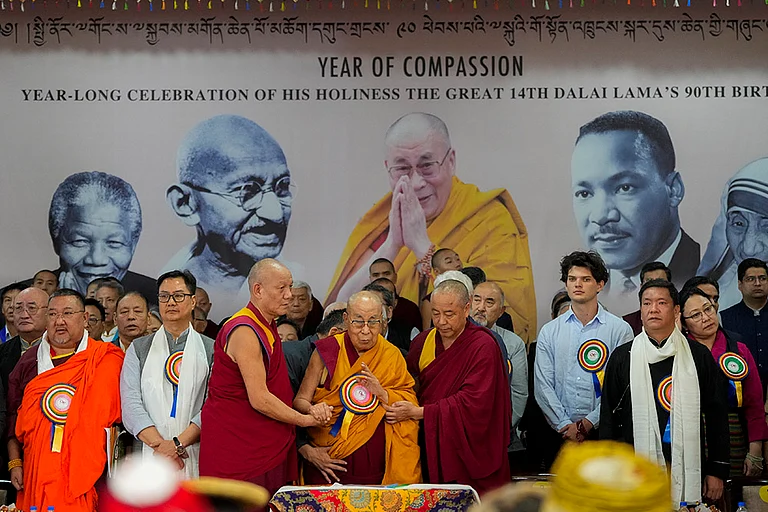
The 14th Dalai Lama, Tenzin Gyatso, has already made two things clear. In a statement issued on July 2, 2025, he affirmed that the institution of the Dalai Lama would continue and that the Gaden Phodrang Trust alone would have the authority to recognise his reincarnation.
Beijing, however, insists that the selection must follow procedures approved by the Chinese state. The competing claims have turned a centuries-old religious institution into the most consequential political questions facing Tibetans in exile. Experts and Central Tibetan Administration (CTA) officials who spoke to Outlook said the Dalai Lama’s eventual absence could pose difficult questions for the Tibetan exile community, even as its leadership prepares for a transition amid tensions with Beijing.
From The Tibetan Plateau To The Foothills Of India
The Dalai Lama institution dates back to the 15th century. Gedun Drupa, born in 1391, is regarded as the first Dalai Lama, although the title itself was conferred retrospectively. Over the centuries, the institution acquired spiritual authority and, under the Fifth Dalai Lama in 1642, became closely connected with Tibet’s political leadership. The Gaden Phodrang, originally established as the Dalai Lama’s administrative office, became central to the institution’s affairs.
The modern rupture came in 1950, when China's People’s Liberation Army (PLA) entered Tibet. The following year, Tibetan representatives signed the Seventeen Point Agreement with the Chinese government, an agreement that brought Tibet under the authority of the People’s Republic of China. Its signing remains contested: accounts of the period describe the Tibetan delegation as having signed under pressure. Resistance and unrest grew in the years that followed, particularly in eastern Tibet, where Chinese political and social reforms provoked opposition.
Advertisement
By March 1959, the unrest had reached Lhasa. Fearing that Chinese authorities intended to detain him, the 14th Dalai Lama left the capital in disguise on March 17. He crossed the Himalayas and reached India on March 31. The uprising was violently suppressed, and thousands of Tibetans subsequently fled across the border. Prime Minister Jawaharlal Nehru’s government granted asylum to the Dalai Lama, opening a new chapter in the relationship between India and the Tibetan people.
Exile was not only a matter of finding shelter but also of rebuilding a society. The Central Tibetan Administration (CTA), established in 1960, became the principal institution administering the community in exile.
Over the years, Tibetan settlements took roots across India, including in Karnataka, Uttarakhand and Himachal Pradesh. Schools, monasteries and cultural institutions helped preserve a language and religious tradition that refugees feared could disappear with each passing generation.
Dharamshala eventually became the headquarters of the CTA and the centre of the Tibetan political and spiritual world in exile.
Advertisement

The Dalai Lama also made a significant institutional change in 2011, transferring his political authority to an elected Tibetan leadership. The move separated the spiritual institution from the administration of the exile community. That distinction is now central to the succession debate: the next Dalai Lama, in the CTA’s understanding, will be a spiritual leader, while the Sikyong and elected institutions will continue to manage political and administrative affairs.

A Reincarnation, Two Competing Claims
The Dalai Lama’s July 2025 statement sought to settle the question of who would oversee the search. He said the Gaden Phodrang Trust would consult the heads of Tibetan Buddhist traditions and follow established religious procedures. The trust, registered in India, is responsible for the institution’s spiritual work and the recognition process. The CTA has since reiterated that no outside government can determine the reincarnation.
Advertisement
Tibetan DIIR Secretary Karma Rinchen describes the matter as settled from the CTA’s perspective. “After that statement, I think things are settled now,” he told Outlook, adding that the administration would assist the Dalai Lama’s office in carrying out its instructions. He called the CTA “fully prepared” for the possibility of a Chinese-appointed candidate, which he described as “more like a politically appointed candidate”.
The Central Tibetan Administration has maintained that the succession is a matter of religious tradition, not political appointment. Spokesperson of the Tibetan government-in-exile, Tenzin Lekshay, said the Dalai Lama had affirmed that the institution would continue and entrusted the Gaden Phodrang Trust with the authority to recognise his reincarnation. “Since the reincarnation is a unique and deeply rooted spiritual tradition of Tibetan Buddhism, His Holiness has entrusted the Gaden Phodrang Trust with the sole authority to recognise his future reincarnation,” the spokesperson told Outlook. The CTA added that the Dalai Lama continues to dedicate himself to the well-being of humanity, describing his legacy in terms of “peace, nonviolence, justice, equality, and global harmony”.
Advertisement
China’s position rests on a different reading of history. Beijing invokes the Qing dynasty’s Golden Urn procedure, introduced in the late 18th century, under which the names of recognised candidates could be drawn by lot. It also relies on a 2007 regulation, commonly known as Order No. 5, requiring state approval for the reincarnation of Tibetan Buddhist “living Buddhas”. The Chinese government presents these measures as an extension of historical practice and an instrument of religious administration.
Professor Srikanth Kondapalli, a Chinese Studies expert at Jawaharlal Nehru University, says the Tibetan objection is rooted in the belief that a religious institution cannot be handed over to a political party. “How can the Communist Party choose their god, Tibetan god?” he asked, pointing to the fact that the Chinese Communist Party is officially atheist. He also argued that the historical record does not show uninterrupted Chinese involvement in the selection of every Dalai Lama.
The Panchen Lama episode remains a particularly painful precedent for Tibetans. In 1995, the Dalai Lama recognised Gedhun Choekyi Nyima as the 11th Panchen Lama. The child subsequently disappeared from public view, and Chinese authorities installed another candidate. The whereabouts of Gedhun Choekyi Nyima remain a longstanding concern for Tibetan groups and international observers. For Kondapalli, the episode illustrates why Tibetans fear state interference in the next succession.

The Unity Question — And The Long Wait For A Political Breakthrough
The Dalai Lama’s absence will leave a space that institutions alone may struggle to fill. The CTA argues that the transfer of political authority in 2011 prepared the community for a future without his direct political leadership. But the spiritual and emotional significance of the Dalai Lama is harder to institutionalise.
Karma Rinchen acknowledged that his absence would be “deeply felt” by Tibetans inside and outside Tibet, as well as by Buddhist followers around the world. Yet he believes the community has the foundations to endure the transition. “His absence will be felt, of course,” he said, “but I think then we will have a future Dalai Lama.”
Dr Sriparna Pathak, Professor of China Studies and founding Director of the Centre for Northeast Asian Studies at O.P. Jindal Global University, believes the exile community is likely to remain broadly united on the question of succession. But she cautions that wider political cohesion is less certain. The Dalai Lama, she said, has been the moral figure holding together Tibetans from different regions, generations and Buddhist traditions. A lengthy interregnum — potentially spanning 15 to 20 years while a successor is identified and educated — could expose differences over political strategy and the future of the movement.
The political road ahead offers little immediate relief. Formal Sino-Tibetan dialogue has been stalled since 2010, when the ninth round of talks ended without agreement. The CTA continues to advocate the Middle Way Policy, seeking genuine autonomy for Tibet within the framework of the People’s Republic of China rather than outright independence. But Beijing has shown little willingness to resume formal negotiations.
Karma Rinchen remains hopeful, even as he describes the situation inside Tibet as “very, very, very sad”. He accused the Chinese Communist Party of trying to “assimilate and systematically destroy the Tibetan identity”, but argued that such policies could not continue indefinitely. “Things will change for sure,” he said, while acknowledging that nobody could predict when. He urged Chinese leaders to consider the Middle Way proposal as a “mutually beneficial” solution.
Dr Abhishek Pratap Singh, Assistant Professor at the University of Delhi and a scholar of Chinese Studies, is less optimistic about a diplomatic breakthrough during Sikyong Penpa Tsering’s second term, which runs from 2026 to 2031. Beijing, he said, has shown “zero willingness to resume any level of formal dialogue”. He expects the CTA to continue its international advocacy rather than secure a major diplomatic shift.

India’s Delicate Position
India occupies an unusual place in this story. It is the country that gave the Dalai Lama refuge, hosts the CTA and is home to a large Tibetan exile population. Yet its official position recognises the Tibet Autonomous Region as part of China. New Delhi has little incentive to turn the succession dispute into another source of confrontation with Beijing, particularly when relations between the two countries remain shaped by the unresolved border question.
In July 2025, after the Dalai Lama announced that the Gaden Phodrang Trust would oversee his reincarnation, the Ministry of External Affairs said India did not take a position on matters concerning “beliefs and practices of faith and religion”. The government reiterated that it upheld religious freedom. That formulation allows India to maintain its longstanding support for the Dalai Lama’s religious freedom without endorsing the CTA’s broader political claims.
Singh believes India is unlikely to adopt a more explicit political position on Tibet. “India is unlikely to abandon its official recognition of Tibet as part of China,” he said, arguing that New Delhi would avoid an escalation with Beijing. But for Karma Rinchen, India’s role has already been indispensable. “India has done more than any other country in the world,” he said, expressing gratitude to the Indian government and people for allowing Tibetans to preserve their culture and religion.
The succession dispute may eventually produce two competing Dalai Lamas: one recognised by the Gaden Phodrang Trust and another backed by Beijing. But the deeper question is whether political authority can manufacture spiritual legitimacy. Kondapalli put the Tibetan position in stark terms: “You may have controlled my area, my land, but you cannot control my mind, my spiritual inclination.”
For a community that has spent more than six decades building a home away from home, the next Dalai Lama will represent more than the continuation of a religious lineage. He will carry the weight of a history interrupted in 1959, and of a people still waiting to return to a future of their own choosing.
Published At: