Nandigram, a default political hotbed over the last couple of decades, is primed to host a tight contest.
In Kendamari’s Booth 226, 321 voters were placed under adjudication, resulting in the deletion of 172 voters―almost one-third of the electorate. However, the village has been in shock when it was revealed that all 172 deleted are Muslim voters.
For Adhikari and his followers, Nandigram’s Hindu voters are enough to hand him a decisive victory.
West Bengal Assembly Elections 2026: In Nandigram, Defiance Against SIR Isn’t A Choice, But A Shot At Survival
Here, it is about assertion, identity, and a defiant stand for posterity.

Summary
There is a sense of recognisable disquiet in Nandigram. Susanta Majhi, a trawlerman, believes there is no other way to win an election here but to polarise the town. The constituency is incapable of witnessing healthy politics, he whispers.
For Majhi, the uncertainty of returning from the sea is a chilling and rousing prospect, but the politics of the land is not. He dreads what follows every time there are elections in Nandigram, like most other voters, dreading the repercussions for every opinion out in the open.
Recently, Trinamool Congress (TMC) General Secretary Abhishek Banerjee launched an attack against the leader of opposition and MLA from Nandigram, Suvendu Adhikari, stating only those suffering from ‘bankruptcy in ideals’ can seek votes in the name of religion. However, for Adhikari and his followers, Nandigram’s Hindu voters are enough to hand him a decisive victory―by hook or by crook, believes Majhi.
In 2021, Chief Minister Mamata Banerjee had taken the fight to Nandigram to contest against her one-time trusted colleague Adhikari, who was then a fresh turncoat. When the results were announced, which remains controversial till date, Adhikari tipped Banerjee by a margin of 1,956 votes to win the seat. As it approaches another crucial election, Nandigram feels like it is stuck in time. On March 14, 2007, the township had infamously witnessed the killings of 14 people in protests against the Left Front government’s land acquisition project for a proposed Special Economic Zone (SEZ) chemical plant. Mamata Banerjee had led the protests with the Adhikari family by her side. Nandigram, which had scripted the rise of the TMC supremo almost two decades back, while also being the Adhikaris’ backyard, is still torn between loyalties, as it votes in the first phase of the elections, on April 23.
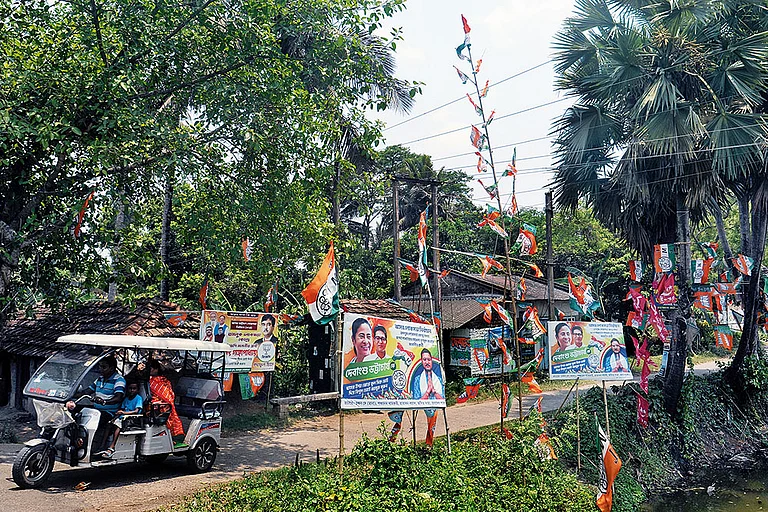
It has been two decades, and a lot has changed, but the burden of a violent past continues to weigh Nandigram down. More than political inscriptions, thousands of Jai Shree Ram flags paint the town saffron as TMC’s Joy Bangla flags peek from the spaces in between. Besides using his connection to the soil, locals feel the incumbent MLA Adhikari has played into the religious sentiments of a Hindu-majority constituency quite safely and effectively. Nandigram, a default political hotbed over the last couple of decades, is primed to host a tight contest this poll season as well.

For many, like Susanta, political affiliations are unwritten. He does not like accepting publicly that he is a ‘ground worker’ for the Bharatiya Janata Party (BJP), but would do what it takes to get the party over the line. “I do not like BJP’s politics. But we fishermen know the wind better than most. It is better to utilise the wind than fear it,” he says. A Hindu voter of Kendamari’s booth number 226, Susanta considers himself to be an essential presence in a Muslim-dominated booth of Nandigram. He says, “Nobody can stop the BJP from coming to power in Nandigram. As a worker, I can only make sure I do my bit in a tricky place. The weather here has been quite inclement since the Special Intensive Revision (SIR).”
Advertisement
In Nandigram’s Kendamari, around 140 km southwest of Kolkata, while long summer days sway to the sound of silence, in the Muslim-dominated Booth No. 226, criticism is not minced. “He (Adhikari) does not even try to hide the fact that he is Islamophobic. He visits both booths adjacent to ours, but has never come to ours even once since 2021, as he knows that this is a Muslim-majority one,” says Sheikh Shoaib, 26. Following SIR, in Kendamari’s Booth 226, it is merely about political antagonism, but collective rage at targeted discrimination. With a little over 600 voters, 321 voters were placed under adjudication in the booth, resulting in the deletion of 172 voters―almost one-third of the electorate. However, the village has been in shock when it was revealed that all 172 deleted are Muslim voters.
According to the Election Commission of India’s (ECI’s) data, Nandigram recorded a total of 2,826 deletions across the recently-published supplementary lists, out of which 2,700 or 95.5 per cent are Muslim voters. Kenda Mari, like the rest of the constituency, reflects the pattern of an alarming deletion rate among Muslims, who comprise 26 per cent of Nandigram’s electorate. Sheikh Redwan, a deleted voter, points at the Kendamari Gangamela Temple and asks, “Evidently, Hindus are part of this booth as well. How is it possible that out of the 172 deleted, all are Muslims? Will they still try to convince people that there is no ulterior motive behind this exercise?”
Advertisement
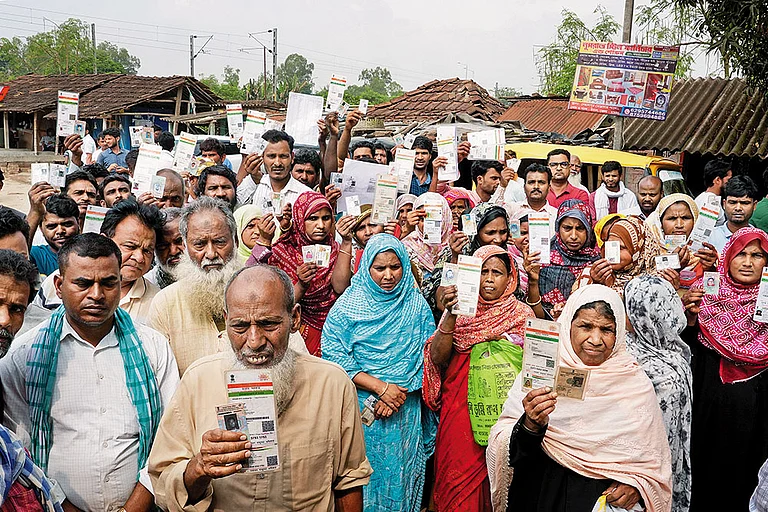
For the people of Kendamari in Nandigram, the deletions defeat logic, reason, and promise. Coming out of their houses, most of the deleted voters held their documents with conviction and emphasis. “Show me one document which is invalid. I have not missed a single document,” says a deleted voter, displaying the papers like a deck of cards on the road, which included her Aadhaar, Voter ID, PAN, ration card, Madhyamik Pass Certificate, father’s death certificate, and parents’ name on the 2002 SIR list. Most voters in the region claim that they have been deleted despite furnishing all necessary documents. Numerous voters whose parents have more than five children have been purged from the rolls―a recurring reason for deletion as mentioned on the notices sent to the deleted voters of the area.
“The ECI is inhuman. Why is it difficult for them to believe that our parents had five or more children? Is it only to target Muslims who have long been associated with overpopulating the country? Wasn’t it a common occurrence among Hindu families earlier as well?” asks Jafar Ali Khan, whose wife’s name has been deleted for the same reason.
Advertisement
The women voters of the village have found themselves in a major limbo following the adjudication process. Most of them, who have studied till Standard six or eight, have been deleted despite linking their names to their parents’ who were on the 2002 SIR electoral lists. Sayeda Bibi, a former Panchayat member, aged around 60, traces her family’s roots to the very soil of Nandigram and Kendamari. She has found herself disenfranchised for the first time in her life. A prominent face in the village, Sayeda, has been a constant support for the deleted women voters, despite her own quandary.
“I have voted all my life. My name is on the 2002 list and yet, I have been struck off. People need to know that this is beyond politics now. This is about fundamental rights. The people of this village are stricken with anxiety. Every single Muslim in the state fears being labelled as a Bangladeshi after the SIR. People here are afraid that they will be deported or put in detention camps,” says a flustered Sayeda. Exposed to the anxiety, the fear has trickled down to the children of Kendamari, who now doubt what the future holds for them. The people of the village raise a genuine concern: Now that parents’ names on the 2002 SIR list will decide the fate of their children, who are now voters, will the 2026 lists not affect future voters―the children and grandchildren of the purged voters?
Advertisement

In Kenda Mari village of Bengal's Nandigram constituency, an overwhelming majority of voters deleted after SIR are Muslims who have been purged on the grounds of their parents having five or more children. Photo by Sandipan Chatterjee / OUTLOOK
For the Muslim-majority village, the thought of generational disenfranchisement not only triggers panic, but also intense fear of potential deportation or amplified discrimination. “If Adhikari has done one thing in the past five years, it is sowing the seed of hatred. This is brewing animosity between friends and neighbours. In Kendamari Anchal 3, Hindus and Muslims have always lived in harmony. Now, the future looks very bleak,” points out Sheikh Shoaib. With 95 per cent of deletions across the supplementary polls being Muslims, Nandigram sits on the communal live wire again. The awareness surrounding the exercise does not come out of interest, but compulsion―compulsion fed by survival and self-preservation.
On the political front, it is being pitched as a contest between the two bhumiputras (sons of the soil). Ironically, Adhikari’s former associate, Pabitra Kar, who jumped ship right before the polls, has been fielded by the TMC in the constituency. Adhikari, who is also contesting from the Bhabanipur constituency against Mamata Banerjee, will certainly look to secure Nandigram for electoral insurance. The town, however, lies divided, as few believe that Adhikari’s political might and connect will make it a smooth sailing for him, while others bet on Kar’s understanding of the inner mechanisms, knowledge of the subtler dynamics, and Mamata’s legacy linked to the name of the land to wrest Nandigram back from the BJP.
Kar, who left the saffron camp owing to irreconcilable differences with Adhikari, says his primary objective is to make sure Nandigram gets to experience politics free of unrest, violence, and controversy, shedding the decades-old bias and burden. On being asked about SIR deletions in the constituency, he says despite a dent in the Muslim votes, which have traditionally gone to the TMC, the arithmetic would not affect the TMC’s performance in the constituency. “Illegal voters will not be voting under my watch, but as announced by the Supreme Court, legitimate voters who have been deleted will find their way back to the rolls,” he says.
Kar adds that with his shift, a sizable portion of Hindu voters and workers have also shifted allegiance, which would be an important factor this time. About Muslim deletions, Kar says, “That is the politics of hate they (BJP) perpetuate. The land has given space to all religions. I aim to go beyond any form of appeasement. The fact that I am a real Sanatani makes me believe in harmonious religious co-existence, while Adhikari, the fake Hindu that he is, certainly opposes that. Nandigram has no space for BJP’s divisive politics.”
When Sheikh Babul Akhtar, 54, found out that three of his four family members had been purged, he felt the embarrassment and anxiety course through his veins. “Once Muslims are singled out, we know what follows. This is the beginning of that process. So, if we are not allowed to vote, I would humbly request the court to allow us to opt for euthanasia,” says Akhtar.
“Why should we be scared? It is our land, our language, and our right. Nandigram has seen enough to be rocked by petty politics. If legitimate voters are not allowed to vote, the entire village will boycott elections,” says Sayeda. Kendamari, like numerous villages across Bengal, awaits answers to numerous questions, anxious of the next rap on the door, the next notice, and the looming announcement. A vote, for the 172 deleted voters of Kendmari’s booth 226, is barely about choice anymore. It is about assertion, identity, and a defiant stand for posterity.
Published At: