



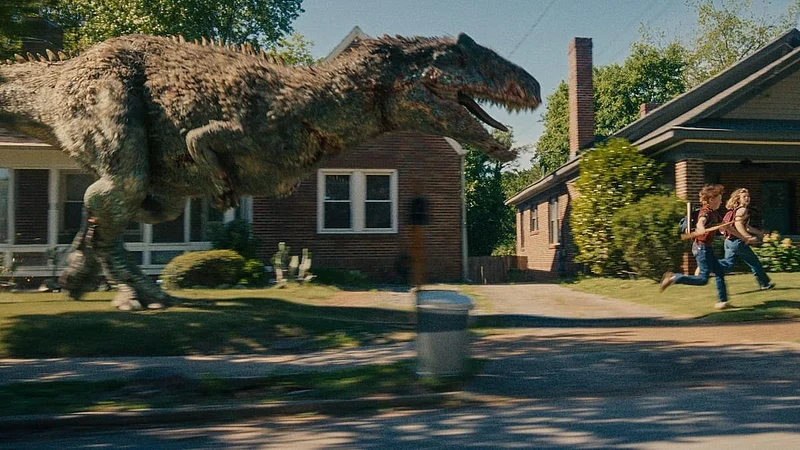
The End Of Oak Street is directed by David Robert Mitchell.
Starring Anne Hathaway in her fourth movie this year, the film merges suspense and heart in a wildly enjoyable dinosaur encounter.
The film also stars Ewan McGregor, Maisy Stella and Christian Convery.
The End Of Oak Street is the most fun I’ve had in a theatre this year. David Robert Mitchell’s dino fare brings ample suspense and heart into the vestiges of blockbuster commercial cinema trappings. It’s strewn with sequences that set my pulse racing and had me almost on the brink of whistles. Honestly, I have to scratch my memory real hard to even recall when a mainstream film got me jiving to its wavelength from the get go and refused to loosen the shackles. The End Of Oak Street is the definition of a proper, thrilling communal experience to get a film that exults in splendidly orchestrated moments. My regret is the theatre was much too empty to feel the ripples bounce across the breadth of the audience. Where are the moviegoers? You have been summoned.

Taking us to a ‘80s Michigan suburb, Mitchell plants a seemingly perfect family. Summer parties are all the mood. Greg’s (Ewan McGregor) family looks like a picture postcard type. Greg is even openly envied for having one. But there are abiding marital fissures between him and his wife, Denise (Anne Hathaway). The couple is on the cusp of disagreements. She accuses him of not being devoted to family time. She’s frustrated with his lack of honesty, his refusal to see the situation as it is. He’s in denial, burying himself in a slew of side gigs for extra cash. Their teenage kids, Audrey (Maisy Stella), and Brian (Christian Convery), have, well, teenage issues. Audrey has a keen affinity for cosmological stuff, an early nugget teasing the grand mysteries undergirding what’s to come. Brian is a school bully who must deal with the consequences of his actions. He’s also infinitely protective of his dog, Starbuck. Mitchell’s screenplay embeds the wider crisis within the domestic fray, a relationship coming apart at the seams. When the plot’s central threat emerges, it turns into a test of togetherness.





The couple’s conflicts are flung into the backseat once a bunch of prehistoric creatures ram through the town, unleashing gruesome attacks. Mitchell finds inventiveness galore in approaching every kill. Each massacre feels spectacularly fresh, pulverising us with endless riches of thrills. This film is a breathless affair, tightly orchestrated. You can feel the thudding suspense as the lurking dinosaurs of varied stripes roam the peripheries, inching closer.
Glimpses of the creatures’ patterned bodies remain constantly evocative. They are these spectacular peeks which inject just the right dose of terror. Mitchell demonstrates an absolute masterclass in setup. The first half hour is peppered with creeping signs of menace. There are all sorts of clues indicating something is afoot. A neighbour, whom Denise shows her work-in-progress secret novel for editorial feedback, has an odd-looking plant sprouting in her backyard. The book is Denise’ true articulation of her domestic stasis. The neighbour swears the plant in contention wasn’t even there two days back. How did it become so tall? A library visit suggests the plant species got extinct centuries ago. Denise is amused but doesn’t heed it. Then, there’s the bright, blinding beam of light. It’s all very uncanny. Of course, everyone dismisses the cues until the town is overrun by a diversity of prehistoric creatures.

Mitchell lets loose a manic circus that’s part of why the film is so ridiculously electrifying. As survival mode kicks in, Greg initially tries to keep his family grounded. Naturally, people are lured out of the house for various reasons. The parents and children scatter. This is a ploy for the film to acquaint us with a complete array of creatures steamrolling through the town. Mitchell mounts one heart-pounding moment after another in a dazzling, dizzying assortment of escape and retaliation scenes. Just as impressive is his oscillation between the gasp-inducing and the earnestly poignant. Hathaway, Stella and Convery earn the aches with solid sincerity.

You might have to forgive the film’s more uncertain, dodgy conceits with time portals, that tries to explain away the strange onslaught. It’s the least convincing and credible facet of the film, but even these grouses don’t really get to fester for long, before Mitchell distracts you with another crazy, pulpy kill. Every doubt gets waived off with yet another chiselled heart-in-the-mouth scene. The chase keeps matters clacking forth at a satisfying speed, spiked with incredible urgency. Mitchell also never loses sight of cheekiness. An indelible funny scene with dinos humping has a beautiful moving segue.
The End Of Oak Street is very smart in how it weaves through space. Diopter shots constantly accentuate a nagging impression that something just might be stalking at the edge of the frame. The interaction between humans and the creatures plays out with a vivid reckoning with distance and proximity, alert, fractious and springing with danger. Thanks to DP Michael Gioulakis’s shrewd work, you stay immersed as to how the two are situated. The world’s boundaries might be vague, but within the town’s ambit, everything seems to close in on the family. Time is running out.
It’s a rollicking delight to follow the family’s manoeuvring through a minefield where every moment and advance is a tease with death. This profusely charming Spielberg homage flecks the well-manicured American suburbia with delicious, unpredictable unease. The End Of Oak Street goes scouring through the pockets and corners of a shrinking landscape and encroaching peril with a surge of pure bedlam joy. It’s hard not to be completely enthralled.















