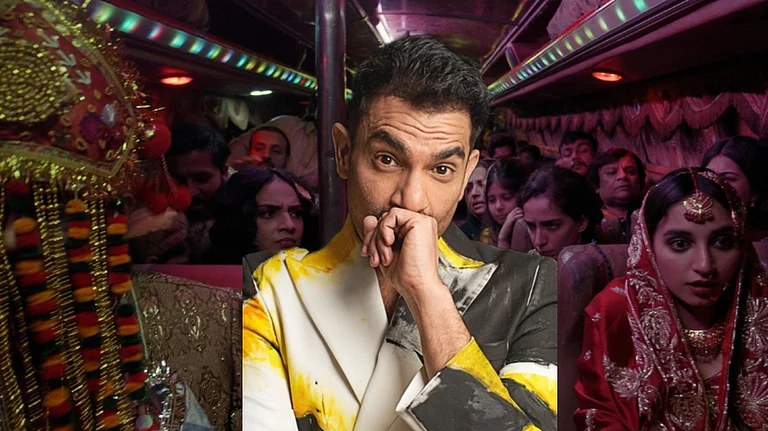
Pakistani filmmaker Umair Bilal's doc, As Light As Air, premiered in Locarno Film Festival 2026.
It plays in the Semaine de la Critique lineup.
The quietly compelling hour-length documentary is set in the Sufi town of Sehwan.
“Where spirituality leaps in, everything else gets submerged”, someone says in the latter stretch of Umair Bilal’s documentary, As Light As Air. Premiering in the Locarno Critics' Week, the film is as open and untethered as cinema has the pleasure and glory of proposing. It calls on us to amble through its central space, the town of Sehwan in Pakistan famous as a Sufi stronghold. Bilal is essentially chronicling the bursting soul of a place, see-sawing between religious doctrine and humane affirmation. Watching this film is a liberating experience. It’s as wondrously soothing as spectacularly transporting. Bilal doesn’t so much map a place with its firm traditions as catch a drift of what it feels like to breathe its air.

It’s humbling to witness the shared osmosis the space ignites. As Light As Air insists on an experiential design, one that’s not hooked on individual trajectories. Bilal culls a community spirit to the forefront. He eschews any allusive tendency, opting instead for the spiritual transmission, the sensorial, a loosely flowing cinematic fabric laced with curiosity, wonder and introspection. We go from a shrine to a fair, while lights dim and the town winds down.
Sehwan is a haven for vagrants of all stripes. It offers shade to all without judgement, prejudice or distinction. Bilal is seeking to capture its welcoming attitude, its ability to contain such beautiful diversity without driving walls in between. It’s one of the final few vestiges where humanity gets a chance of transcendence, shuffling out of self-imposed chasms. There’s something incredibly cathartic to watch men, women, everyone giving themselves over to Sehwan’s unique subliminal force. In an age vitiated by rampant polarisation, the shutting down of doors, Sehwan’s reprieve embraces radical empathy.


Bilal’s approach switches seamlessly between a vivid embodiment and something far more elusive and ungraspable. The film moves from the opening serenity to a rush of pilgrims and travellers. We pick our way through Sehwan’s splendid chaos, awestruck by the elevating raptures of a dhamaal. The 65-minute documentary takes its time to arrive at a fluidity that feels organic and unbound.

Leaping between colour and monochromatic, freeze frames and re-animating sequences, As Light As Air feels both modest and epic in the same breath. Wending through the nooks and crannies of Sehwan, it knows when to pull up. We witness a man shed a tear, be overcome with pure emotion. “Love just happens, it can’t be sought”, someone remarks elsewhere. What’s remarkable is how Bilal alternates between gorgeous meditativeness and vigorous devotion. Each has its rhythm, a philosophy, both equally regarded.
Along with Konstantin Stell, Bilal shoots the historic town with complete abandon. He’s not trailing a specific figure but a panoply streaming through the streets and by-lanes. Diverse moods register over the breadth of the film. There’s celebration, exultation and lament coursing through visitors pouring in, each on their own different quests. Bilal shifts away from scanning what underpins those moods to veer towards a choral tapestry. As Light As Air is by turns rousing and suffused with calm resignation. Editor Siddhant Sarin has a tricky challenge. The filmic threads are seemingly scattered but he has to establish a concentrated surge of energy. It oscillates between joyful surrender and melancholic reckoning. We witness the daily hubbub as mornings darken into nights and bustling streets die down. Bilal embeds us both in the manic thrust of Sehwan’s devotional pulse and its quieter, nocturnal hum of submission. Grace can be found in both as long as we know and build an equation with a sense of equilibrium.

It’s also quietly riveting to encounter how Bilal presents a town eventually folding up after a day’s exertions, just as how every dawn brings a variation on a familiar cycle. Music and performance cradle Sehwan. Through them, pilgrims connect with whatever they are seeking, hoping for a salve. The film consciously edges near people but refrains from delving into backstories and details. We have to trust, partake in the collective essence, behind the candle smoke and bells. As Light As Air escalates to a trance, a live alchemy throbbing with accumulated emotion, ache, projection and vitality drawn from the place. Right after, silence and tranquil envelop. It’s this balance at the heart of life. Umair Bilal has made a film that’s as affecting as defiant in chalking out its own beat.