Jantar Mantar has long defied the old adage that lightning never strikes twice. The 18th-century observatory built by Maharaja Jai Singh II has, time and again, become the unlikely birthplace of political storms. Governments in India have periodically learnt that movements born on the pavement of Jantar Mantar often have a deep impact, sometimes making the heart of power nervous and uncomfortable.
Cover Story | Powerful Government, Defiant Gen Z, and the Politics of Accountability
For all the importance of parliamentary arithmetic, Indian democracy has always drawn its strength from the space between Parliament and the street. Dharmendra Pradhan’s resignation as India's education minister is the latest reminder that governments cannot govern by numbers alone.

But, history is not liked by the powerful. So, when Abhijit Dipke, the founder of the fledgling Cockroach Janta Party (CJP) arrived at Jantar Mantar in June demanding the resignation of Union Education Minister Dharmendra Pradhan following the National Eligibility Cum Entrance Test (NEET) controversy after a paper leak, the initial reaction was to dismiss him. His outfit, after all, was only days old, its organisational footprint barely existed and the protest attracted little attention beyond a small circle of Gen-Z supporters. Millions engaged with the party’s Instagram page, but a few felt compelled to leave their screens and join the demonstration on the ground.
The political climate offered Dipke little reason for optimism. The National Democratic Alliance (NDA), led by the Bharatiya Janata Party (BJP), had been consolidating its political dominance through successive victories in state elections, driven by the twin narratives of Hindutva and Viksit Bharat. The government’s mood was upbeat and hence the demand for the resignation of one of its ministers appeared less like the beginning of a movement than an act of political futility.
The first fortnight did little to alter that impression. Dipke was dismissed as an Opposition proxy, while his supporters were written off as a bunch of online activists unlikely to survive beyond the news cycle.
The script, however, altered almost two months later. Pradhan had to resign.
The resignation of a Cabinet minister has not altered the balance of power in New Delhi. But it has marked something significant. A government that had spent more than a decade cultivating the image of a regime never yielding to the Opposition’s pressure had conceded the central demand of a protest movement led by a political unknown and propelled largely by Gen Zs.
What changed in a span of weeks? How did a protest that struggled to gather supporters at Jantar Mantar initially compel the country’s most politically dominant government in decades to retreat?
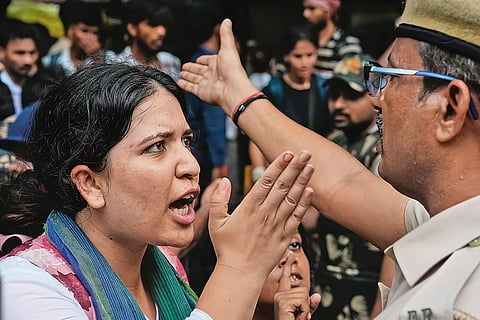
Frayed Tempers: A protester and a policeman captured while having a heated argument | Photo: AP
The Weight of a Fast
A meal derives its flavour from many spices. A political movement, too, gathers strength from many ingredients. Anger ignites it, slogans sustain it and crowds give it visibility. History remembers movements for something else entirely— the willingness of an individual to suffer for a larger cause. For CJP, that moment arrived when Sonam Wangchuk joined the movement.
Advertisement
The Ladakh-based engineer and environmentalist, who had himself endured detention under the National Security Act last year while campaigning for statehood and constitutional safeguards for the Union Territory, announced that he would join the protest and begin an indefinite fast until its demands were met.
Few political acts in India possess the moral gravity of a fast. It is among the oldest idioms of democratic dissent, forged during the freedom struggle and carried across generations of protest. Mahatma Gandhi transformed fasting into an instrument of moral persuasion, embedding the idea deep within India’s political imagination. Potti Sriramulu’s fast redrew the linguistic map of independent India. Anna Hazare’s hunger strike revived a nationwide debate on corruption decades later. Whether one agreed with their demands was secondary. The fast itself altered the moral balance of the argument.
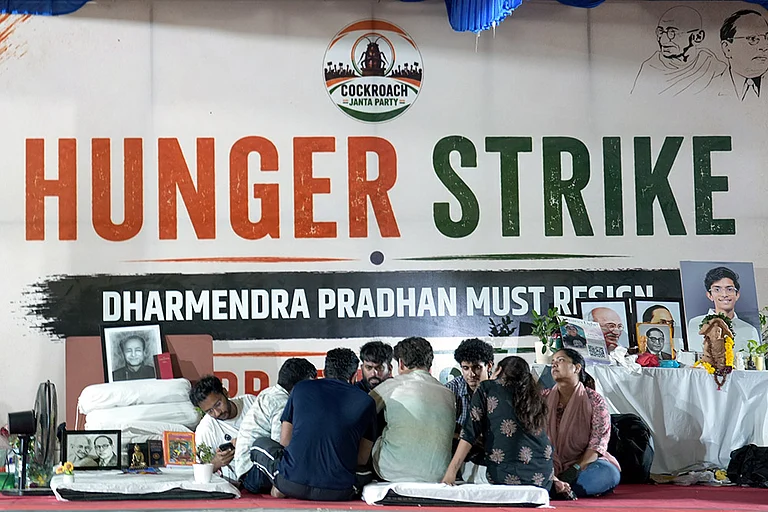
Its power lies in the moral dilemma it creates. Governments can dismiss slogans, question motives and dispute the size of a crowd. They can arrest protesters, erect barricades and wait for public attention to fade. But they can’t ignore a human body willingly embracing suffering for a political cause. A fast shifts the contest from politics to conscience. It asks not just whether a demand is justified, but whether a government is prepared to watch an individual suffer rather than respond.
Advertisement
As political scientist Yogendra Yadav observes: “Self-sacrifice establishes authenticity. Fasting is one expression of that tradition, where action communicates more powerfully than speech.”
A political movement, gathers strength from many ingredients. Anger ignites it, slogans sustain it and crowds give it visibility.
The effect of Wangchuk’s fast was immediate. The crowd at Jantar Mantar started swelling. Students who were following the protests on their mobile screens and Instagram feeds started booking their tickets to Delhi. It was no longer restricted to Gen Z. Parents of children who slogged for years preparing for competitive exams and whose children died by suicide after the NEET paper leak arrived too. Volunteers arranged for food and water; some organised medical camps. As the mercury rose, the intensity of anger went up as well. What had begun as an everyday protest in the calculations of the government was becoming one it could no longer afford to underestimate.
Then came the morning of July 18 that changed the course of the movement.
Advertisement
Acting on Delhi High Court’s observation that Wangchuk’s life had to be “protected”, police in plainclothes arrived at Jantar Mantar at around 7 am and took him to the Safdarjung Hospital. What was intended to draw the curtain on the agitation instead became its defining image. The white sheets used to shield the operation from public view evoked a range of emotions—anger, disbelief, sympathy, shock. Those images helped millions following the story on social media connect with the protest.
The government’s calculation was precise and logical—remove the fasting leader and the movement might lose its emotional anchor.
The opposite happened at Ground Zero. Word spread within minutes. By sunrise, volunteers had formed a human chain around the stage, fearing similar police action would be taken against others associated with the protest. Over the next 24 hours, ahead of the July 20 ‘Sansad Chalo’ march, people started camping at Jantar Mantar.
After Wangchuk was taken to the hospital, more politicians arrived at the venue. Bhim Army chief Chandrashekhar Azad arrived in the dead of night on June 19 and remained until dawn to ensure protesters were not driven away from Jantar Mantar. A shift was visible in the Opposition’s response. Politicians cutting across party lines walked along with the students on July 20. By noon, reports of excessive force by police fuelled news feeds, following which leaders such as Dimple Yadav, Dharmendra Yadav and John Brittas converged at the protest site. Several other leaders reached Jantar Mantar on subsequent days.
Advertisement
Leader of the Opposition Rahul Gandhi, accompanied by his sister Priyanka Gandhi Vadra, Samajwadi Party chief Akhilesh Yadav, Karnataka and Kerala chief ministers D.K. Shivakumar and V.D. Satheesan, among others, marched towards the prime minister’s residence on Lok Kalyan Marg on July 21, courting arrest. Images of Rahul being manhandled by the police went viral on social media. A bruised nose but an unbroken spirit gave him the political moment every Opposition leader waits for.
From Meme to Movement
It is difficult to judge the significance of a political movement before it becomes one. They seldom emerge where power expects them to. More often than not, they begin at the margins, dismissed as passing spectacles before gathering a momentum that catches governments by surprise.
The CJP came into being just by chance. Its origins lay not in a political manifesto or a mass organisation, but in an internet meme sparked by reports that Chief Justice of India Surya Kant had referred to unemployed youths as cockroaches during court proceedings. Justice Kant later denied ever using the word, saying sections of the media had inaccurately reported his oral observations. By then, however, the meme had escaped the confines of the courtroom. What began as online satire soon acquired a political life of its own, evolving into an unlikely identity that attracted a sizeable digital following, even if a few initially believed it could ever translate into a movement.
Similarly, a few within the ruling establishment could have imagined that a meme born out of a courtroom exchange would, within weeks, become the banner of a nationwide movement demanding accountability from the government. They never imagined that party leaders would have to defend the country’s most electorally dominant government in decades on various platforms—on the streets, in Parliament and across social media.
For the CJP, the journey from meme to movement was as improbable as it was revealing. It showed that in the age of algorithms, political movements can emerge from the unlikeliest places. What determines their fate, however, is not the novelty of their origins but their ability to capture the anxieties of their time.
Political theorist Pratap Bhanu Mehta believes that such movements often draw strength from their newness. “They are not weighed down by the baggage of the past. There is a yearning for something new, something that allows people to suspend their cynicism, at least for a while,” he says.
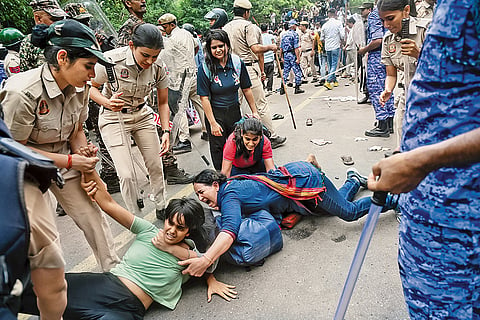
The Big Clash: On July 20, police used excessive force on protesters, resulting in many sustaining injuries Photo: AP
Young Nation
India possesses one distinction that few nations can rival. It is not only the world’s most populous country but also one of its youngest. With a median age of around 29, it has the largest working-age population on the planet. Successive governments have celebrated this demographic dividend as India’s greatest strategic advantage, pointing to the country’s rise as the world’s fifth-largest economy as proof that the promise is being realised.
Yet economic statistics can hide the mood of a generation. Nearly a third of India’s workforce continues to depend on agriculture for its livelihood, while millions more survive on informal and gig work that offers little income security or opportunity for advancement. For countless young Indians, admission to a premier educational institution or success in a competitive exam is more than an academic milestone. It is one of the few reliable pathways to social mobility.
Labour economist Santosh Mehrotra argues that we are on the verge of losing our demographic dividend because though the number of young people entering the working-age population is increasing for now, there are very few jobs. Private-sector jobs have not been growing at the rate at which there is a need for them. This has translated into a surge in demand for government jobs in the past 10 years. “This surge reflects a deeper structural weakness in the economy. The large number of candidates appearing for competitive exams is a consequence of rising educational attainment without a corresponding increase in employment opportunities,” he says.
The anxieties of young India have deepened with the arrival of artificial intelligence (AI). For more than three decades, the information technology industry served as the country’s most dependable engine of middle-class aspirations. An engineering degree often promised a first job, a first flight, a first car and, for many families, their first experience of economic security.
That promise is beginning to fray.
Automation and generative AI are steadily reducing demand for many entry-level coding and back-office roles that once absorbed thousands of engineering graduates every year. Concerns over shrinking opportunities have become recurring themes in boardrooms, policy discussions, newspaper headlines and online forums frequented by young professionals. Yet they don’t occupy the centre of India’s political conversation.
Instead, electoral politics has continued to revolve around questions of identity, caste, religion and nationalism.
The gap is not merely political. It is generational.
The generation that dominates India’s political leadership was shaped by the upheavals of the late 20th century. It witnessed the implementation of the Mandal Commission’s recommendations, the rise of the Ram Janmabhoomi movement and the transformation of identity politics into the principal language of electoral mobilisation. Those experiences continue to shape the vocabulary of contemporary politics.
Gen Z, however, has grown up in a different India. For millions of them, the next general election will be their first opportunity to vote. Their formative years have been shaped less by the ideological battles of Mandal and mandir than by hyper-competitive entrance examinations, social media, AI and an increasingly uncertain transition from classrooms to careers.
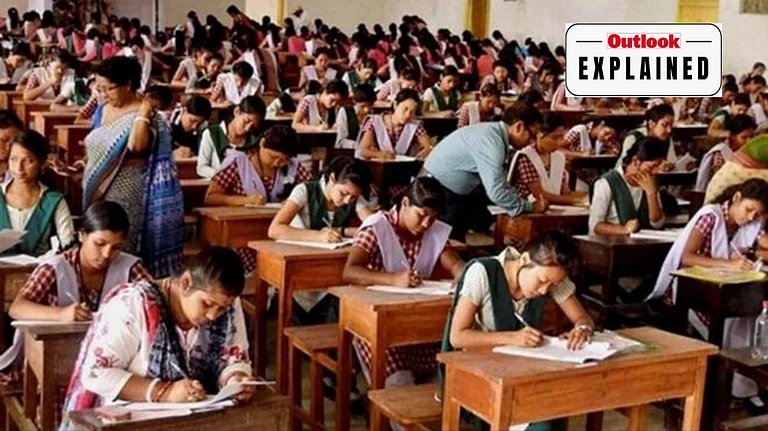
For many of them, the NEET controversy became the moment when private anxieties about education and employment acquired a political expression. Richa, who describes herself as politically non-aligned, had never attended a protest. “Until now, I believed we could only complain about the system. These protests have shown us that, as a collective, we can actually bring about change. I now feel it is our responsibility to take an interest in the country’s politics because it is people like us who can bring real change,” says Richa, who is also preparing for competitive exams.
This perhaps explains why, despite the BJP’s recent electoral successes, thousands of young people took to the streets in dozens of cities. Only a fraction of India’s youth had appeared for the NEET exams, and fewer still were directly affected by the alleged irregularities, yet the movement resonated far beyond those candidates because it came to symbolise a larger anxiety shared by an entire generation— that years of hard work could be undone by forces beyond one’s control.
Politcal Pragmatism
Democracies are most vulnerable not when electorally chosen governments are weak, but when public anger acquires a momentum of its own.
Over the past two years, India’s neighbourhood has witnessed two powerful youth-led movements—in Bangladesh and Nepal—that uprooted incumbent governments through violent uprising. Though the circumstances differed, both demonstrated how student protests could evolve into broader political challenges. Those developments were not lost on the BJP’s leadership.
The protest symbolised a larger anxiety shared by an entire generation— that years of hard work could be undone by forces beyond one’s control.
For years, the party has argued that foreign forces exploit protest movements to obstruct India’s development trajectory. Prime Minister Narendra Modi himself popularised the term “andolan jeevis” to describe what he portrayed as a class of professional protesters and political opponents who, in his view, resisted every major development initiative undertaken by his government.
Yet political instinct often demands a different response from political rhetoric.
By the time the NEET agitation gathered momentum, the BJP was politically stronger than it had been at any point since the 2024 General Election. Its expanding numbers in Parliament gave it little reason to fear a challenge from the Opposition. But street movements operate on a different arithmetic. Once the party’s internal feedback suggested that the protests were resonating beyond NEET aspirants and beginning to shape wider public opinion, the leadership chose pragmatism over confrontation.
The contrast was striking. Just two days before Pradhan’s resignation, a BJP spokesperson had told Outlook: “We don’t believe resignation is the answer. Unlike the Congress, we believe in fixing the problem and ensuring accountability.”
It was this intransigence, according to Pratap Bhanu Mehta, that allowed the movement to spread like a wildfire. According to him, the NEET controversy cut across political loyalties because the anxieties surrounding education and competitive exams affected families irrespective of whom they voted for. “Even BJP supporters were deeply upset because their own children had suffered through examination scandals and faced uncertain futures,” he says.
The government tried to win over protestors by announcing the establishment of fast-track courts to expedite paper-leak cases and proposed a law prescribing tougher punishment for those involved in examination fraud. Administratively, the Centre sought to reassure students that the system would be strengthened. Politically, however, the movement had already outgrown the issue of institutional reform. It had become a question of public trust.
With more than five crore cases already pending across India’s courts, including in existing fast-track courts, the announcements alone were unlikely to extinguish public anger. The leadership ultimately chose political pragmatism over institutional stubbornness. By asking Pradhan to step down, it absorbed the immediate political cost in order to prevent a larger confrontation, something it had done when it repealed the three farm laws in 2021.
Politics on Parliament Street
Two weeks before the monsoon session of Parliament, political observers were preoccupied with a different question: how long would it take the NDA to secure the elusive two-thirds majority it had sought for years? Opposition leaders were crossing over to the ruling party with increasing frequency, convinced that India’s political future lay with a government that had steadily expanded its dominance through successive electoral victories.
The other calculation unfolds on the streets outside it, where citizens negotiate with the Republic every day. Electoral victory confers lawmakers with the authority to govern, but they do not suspend the public’s right to question them. Between one election and the next, governments continue to seek legitimacy not only through legislations in Parliament but also through the consent they command beyond its walls.
Independent India has witnessed governments of extraordinary parliamentary strength. Jawaharlal Nehru governed with an Opposition too weak to pose a serious challenge. Indira Gandhi’s overwhelming majority culminated in the Emergency, when democratic freedoms were suspended. Rajiv Gandhi commanded one of the largest mandates in the country’s electoral history. Narendra Modi, too, has presided over a decade of remarkable political dominance.
Yet, each government discovered, in its own way, that parliamentary numbers alone cannot insulate a government from the judgement of the street.
That may be the enduring lesson of the movement that began with an infantile meme. It reminded India that while governments are formed in Parliament, democracies remain alive on the streets that surround it.
Ashlin Mathew is senior associate editor, Outlook; Fozia Yasin is senior associate editor, Outlook
(This story appeared in Outlook magazine’s August 17 issue, 'Parliament on Street', which takes an incisive look at the student protests against recurring examination paper leaks, the zing of Gen-Z politics and the Jantar Mantar protest at Delhi which triggered a strong response all across India, sending out a clear reminder that while governments are formed in Parliament, democracies remain alive on the streets)
Published At:
Tags