As soon as the US-Israel war on Iran began, craftsmen have not been getting commercial LPG cylinders, crucial for their workflow
After attacks on Qatar’s energy facilities, the LNG supply to large-scale glass industries was cut by 20 per cent, impacting production
While the flame workers are out of work, industries had to send their labourers on leave
Firozabad Ground Report | West Asia War Hits India’s Glass City, Craftsmen, Industry Feel The Pain
Amid LPG, LNG crisis, traditional craftsmen are out of work, industries say it will take them six to eight months to recover losses incurred in March alone

Summary
It’s a tiny workshop. Different sizes of miniature Ganesh idols made of glass are kept on a shelf. The wooden racks are full of decorative glass items, neatly packed in small cardboard boxes, ready to be dispatched to markets, local and across the country. Usually, on a Tuesday morning, the workshop is buzzing with activities. Today, there is silence.
Sitting on a cot, Shailesh Kumar is anxiously watching news updates on YouTube. Disappointed that the Strait of Hormuz blockade by the US continues, he switches off. A month ago, Kumar didn’t know about the Strait’s existence or its strategic importance until the US-Israel war on Iran began. The war’s very intense ripple effect has been felt far away in India, in Uttar Pradesh’s Firozabad—also known as the ‘glass city of India’—impacting the lives of Kumar and lakhs of other craftsmen and labourers who are associated with the glass industry. Kumar never imagined that something happening in a region geographically so far away would make him anxious. That the political game of chess played by agenda-driven countries would give him sleepless nights.
As soon as the war began, commercial Liquefied Petroleum Gas (LPG) cylinders went missing from Firozabad, even from the black market. Without any explanation, the Regasified Liquefied Natural Gas (RLNG) supply was cut. Traditional craftsmen and big industry players, who drive Firozabad’s glass sector, talk in hushed tones. They say the government did so to prioritise the supply of household LPG in case the war drags on. However, due to the absence of the most crucial elements required by the sector—LPG and RLNG—Firozabad’s glass industry is staring at a probable shutdown.

It’s bad news for the overall economy—the unorganised sector accounts for 70 per cent of the total glass produced in India, as well as the manufacturing of 1,500 tonnes of glass bangles per day, providing direct and indirect employment to an estimated five-seven lakh people, supporting the lives of over 50,000 families. The large-scale industries in Firozabad manufacture products like liquor bottles, perfume bottles, lab apparatus, chandeliers and glass handicrafts. As per industry estimates, goods worth Rs 2,000 crore are exported to different countries, including in some of the war-torn West Asian countries. A large chunk of exports goes to the US.
Advertisement
The industry was limping back to normalcy post-pandemic. Recent hiccups like the recent trade war triggered by the US and the increase in the cost of raw materials arriving from China were bad news, but the war has completely shattered people. “It will take us six to eight months to mitigate the losses incurred in the month of March alone because there won’t be an uptick in orders immediately,” says Anup Sharma, a young craftsman.

Kushwaha Nagar in Firozabad is home to more than 400 flame workers. Due to the scarcity of commercial LPG, most are out of work Tribhuvan Tiwari
Flame Workers Are Out Of Work
The signs of doom were visible in the Kushwaha Nagar area of Firozabad—home to more than 400 craftsmen, flame workers to be specific. These craftsmen, who form a large chunk of the unorganised sector, use flames fuelled by oxygen and LPG to melt and shape glass rods at high temperatures—the technique of manipulating molten glass directly in the flame enables the creation of intricate items like jewellery beads, small sculptures, decorative pieces, bangles and marbles.
Advertisement
There are rows and rows of small houses, each doubles up as a workshop. The tiny rooms are filled with raw materials and finished products—colourful glass rods, bangles, decorative materials, paints and cardboard boxes. In each house, there is definitely one work station—a wooden or iron desk, a small, LPG-fired flame rod, glass rods of different colours, different moulds and dark shades to protect eyes from the blaze. Giant oxygen cylinders lined up outside homes/workshops signify that each home is a production hub. That each home is self-sufficient. Financially independent.
Was.
Business was brisk until the recent crisis. Each craftsman was taking bulk orders and supplying to the local markets. Profit and productivity were not an issue. They could hire two or three labourers, who worked in shifts to keep up with the demand. Women of the house pitched in too, by helping in decorating artefacts and bangles and in packaging. Months between Holi and Diwali are considered to be the peak season. Just when the craftsmen were gearing up post-Holi, it all came crashing down.
Advertisement
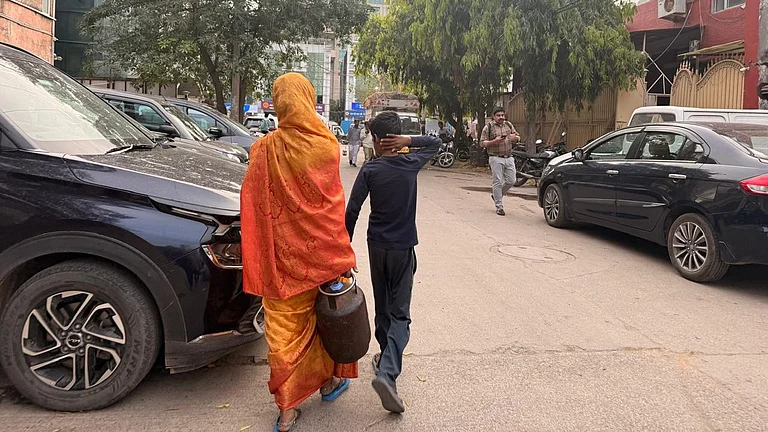
“In the absence of cylinders, the workshop is shut. I have sent the labourers on leave,” says Kumar. “Those who had spare cylinders are still able to operate; the rest are sitting idle, hoping for things to change. If the uncertain situation prolongs, we will not get new orders, not know what to do with the existing inventory and, more importantly, we will have to take loans for everyday expenses,” he adds.
The lanes and by lanes of Kushwaha Nagar reflect the sense of helplessness that Kumar talks about. In the absence of work, people spend time sitting outside their homes, chit-chatting. Dharampal Singh, 70, a veteran who has seen the transition from mitti ka tel (kerosene oil), petrol, coal and now gas, is napping in his workshop. A few houses away, Tarun Prakash Kushwaha was playing with his kids. “Even though there is no work, we still have to pay the rent, give salaries to labourers, keep our kitchens running and pay school fees. If the uncertainty continues, I will be forced to let the labourers go and look for some other work,” he says. His neighbour, Uday Pratap Singh, who has been in the trade for 20 years, says: “Never before have I seen such a crisis.”
Advertisement
In one house, Anil Kumar is creating a fish by blowing flame on a melting red-coloured rod, “just to kill time”. In the house next door, four women are pasting decorative stuff on plain green bangles. “We get Rs 80 for 100 bangles, and we work from evening to night. Usually, the finished bangles are sent to the markets the same evening. But now, they are just stored here in these boxes,” says one.
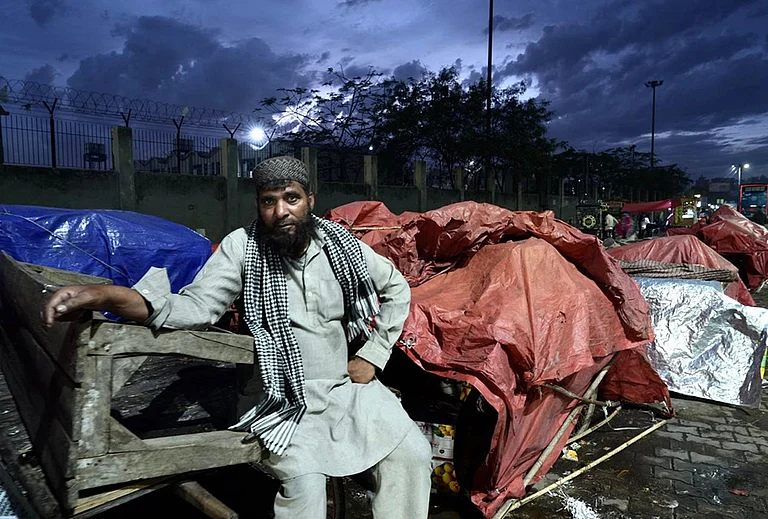
They are all aware of the yudhdh (war) and know that it is the reason why gas is not reaching them, but now they consume news and are well versed with the daily happenings. Almost everyone is a “Hormuz” expert. During the discussion, terms like tel (oil) and parmanu (nuclear) come up. A debate breaks out: who is at fault—Trump, Iran or Netanyahu? Ajit Pal Singh, a bystander, laughs and says: “Most are either illiterate or, at max, high school pass outs. But due to this forced unemployment, they spend hours watching updates on YouTube. It, after all, affects them.”

As many as 200 units in the city depend on LNG. Due to the cut in its supply by almost 20 per cent, the furnaces are not able to function at optimal capacity. Tribhuvan Tiwari
Industries Forced to Cut Production
Dozens of large-scale glass industries are lined up along the Yamuna Expressway. Some automated, some manual; all hire a large number of labourers to keep the production running. The furnaces here run 24x7, and need continuous gas supply to manage the high temperature. As many as 200 units in the city depend on RLNG. Due to the cut in its supply by almost 20 per cent, the furnaces are not able to function at optimal capacity. In such a situation, some industries are forced to cut or halt production, leading to contractual labourers, all daily wagers, being relieved of their jobs or sent on forced leave.
When asked why the RLNG supply was cut, Parag Gupta, director of Advance Group of Industries, says: “I was told following attacks on its energy infrastructure, Qatar halted LNG production, impacting supplies to India. But that’s the thing. We don’t get any concrete information from the government. Ideally, the government should have kept us in the loop from the start. Even if they had decided to reduce supply, we should have been informed so that we could have made alternate adjustments.”
The reduced gas supply has impacted the entire chain. “Financial loss aside, due to the prevailing uncertainty, we are not able to commit to our clients and customers. We produce alcohol bottles for a premier brand. Summer is the peak time for us, but right now, we are producing only 30-40 per cent of what we should be producing,” says Gupta.
At his factory, dozens of workers are involved in different activities. The automated machines are producing liquor bottles in lakhs while the workers are busy packaging, stocking inventory and transportation. The increased temperature around the multiple furnaces and the mechanical cacophony of giant machines is having absolutely no impact on them; there is a deadline to be met, and workers are focussed on numbers, numbers that will fetch them wages for the day. “It’s always this busy, day or night. The furnace never stops burning. But what you are seeing right now is just half the strength and reduced production,” says one worker.

Gupta is the only one who shares industry insights. Others choose silence, fearing backlash on their businesses. The industries look deserted from the outside. Most managers respond with “no comment” to our queries. A manager in one industry says: “The reason is, work has come to a complete standstill. There are no labourers inside. The industry players don’t want this fact to come out because then they will have to compensate them.”

Most of the labourers working in glass industries have not earned anything in March Tribhuvan Tiwari
Anger, Helplessness at Labour Colony
The hunt for the missing labourers takes us to the Labour Colony. Around 9,000 families of labourers associated with the glass trade live here. The battery rickshaw is barely able to navigate through the narrow lanes. At a tea stall, at least 10 men, all out of work, are sipping tea. The presence of a journalist excites them. “Please write about our situation. Maybe something will change,” says Md Azim. He got paid for just six days in March. “I go to the factory every morning, only to be told that there is no work. They don’t tell us when we should return or whether we should return at all.” Azim has already taken a loan from his relative. He will be forced to borrow more if he remains out of work. “How will I repay is the question,” he says.
Sitting next to him, Md Javed says: “March 10 was the last day I got paid. We understand that nobody is to be blamed for the present crisis, but the factory owners will probably not feel the impact on their daily lives. We do. But our maaliks (bosses) are silent.
Someone from the crowd says we must protest. The others cut him off. “You saw what happened in Noida yesterday. The protesters were beaten up and jailed. The same thing will happen to us here.”
What compounds the problem is that these labourers are not migrant workers. There is nowhere to go to escape the situation. “Glasswork is the only skill they know. Very few have lands for agriculture to fall back on. Others are dependent on glass factories. They say that the pandemic was better. At least they were getting free ration from the government. Right now, no no one is bothered about them,” says Rajesh Sharma, a glass expert, who is still able to operate because he has a stock of cylinders. He, however, prefers to keep the workshop locked from the outside while the work is going on to avoid any unnecessary attention.

Sadar Bazaar in Firozabad is home to nearly 1,000 bangle shops. The market stands deserted Tribhuvan Tiwari
Bangle Markets Are Deserted
Sadar Bazaar in Firozabad, home to nearly a thousand retail and wholesale bangle shops, is a colourful place. Despite the colour, there is gloom. Due to the gas shortage, production has stopped. Shoppers are not shopping. Bulk orders from outside have dried up. Inventory is piling up. “Aap hi dekhiye, sannata hai (as you can see, the market is deserted),” says Giridhar Pant, while cleaning maroon bangles and arranging them on a hanger.
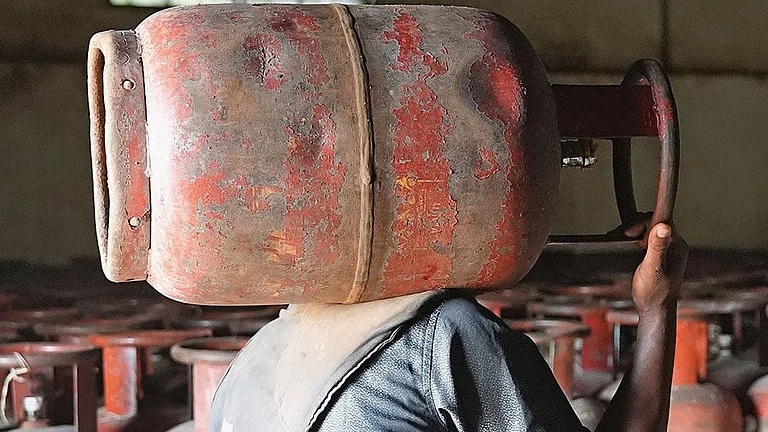
Iqbal Ahmed, 70, calls us to his shop and says: “I know everything about the war, ask me anything.” Ask him the main reason behind the present crisis, and he says: “Vyapaar (business). Oil is at the centre of the conflict. Our country is well connected in terms of trade, hence the war so far is impacting my small bangle shop.” When asked how he will manage if there is no end date to the present crisis, he says: “Upar wala dekhega (God will take care of everything).”
Published At:
Tags