A month after US–Israel strikes on Iran disrupted shipping routes, LPG shortages in India have driven refill costs of small cylinders up to ₹300 per kg, hitting low-income households hardest.
Informal refill networks that once sustained street vendors and poor families are collapsing, as supply shrinks and prices nearly triple.
From tea stalls to home kitchens, the crisis is forcing families to cut meals, shut businesses, and return to wood fires, exposing deep vulnerabilities in urban fuel access.
Vultures Of War: LPG Shortage Pushes Small Businesses In The Capital To The Edge
Shortages triggered by West Asia tensions and disrupted shipping through the Strait of Hormuz push small LPG cylinders out of reach, forcing Delhi’s most vulnerable to fall back on unsafe and unsustainable alternatives.

Summary
On Monday evening, a woman in Okhla Phase 2 walked through the neighbourhood with her son, who clutched an empty five-kg Free Trade LPG (FTL) cylinder, as they went from shop to shop trying to find a place that could refill it in time to cook dinner for their family of six.
Just days earlier, she had been cooking on a makeshift wood stove inside their one-room home, watching it fill with smoke she feared would draw complaints from the landlord. “He would ask us to leave, that would be a bigger problem. So we decided to get the gas filled again,” she says.
But even that has become a struggle. Across neighbourhoods in Delhi, a sharp shortage of LPG has pushed up the cost of refilling small portable cylinders, once the cheapest fallback for low-income households, to nearly three times their usual rate, with prices touching Rs 300 per kilogram in some areas.
Nearly a month after the US and Israel escalated hostilities, the ripple effects are being felt far beyond the conflict zone. A sudden LPG shortage, triggered by escalating West Asia tensions after US–Israel strikes on Iran and the resulting disruption to shipping through the Strait of Hormuz, has set off the current crisis.
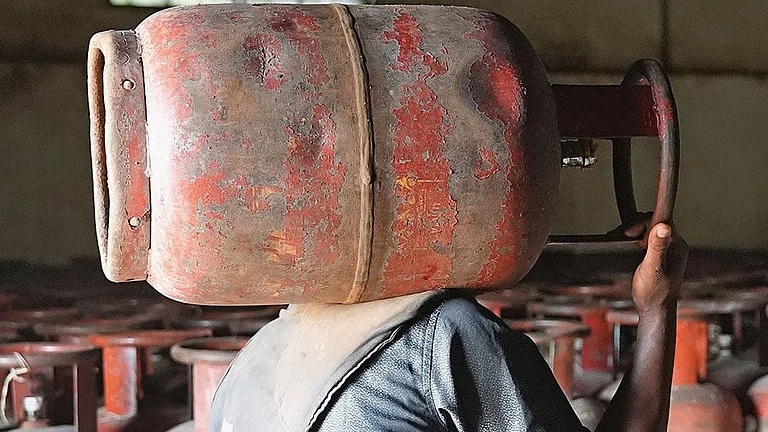
In India, disruptions in LPG availability have left many households scrambling for fuel. Those who once relied on informal local vendors to refill small cylinders for as little as Rs 90 per kilogram now find both supply and affordability slipping out of reach.
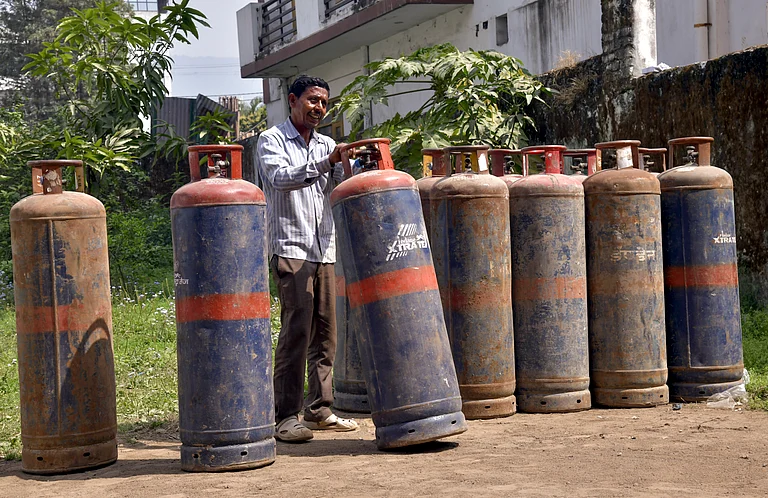
The five-kg FTL cylinders, widely used by students, campers, and small food businesses, have long been marketed as accessible alternatives. Hindustan Petroleum Corporation Ltd (HPCL) sells them as Appu, Bharat Petroleum Corporation Ltd (BPCL or BharatGas) markets them as Mini, and Indian Oil Corporation Ltd (IOC or Indane) brands them as Chhotu. These cylinders are available through gas distributorships, select retail outlets, kirana stores, and utensil shops, with an initial purchase requiring the cylinder and regulator, and subsequent refills costing only the price of gas.
Advertisement
The woman in Okhla is among many for whom finding LPG has become a daily struggle, with some spending more than half their income on just a kilogram. In the past six days alone, she says she has had to refill her FTL cylinder twice. “It lasts me hardly for two to three days,” she says, adding that getting it filled completely costs about Rs 900, making it nearly impossible to imagine having a full cylinder at home. “And then the struggle begins again.”
Informal Fixes, Formal Scams
Across Delhi, many who could not afford full-sized domestic cylinders depended on local vendors who would refill these smaller cylinders using their own supply, charging around Rs 90 per kilogram. As shortages deepened, many households turned to these FTL cylinders as a more affordable option. But with limited availability now driving prices up nearly threefold, even this alternative is fast becoming unaffordable, exhausting yet another coping mechanism for the city’s most vulnerable.
Advertisement
In New Delhi’s Govindpuri, Ramdevi, a woman in her 80s, has an LPG connection through which she has, for years, received a full-sized cylinder on call. But the cylinder is not used for her personal cooking. From her small chai stall, she transfers LPG from this cylinder into smaller FTLs for people, mostly street vendors from the neighbourhood.
Earlier, she says, she would sell a kilogram of LPG for Rs 90. But with the ongoing war, it has become “impossible” to continue at that rate.
“Prices increased around Holi. When we came back [from our village in Uttar Pradesh], everything was already expensive. And if we don’t get supply, how can we sell the gas?” she asks. For her own household, she adds, her daughter-in-law now cooks on a wooden stove.

Ramdevi tells Outlook that her chai stall alone could not sustain a family of eight. Selling LPG from her personal cylinder into smaller FTLs, she says, helped bring in an additional Rs 300. “That helps us manage expenses, food and basic needs,” she says.
Advertisement
The ongoing crisis has also exposed another layer of anxiety among residents who had already shifted to piped gas connections at home. Some allege that gas agencies were engaging in what they described as a “sort of scam” by altering customer records without prior notice.
One resident of the double-storey flats in Kalkaji says that although his household had moved to a piped gas connection nearly two years ago, they had deliberately not cancelled their LPG connection as a backup. But when the shortage worsened and they tried to book a cylinder “just to be on the safer side”, the automated system informed them that their number was invalid.
“We never cancelled the connection after getting the pipeline. It’s been two years, but we kept it active as a backup,” he says. According to him, when he called the agency to understand the issue, an employee allegedly told him that since the connection had not been used for over a year, he had “updated the number himself”.
Advertisement
He then allegedly assured him that a cylinder could still be arranged if required. “He told me, ‘If you need it, I will send you a cylinder,’” he said, questioning how such changes could be made without the consumer’s consent. Outlook reached out to the gas agency but no response was received.
FTL Gas Turns Luxury
For the city’s roadside vendors and small shop owners, the LPG shortage was not an abstract supply-chain disruption but an immediate threat to survival. The small 5 kg cylinders that power tea stalls, pakoda carts and makeshift fast-food counters had become their most dependable option during the peak of the crisis, largely because they were cheaper and easier to refill than domestic cylinders. But as supplies tightened, even that option began to disappear.
Officials at one storage facility admit that while domestic deliveries had improved, the shortage in commercial and small-cylinder supply persisted. “Earlier where two truckloads used to come, now only one is coming,” one official says, explaining that supply had reduced to nearly 300–360 cylinders a day, automatically creating a backlog. He acknowledges that small cylinders had “not come at all” and that smaller users were facing the brunt of the disruption, as priority was being given to hospitals and large establishments with registered commercial connections.
The crisis has been equally devastating for Tulsi Devi, 28, who runs a pakoda stall from a settlement in Phase 2 and has been in the business for only a few months. What little she earns now barely covers costs. “Now I don’t even recover the gas cost,” she says. Her calculation is stark and immediate, if she makes Rs 300 in a day, nearly Rs 200 goes into oil, Rs 90 into lentils, and another Rs 25 into onions.
“I’m just covering expenses, there’s no profit.” For nearly ten days, her stall remained shut, cutting off her only source of income. The pressure has spilled over into family life. Her husband, who was unwell, has returned to their village in Bihar, partly because the household could no longer sustain itself. Tulsi says she has two children, and even a seemingly small expense has now become unmanageable. “Tuition fee is Rs 500 for one child. I haven’t been able to pay for two months,” she says.

The crisis has been equally devastating for Tulsi Devi, 28, who runs a pakoda stall from a settlement in Phase 2 and has been in the business for only a few months. Photo: Zenaira Bakhsh
While the children attend a government school, even basic educational expenses are now slipping out of reach. For a few days, she somehow managed cooking without gas, and then the family was forced to buy an induction stove for Rs 4,000, an expense that, for many, would amount to several days’ earnings. She finally managed to refill her domestic cylinder only the day before yesterday, after days of uncertainty. “There was no other option,” she says.
Another woman, who runs a fast-food stall and has lived in Delhi for nearly three decades after moving from Darjeeling, the crisis has turned everyday operations into a balancing act. She says that where a regular cylinder once arrived within two days, it now takes anywhere between 21 and 25 days.
During the worst of the shortage, she relied on small cylinders refilled from Govindpuri, but even that supply line has now dried up. “Everything is shut because cylinders aren’t available,” she says, adding that the refill she managed just before the stoppage would only last another two or three days. Her stall has remained partially shut, leading to significant losses. While her husband’s chicken shop offers some support, the uncertainty around fuel has made daily planning nearly impossible.

For Vishnu, who until last week ran a tea stall by the roadside, that shortage has meant a complete halt to work. Photo: Zenaira Bakhsh
For Vishnu, who until last week ran a tea stall by the roadside, that shortage has meant a complete halt to work. He says he earlier used FTLs exclusively to make tea, and a refill would cost him roughly ₹100 per kilo. Now, he says, refill prices had surged to Rs 300–400, and even then there was no guarantee that anyone would fill it. “Sometimes they fill it, sometimes they don’t. Now they just say it’s not available at all,” he says.
Earlier, he managed local refills from a nearby stall where the smaller cylinder would be filled from a larger one, but that too has stopped. The result: his tea stall, which used to bring in Rs 300–400 in daily sales, has been shut for more than a week. To keep the household running, he has shifted to selling biscuits, where a sale of Rs 12–20 leaves him with barely ₹5 in profit. “It just covers vegetables, basic food,” he says, referring to the needs of his wife and 13-year-old daughter.
There is no bitterness in Vishnu’s voice, only exhaustion. When asked whether he blamed the government, Vishnu simply says, “Madam, if supply itself is blocked from outside, how will it come here?” adding that compared to other countries, “our situation is still better.”
Published At: