The 2026 UGC rules were introduced to curb systemic caste discrimination in universities, following rising complaints, student suicides, and Supreme Court intervention.
The backlash, centred on claims of ‘misuse’ and reverse discrimination, mirrors past resistance to anti-caste laws, recasting safeguards as persecution.
The controversy reveals deep institutional bias, where protections for marginalised communities face scrutiny while structural caste power remains unquestioned.
Equity On Trial: When Accountability Is Called Persecution
The uproar over the University Grants Commission (Promotion of Equity in Higher Education Institutions) Regulations, 2026, is a revealing moment in India’s uneasy engagement with caste.

Summary
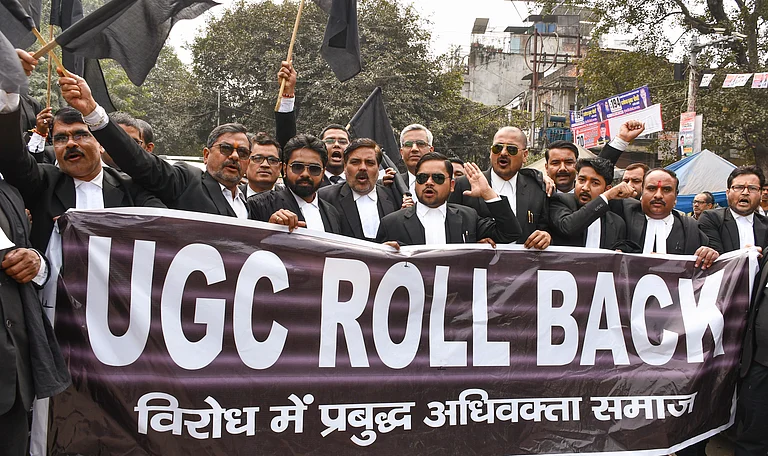
The uproar over the University Grants Commission (Promotion of Equity in Higher Education Institutions) Regulations, 2026, is a revealing moment in India’s long and uneasy engagement with caste. Notified on January 13, 2026, the regulations—meant to curb caste discrimination in universities—were immediately challenged in the Supreme Court (and the court quickly stayed them), denounced on social media, and met with violent protests across campuses. The reaction followed a familiar script: any attempt to protect the marginalised was recast as an attack on the privileged. While open denial of caste discrimination has become untenable, opposition has shifted to the safer claim of ‘misuse’. Protective measures for Scheduled Castes, Scheduled Tribes and Other Backward Classes are said to threaten merit and enable reverse victimisation. The irony is stark. These arguments come from social groups that continue to dominate university administrations, faculty ranks, regulatory bodies, and the higher bureaucracy, yet present themselves as besieged minorities.
This is not the first time we have witnessed this theatrical performance of upper-caste victimhood. A few years ago, the same script was enacted when the Supreme Court diluted the SC/ST (Prevention of Atrocities) Act in March 2018, claiming it was being ‘misused’. Nationwide protests by Dalit communities forced Parliament to intervene and restore those provisions through an amendment in August 2018. The Supreme Court, recognising its error, ultimately upheld the restoration in February 2020.
History, it appears, repeats itself—first as tragedy, then as farce!

To grasp the significance of the UGC’s updated equity rules, one must confront the conditions that compelled the UGC to act. It was forced by years of mounting evidence that caste discrimination in Indian universities is not episodic but routine and systemic. Students from SC, ST and OBC communities have consistently reported humiliation, academic isolation, denial of supervision, biased evaluation, and exclusion from the informal networks that determine academic survival. In several cases, these experiences culminated in suicide—each death briefly shocking the public conscience, only to be absorbed into institutional amnesia.
Advertisement
Rohith Vemula’s death remains emblematic, not because it was exceptional, but because it exposed the ordinary workings of caste in a modern university. On January 17, 2016, Rohith, a 26-year-old Dalit PhD scholar at the University of Hyderabad, died by suicide after prolonged humiliation, ostracism and effective expulsion from campus life. Despite the nationwide outrage his death provoked, the institutional response was revealing. Instead of holding those responsible to account, the casteist establishment sought to discredit him—falsely alleging that he had produced a fake caste certificate and reducing his death to personal frustration. Subsequent inquiries and committees generated expressions of regret but no structural change. Equal Opportunity Cells and grievance redressal mechanisms existed largely in form, not function: they were understaffed, underpowered and often controlled by the very social groups whose practices were under scrutiny. Complaints were routinely dismissed as ‘misunderstandings’, ‘personality conflicts’, or individual psychological failures.

Advertisement
What stands out is the asymmetry of concern. Structural discrimination must be proven exhaustively, often at great personal cost, while misuse is presumed in advance.
Three years later, on May 22, 2019, Payal Tadvi, a 26-year-old postgraduate medical student from the Tadvi Bhil Adivasi community, died by suicide at Mumbai’s BYL Nair Hospital after enduring sustained caste-based abuse by her upper-caste seniors. These were not aberrations. From 2019 to 2021 alone, at least 98 students from SC, ST and OBC communities died by suicide in central universities and premier institutions such as the IITs, NITs, IIMs and IISERs. During 2004-24, 115 Dalit student suicides were reported, many directly linked to caste discrimination. In the 14 months preceding the drafting of the 2026 regulations, the courts took note of 18 suicides in higher education institutions explicitly attributed to caste-based discrimination.
The UGC’s own data reinforces this reality. Complaints of caste-based discrimination rose by 118.4 per cent over five years—from 173 cases in 2019-20 to 378 in 2023-24. In total, 1,160 complaints were received from 704 universities and 1,553 colleges during this period. The Commission has cited this surge to underline the failure of advisory mechanisms and the need for enforceable institutional safeguards to ensure a safe, dignified, and inclusive academic environment for students, faculty, and non-teaching staff.
Advertisement
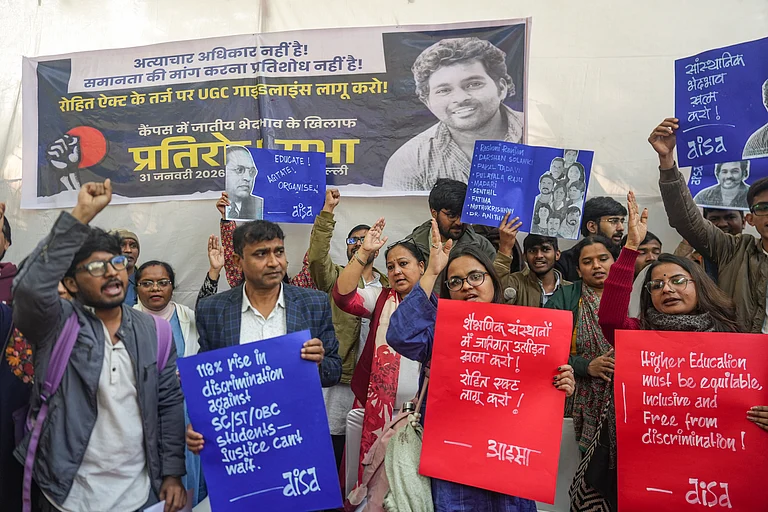
It is also crucial that the 2026 regulations emerged from judicial intervention. In 2019, Radhika Vemula and Abeda Salim Tadvi—the mothers of Rohith Vemula and Payal Tadvi, respectively—approached the Supreme Court questioning why the UGC’s 2012 anti-discrimination regulations, which were merely advisory, had failed to prevent their children’s deaths. They demanded a “very strong and robust mechanism” to address caste discrimination in higher education. Acting on the court’s directions, the UGC was required to submit revised rules. The 2026 regulations are, in a direct and literal sense, the institutional response to that demand.
The 2026 UGC regulations replace the largely toothless 2012 framework with a comprehensive and binding institutional architecture. They mandate that every higher education institution establish Equal Opportunity Centres to support disadvantaged students; Equity Committees with mandatory representation from SC, ST and OBC communities, persons with disabilities, and women; round-the-clock Equity Helplines; and Equity Squads or Ambassadors to monitor vulnerable campus spaces. The regulations also prescribe clear timelines for complaint resolution and require annual reporting to the UGC to ensure transparency and accountability.
Advertisement
The Anatomy of False Victimhood
The petitions challenging the UGC regulations argue that defining caste-based discrimination as discrimination against SC, ST and OBC communities “excludes general categories from protection” and creates a “presumption of guilt against upper castes.” This claim is predictable and disingenuous, and it deserves attention only because it exposes the anxieties of those who make it.
To begin with, it is factually wrong. The regulations do not confine protection from discrimination to SC, ST and OBC communities. Regulation 3(e) defines discrimination broadly—on grounds of religion, race, caste, gender, place of birth, or disability—covering all students. The separate definition of “caste-based discrimination” in Regulation 3(c) merely acknowledges an elementary sociological fact: caste discrimination is structural and directional. It flows downward. Upper castes do not face systemic or institutional discrimination on the basis of caste. They may encounter individual hostility or conflict, but that is not caste discrimination.
The demand for ‘caste-neutral’ language is therefore evasive rather than principled. It is akin to demanding race-neutral language to address racism or gender-neutral formulations for sexual harassment. Such neutrality does not ensure fairness; it erases power by obscuring hierarchy.
The second objection—the fear of ‘misuse’—is even more revealing. Critics object to the absence of penalties for false complaints, a provision dropped from early drafts. This omission is deliberate and justified. Experience with protective laws shows that ‘false-complaint’ clauses shift the burden onto victims, create chilling effects and deter genuine reporting—especially in contexts shaped by entrenched inequality.

This script is familiar. In 2018, the SC/ST (Prevention of Atrocities) Act was diluted on the ground of ‘misuse’, triggering nationwide protests and forcing Parliament to restore the law—a move later upheld by the Supreme Court of India in 2020. Significantly, the Court observed that “there is no presumption that the members of the Scheduled Castes and Scheduled Tribes may misuse the provisions.” High acquittal rates under the Act do not indicate false cases; they reflect failures of investigation, prosecution and a judiciary overwhelmingly drawn from dominant castes. Yet, the myth of misuse persists, now transplanted to higher education.
What stands out is the asymmetry of concern. Structural discrimination must be proven exhaustively, often at great personal cost, while misuse is presumed in advance. The hypothetical possibility of a false complaint is treated as more alarming than the certainty of routine humiliation and exclusion. The burden of proof is inverted: the oppressed must demonstrate flawless victimhood, while the privileged seek immunity from scrutiny.
This posture is particularly hollow given who advances it. Upper castes continue to dominate the bureaucracy, judiciary, academia, and media; they control selection committees, grievance mechanisms and appellate forums. Yet, they portray themselves as uniquely vulnerable to laws meant to protect the historically oppressed. The performance of victimhood by the powerful would be absurd if it were not so effective.

The third objection—complaining that Equity Committees lack mandatory ‘general category’ representation—lays bare the underlying logic. What is demanded is upper-caste oversight over complaints of caste discrimination. This is no different from insisting that men must be mandatory members of sexual harassment committees to ensure ‘fairness’. It reflects a refusal to acknowledge structural discrimination and the need for safe spaces where victims can report abuse without fear.
Taken together, these objections do not reflect concern for equality or due process. They constitute a politics of false victimhood that recasts accountability as persecution and scrutiny as injustice. What is being resisted is not misuse, but the erosion of caste impunity in institutions long masquerading as casteless.
Hypocrisy of the System
The protests that erupted across north India lay bare the deep hypocrisy of India’s institutions. Openly violent agitations by outfits such as the Karni Sena, Brahman Mahasabha, Kayastha Mahasabhas and several Vaishya organisations—now grouped under the Savarna Samaj Coordination Committee—were allowed to unfold with near-complete impunity. Effigies of Modi and Shah were abused in crude casteist language and publicly burnt, yet the police were conspicuously absent. This tolerance is revealing. Had even five per cent of such violence occurred at Jawaharlal Nehru University or in any space associated with students, Dalits, Muslims or dissent, the response would have been swift and brutal: wall-to-wall media vilification, mass arrests and the full coercive machinery of the State unleashed. The political calculation is transparent. With the Uttar Pradesh elections approaching, the Bharatiya Janata Party needs to consolidate SC, ST and OBC support and can afford to temporarily irritate upper-caste groups, fully aware that they have nowhere else to go electorally. Only a party as cynically entrenched as the BJP can play this double game—provoking symbolic upper-caste rage while retaining their loyalty. The judiciary, too, performed its role predictably. The Supreme Court, unmoved by undertrials languishing for years without bail, displayed astonishing urgency here: agreeing on January 28 to hear petitions against the regulations and staying them the very next day, pushing the next hearing to March 19. What emerges is not a failure of institutions, but their selective efficiency—a system that moves with lightning speed for upper-caste and elite interests, while constitutional rights of the marginalised remain indefinitely deferred.
It would be deeply naive to expect anything substantive from this manoeuvre by the BJP, a party that has already installed its ideological agents across institutions. These actors subscribe to an ideology that normalises caste hierarchy and legitimises exclusion; in such a setting, formal safeguards can only be symbolic. It is these very functionaries who will interpret and administer the regulations, ensuring that their intent is diluted or quietly subverted. The likely outcome will mirror the trajectory of the Atrocities Act: victims will be offered a false sense of protection, while perpetrators, cushioned by institutional backing and social impunity, will feel further emboldened to discriminate. Even so, in the present climate, such gains should still be used as levers to strengthen the struggle.
(Views expressed are personal)
Anand Teltumbde is an indian scholar, writer and human rights activist
This article appeared in Outlook's February 21 issue titled Seeking Equity which brought together ground reports, analysis and commentary to examine UGC’s recent equity rules and the claims of misuse raised by privileged groups.
Published At:
Tags