The absence of Prime Minister Narendra Modi from the new Bihar CM’s swearing-in ceremony sparked lots of speculation
Several leaders within the party had reservations about the fact that Chief Minister Samrat Choudhary was relatively new to the BJP and had no organisational background in the Sangh.
Samrat has served as a minister under three chief ministers,Rabri Devi, Jitan Ram Manjhi and Kumar, and handled more than five departments. His political rise within the BJP has been particularly rapid
BJP's First CM In Bihar: What Lies Ahead In The Samrat Era?
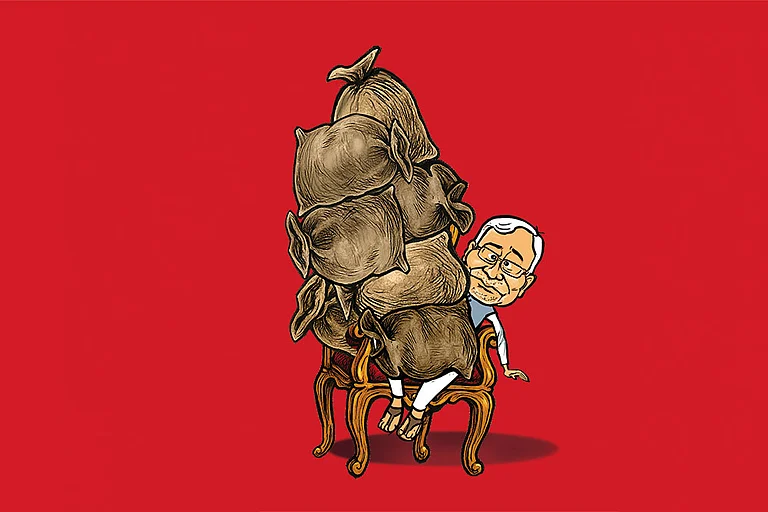
Samrat Choudhary, Bihar’s first BJP chief minister, faces many challenges; among them, the task of carrying forward Nitish Kumar’s model of governance

Summary
Newly appointed Bihar Chief Minister Samrat Choudhary recently sparked a controversy at a public function held in Patna on April 17 to congratulate him. When an elderly Muslim party worker offered the CM a skull cap, he took the cap in hand but declined to wear it. Later, he reportedly accepted a shawl presented by the same worker and wore it. Samrat’s refusal to wear the cap was a stark contrast to his predecessor, Nitish Kumar, who was photographed quite often in public wearing a skull cap and was a regular attendee of Eid prayers at Patna’s Gandhi Maidan.
Even after he teamed up with the Bharatiya Janata Party-led NDA, Nitish’s public outreach to the minority community and gestures signalling his commitment to communal harmony carried on unabated. Samrat, who has made political history by becoming Bihar’s first CM from the Bharatiya Janata Party, faces many challenges; among them, the task of carrying forward Nitish’s model of governance, and perhaps even more importantly, retaining the confidence of his own party. Much of the political discussion around his appointment has revolved around a single question: how independent a leader will Samrat be within the BJP?
The absence of Prime Minister Narendra Modi from the new Bihar CM’s swearing-in ceremony sparked lots of speculation. During Modi’s 12 years in office, there have been about 40 swearing-in ceremonies in the states where BJP leaders took oath as chief ministers. The PM has skipped only very few. Bihar has long been a state where the BJP has nurtured the ambition of having its own chief minister. After nearly two decades of coalition politics, when that ambition was finally realised, the celebratory atmosphere many expected was noticeably missing.
Observers say that Samrat was never the preferred choice of the Rashtriya Swayamsevak Sangh (RSS). The organisation was keen on the BJP’s first chief minister in Bihar being someone from its original cadre, preferably from a Dalit or Extremely Backward Caste background. A similar view existed within a section of the BJP as well. Samrat was seen by them as an outsider to the party’s traditional structure.
Advertisement

Several party leaders had reservations about the fact that Samrat was relatively new to the BJP and had no organisational background in the Sangh.
Several leaders within the party had reservations about the fact that Samrat was relatively new to the BJP and had no organisational background in the Sangh. This sentiment was reflected, in part, in a statement made by Vijay Kumar Sinha, considered both a colleague and a rival, while reacting to Samrat’s selection. He said, “Today, the third and fourth generations of BJP workers are active. We have spent years working with dedication and sacrifice before reaching this point. Following the direction of our leadership, and keeping alliance politics in mind, we proposed Samrat Choudhary’s name.”
There is also talk that Samrat enjoys Nitish’s support partly because of long-standing family ties. Samrat’s father, Shakuni Choudhary, was among the founding members of Nitish’s first party, the Samata Party. In Bihar’s political vocabulary, the Kushwaha community of Shakuni Choudhary and the Kurmi community of Nitish Kumar are often referred to as the “Luv-Kush” combine. Both are agrarian communities and had once come together politically to challenge the Rashtriya Janata Dal (RJD) government led by Lalu Prasad Yadav and Rabri Devi.
Advertisement
Samrat’s political journey began in 1995 under his father’s guidance. At that time, Shakuni Choudhary was with the Samata Party. In the 1995 Bihar Assembly elections, when the new party won just seven seats, one of them was Tarapur, from where Shakuni Choudhary was elected.
However, relations between Shakuni Choudhary and Nitish soon deteriorated, and he later joined the RJD. During that period, Samrat Choudhary became Agriculture Minister in Rabri Devi’s cabinet, even though he was not a member of either House. Questions were also raised about whether he met the age requirement for the post, and he had to step down within six months. The following year, he contested from Parbatta Assembly constituency on an RJD ticket and won. That was his first electoral victory. Even in 2010, when the RJD won only 22 seats across the state, Samrat retained Parbatta. Because of this, many people believe his political career began with the RJD. Before joining the BJP, Samrat, like his father, spent time in several political parties. In 2013, he stood by Nitish at a time when Nitish needed support the most. That year is considered a turning point in his career. When Nitish broke ties with the BJP, Samrat reportedly helped secure the support of 13 RJD MLAs to stabilise the Janata Dal (United) government.
Advertisement
After the 2014 Lok Sabha elections, which Nitish fought on his own, he made Jitan Ram Manjhi CM, and Samrat became a minister in his cabinet. Nine months later, when Manjhi stepped down and formed his own party, HAM, both Shakuni Choudhary and Samrat joined him. Around this time, Samrat’s proximity to the BJP increased. In 2018, he formally joined the party, and since then, his stature within the BJP has steadily grown.
Samrat has served as a minister under three chief ministers—Rabri Devi, Jitan Ram Manjhi and Kumar—and handled more than five departments. His political rise within the BJP has been particularly rapid. Soon after joining the party, he was made an MLC and later the Leader of the Opposition. In 2023, he was appointed state BJP president. When Nitish returned to the National Democratic Alliance (NDA) in 2024, Samrat was made deputy chief minister alongside Vijay Kumar Sinha. After the NDA’s strong mandate in November 2025, he was given the Home portfolio in addition to the deputy chief minister’s post. Given this trajectory, it appeared that the BJP leadership had been projecting him as a future chief minister. So, why has his selection still generated so much debate?
Advertisement
Senior journalist Nalin Verma does not agree with the view that Samrat became CM only because of Nitish’s insistence. He says that this is a narrative created by the BJP. And through it, the party is trying to achieve several objectives at once. “It wants to send the message that Samrat became the chief minister at Nitish’s request so that Nitish’s support base remains sympathetic to the BJP. Samrat’s elevation is also an attempt to make inroads into Nitish’s Luv-Kush vote base. It also helps manage internal dissent within the party by suggesting that coalition compulsions limit what the BJP can do.”
Unlike many other states, Bihar’s politics continues to be shaped strongly by caste alignments. Several observers believe that if the BJP has managed to reach close to 90 seats in the Assembly, it is largely because of Nitish’s social engineering. After the first Assembly election following the Modi wave, even when most of today’s NDA partners were already with the BJP, the party could win only 53 seats.
Samrat cannot be seen merely as a CM chosen to manage political circumstances. He is also seen as a leader with strong organisational backing. Pushpendra, former Professor, Tata Institute of Social Sciences, says, “Samrat is skilled at political negotiation as well. He has previously brought legislators away from both the RJD and the JD (U). The BJP may hope that within a year he can help create conditions where the party is in a position to form a government on its own. If he does that, it will be difficult for the BJP to replace him during the remaining tenure.”
With the 57-year-old Samrat taking charge as the CM and Nitish stepping aside, Bihar’s politics appears to be entering a new generational phase. Nitish’s departure has also revived an older debate: whether the era of socialism that shaped Bihar’s politics after 1990 is coming to an end, and whether Delhi’s influence over the state government will increase. Since Lalu Prasad Yadav became chief minister, political decisions in Bihar were largely shaped in Patna. This pattern continued through the Rabri Devi and Nitish years. Earlier, during the long period of Congress rule, decisions were often seen as being controlled from Delhi. The question now being asked is whether under Samrat Choudhary, the BJP will again run Bihar’s government from the national capital.
Md Asghar Khan is senior correspondent from Jharkhand
Published At: