Ten Lashkar-e-Taiba terrorists launched coordinated attacks at multiple locations in Mumbai on November 26, 2008, killing 166 people.
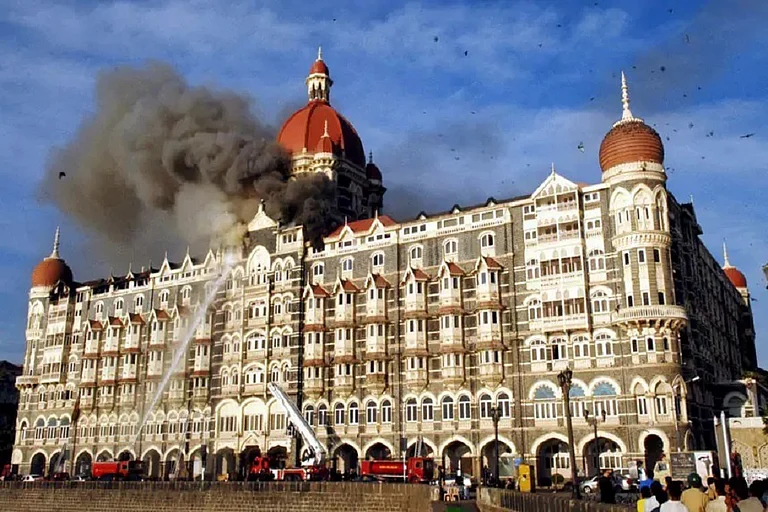
The 60-hour siege targeted the Taj Mahal Palace Hotel, Oberoi-Trident, Chhatrapati Shivaji Terminus and Nariman House, among other locations.
The attacks ended on November 29 after security forces killed nine attackers and arrested Ajmal Amir Kasab, the only terrorist captured alive.
26/11 Mumbai Attacks: How 10 Terrorists Held the City Hostage For 60 Hours
From the firing at Chhatrapati Shivaji Terminus to the sieges at the Taj, Oberoi and Nariman House, a timeline of the 2008 Mumbai terror attacks that killed 166 people.

Summary
On November 26, 2008, ten armed terrorists from Pakistan-based Lashkar-e-Taiba (LeT) entered Mumbai by sea and launched coordinated attacks across the city, targeting crowded public places, two luxury hotels and a Jewish community centre. The attacks involved indiscriminate firing, grenade attacks and bomb blasts at 13 locations, leaving 166 people dead and 238 injured. Among those killed were 18 police officers and security personnel and 26 foreign nationals. Nine attackers were killed during the security operations, while the tenth, Ajmal Amir Kasab, was captured alive.
The attacks, which continued for nearly 60 hours, brought Mumbai to a standstill as police, the Army, Navy commandos and the National Security Guard (NSG) attempted to rescue hostages and neutralise the gunmen. The assault exposed major gaps in India's coastal and internal security arrangements and prompted changes to its counterterrorism infrastructure. Eighteen years later, here is a timeline of what happened during the November 26–29 attacks.


November 26, 2008: The attackers enter Mumbai
The ten terrorists travelled from Karachi, Pakistan, towards Mumbai by sea. According to then Union Home Minister P Chidambaram's statement in the Lok Sabha on December 11, 2008, they left Karachi on November 23 aboard a vessel named Al Hussaini. They subsequently hijacked an Indian fishing boat, the MV Kuber, killed its occupants and used it to approach the Mumbai coastline.
The attackers abandoned the fishing vessel a few miles from the city and transferred to inflatable dinghies. According to the Supreme Court's account, eight of the terrorists landed near Badhwar Park in Colaba between 8 pm and 8.30 pm on November 26. The remaining two continued towards Nariman Point by boat before making their way to the Oberoi-Trident Hotel. The attackers then split into groups and moved towards their designated targets.
Advertisement
The locations included Chhatrapati Shivaji Terminus (CST), Leopold Café, the Taj Mahal Palace Hotel, the Oberoi-Trident Hotel and Nariman House, a Jewish community centre in Colaba.
9.30 pm onwards: Attacks begin across Mumbai
The attacks began at approximately 9.15 pm, according to the Supreme Court judgment. One of the first locations targeted was Leopold Café, a popular restaurant frequented by tourists and locals. Two gunmen entered the establishment and opened fire, killing people and injuring several others. The Maharashtra High-Level Enquiry Committee recorded the attack at approximately 9.30 pm, while the first police control-room call about firing at the café came later.
The attackers also targeted the Taj Mahal Palace Hotel, the Oberoi-Trident Hotel and CST within a short period. According to the Maharashtra High-Level Enquiry Committee's report, the Mumbai Police control room received its first call about injuries at Leopold Café at 9.48 pm. Reports of firing at the Taj, Oberoi and CST followed.
Advertisement


At CST, two attackers, Ajmal Kasab and Abu Ismail, opened fire on passengers in the crowded railway terminal. They fired indiscriminately and hurled grenades before leaving the station and moving towards Cama and Albless Hospital.
At Cama Hospital, Kasab and Ismail entered the premises and opened fire. They moved through the building as police personnel attempted to confront them. Additional Commissioner of Police Sadanand Date and other officers engaged the attackers, but the two terrorists managed to escape. They subsequently ambushed police personnel outside the hospital, killing several officers.
The attacks extended beyond the main target locations. Two taxis carrying explosives were blown up in separate explosions at Mazgaon, near Wadi Bunder, and Vile Parle. The Mazgaon blast killed three people and injured 19, while the Vile Parle explosion killed two people and injured three, according to the Supreme Court judgment.
Advertisement
Meanwhile, other attackers entered the Taj and Oberoi-Trident hotels, opening fire and taking people hostage. At Nariman House, the terrorists attacked the Jewish community centre, trapping residents and visitors inside.
Late November 26: Police officers ambushed
After leaving CST, Kasab and Abu Ismail moved towards Cama and Albless Hospital. During their movement through the city, they ambushed police officers, killing several personnel, including Maharashtra Anti-Terrorism Squad chief Hemant Karkare, Additional Commissioner of Police Ashok Kamte and encounter specialist Vijay Salaskar.
After the ambush, the two terrorists seized a police Qualis and escaped. They later abandoned the vehicle and forced their way into a white Skoda car at gunpoint, taking its occupants' vehicle before heading towards Girgaum Chowpatty.

Early November 27: Kasab is captured alive
At approximately 12.30 am on November 27, police intercepted Kasab and Abu Ismail at a barricade near Girgaum Chowpatty. According to the Supreme Court's account in the Kasab case, the two attackers were travelling in a Skoda car when they were stopped.
Advertisement
Abu Ismail was killed in the ensuing exchange of fire, while Kasab was captured alive. Assistant Sub-Inspector Tukaram Ombale was fatally injured while attempting to overpower Kasab and disarm him.
Kasab's arrest provided investigators with a surviving attacker who could be questioned about the planning and execution of the assault.
November 27, 2008: Security forces launch rescue operations
As the scale of the attacks became clear, Mumbai Police, the Army and the Navy's Marine Commandos (MARCOS) were deployed across the affected locations.
The NSG, India's elite counterterrorism force, was mobilised from its base in Manesar, Haryana. According to Chidambaram's parliamentary statement, the government alerted the force at approximately 11.30 pm on November 26, and around 200 personnel were airlifted to Mumbai that night. They were deployed at the affected locations in the early hours of November 27.
The NSG divided its teams to tackle the hostage situations at the Taj, Oberoi-Trident and Nariman House simultaneously. The operation was named Operation Black Tornado.
Gun battles continued inside the buildings as commandos attempted to rescue hostages and clear the premises. Hundreds of people were eventually rescued from the affected locations.
November 28, 2008: Operations at Oberoi and Nariman House end
On November 28, NSG commandos completed their operation at the Oberoi-Trident hotel, killing the two terrorists inside and rescuing those trapped there.
At Nariman House, commandos carried out an operation involving a helicopter-assisted entry onto the building's terrace. The two terrorists inside were eventually killed. Rabbi Gavriel Holtzberg, his wife Rivka Holtzberg and four guests who had been staying with them were killed during the siege. NSG commando Havildar Gajender Singh was also killed during the operation.
The siege at the Taj Mahal Palace Hotel, however, continued.
During the operation at the Taj, NSG commando Major Sandeep Unnikrishnan was killed while leading a team attempting to rescue hostages trapped inside the hotel. He was posthumously awarded the Ashoka Chakra for his actions.
November 29, 2008: Taj operation brings attacks to an end
The final phase of the operation took place at the Taj Mahal Palace Hotel, where the remaining terrorists were still fighting security personnel.
NSG commandos continued their search and clearance operation, moving through the hotel as gunfire and explosions were reported. The Supreme Court judgment in the Kasab case records that the last attacker was killed at approximately 9 am on November 29, bringing the three-day assault to an end.
By the time the operations ended, 166 people had been killed and 238 injured. Nine of the ten attackers had been killed, including Abu Ismail, who was shot dead by police at Girgaum Chowpatty. The remaining eight were killed during the security operations at the three principal hostage locations. Kasab was the only attacker captured alive.
What happened after the 26/11 attacks?
Kasab was tried in India and convicted for his role in the attacks. The Supreme Court upheld his death sentence, and he was hanged at Yerawada Central Jail in Pune on November 21, 2012.
The attacks prompted a major overhaul of India's security arrangements. The National Investigation Agency Act was enacted on December 31, 2008, leading to the establishment of the NIA as a central agency to investigate and prosecute terrorism-related offences.
The government also reviewed coastal security, expanded the deployment of coastal police stations and interceptor boats, and introduced measures to strengthen maritime surveillance and intelligence coordination. The government also established four NSG regional hubs in Mumbai, Chennai, Hyderabad and Kolkata, which became operational on June 30 and July 1, 2009, to improve the force's response time during emergencies.
The 26/11 attacks exposed major gaps in India's coastal surveillance, intelligence coordination and counterterrorism response. The subsequent establishment of the NIA, four NSG regional hubs and expanded coastal security infrastructure reshaped the country's approach to preventing and responding to terrorist attacks.
Published At: